
El Niño Forces California to Choose Between Saving Homes or Losing Beaches
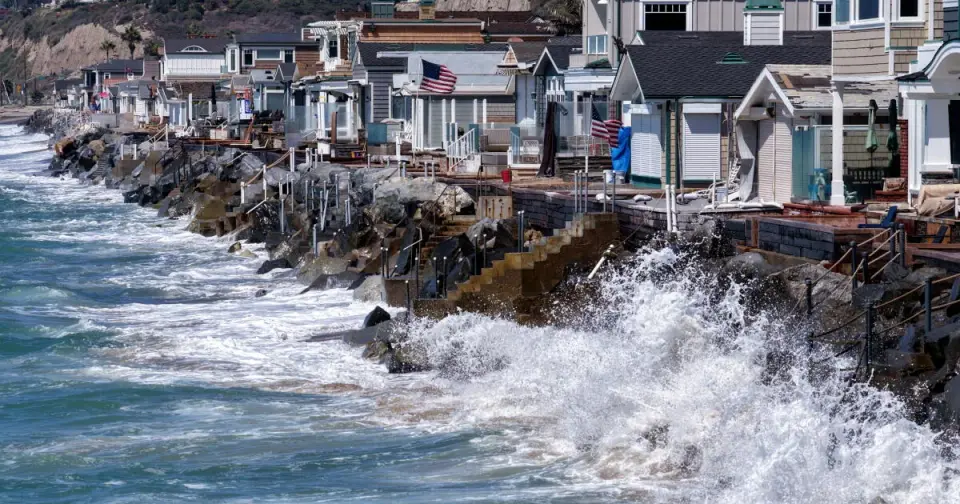
A strengthening El Niño is causing severe coastal erosion in California, forcing officials to install emergency rock barriers and seawalls to protect infrastructure and homes. While these measures offer short-term protection, experts warn they accelerate the loss of public beaches by preventing natural sand retreat, creating a long-term conflict between private property safety and public coastal access.
Key points
- A 'super' El Niño is driving record wave heights and erosion along the California coast, threatening homes, rail lines, and public beaches.
- In Dana Point, the California Coastal Commission approved 24 emergency permits for rock revetments to protect 201 high-risk parcels on Beach Road.
- The Orange County Transportation Authority has secured over $300 million to protect a critical rail line carrying $1 billion in annual freight, using rocks and sand placement.
- Experts from the U.S. Geological Survey and Surfrider Foundation warn that hardening the coast with rocks and walls destroys beaches by eliminating the space needed for sand to retreat inland.
- In Long Beach, sand berms failed to stop waves, leading to home damage, while in Malibu, erosion caused a sinkhole near a high-value residential area.
Background
California declared a statewide emergency in September 2026 in anticipation of a potent El Niño, which scientists predict could bring the highest sea levels ever recorded to the state. Previous coverage noted that this El Niño could impact 170,000 people and $60 billion in property, with sea levels rising six inches to a foot due to Kelvin waves and an 18-year King Tide cycle. The current crisis is an acute manifestation of long-term sea-level rise, which has already increased by one foot over the last 125 years.
How outlets are covering it
The Los Angeles Times and The New York Times emphasize the immediate physical destruction and the urgent, albeit controversial, response by local governments. The Atlantic highlights the human impact, noting specific incidents like a sinkhole near a high-value home in Malibu and the collapse of a road in Point Dume. While all sources agree on the severity of the erosion, they differ on the solution: The Los Angeles Times presents a balanced view of the trade-off, quoting officials who acknowledge that rocks exacerbate erosion but are necessary for emergency protection. The Atlantic focuses on the visceral reality of the coast 'falling into the ocean,' while The New York Times frames the issue as a shift from an abstract future problem to an immediate present crisis for Southern Californians.
Why it matters
This conflict highlights a critical policy dilemma in coastal management: the tension between protecting private infrastructure and preserving public natural resources. As sea levels rise, the reliance on 'hardening' the coast may lead to the permanent loss of beaches, potentially increasing long-term costs and reducing public access to the ocean. The outcome of these emergency measures will set precedents for how other coastal communities manage similar threats in the future.
What to watch
Orange County officials are pushing to expedite large-scale sand replenishment projects, such as moving 200,000 cubic yards of sand to Newport Beach, to mitigate the negative effects of rock barriers. The Orange County Transportation Authority is working on long-term solutions for the rail line, while the California Coastal Commission continues to review emergency permits. Advocacy groups like Save Our Beaches San Clemente are opposing further rock installations, urging a shift toward relocation or nature-based solutions.
- California’s plan to save coastal homes from El Niño could end up killing beaches Los Angeles Times
- The Edge of California Is Falling Into the Ocean The Atlantic
- Sea level rise is reshaping a California beach town and threatening a key rail line ABC News - Breaking News, Latest News and Videos
- Beaches Are Disappearing in Southern California as El Niño Bears Down The New York Times
- Rising sea destroys homes, erases beaches in California. Is worse to come? Reuters
Want the full story? Read the original reporting
Read on Los Angeles Times