
US scrambles to develop deep-penetration bombs as Iran fortifies underground nuclear site
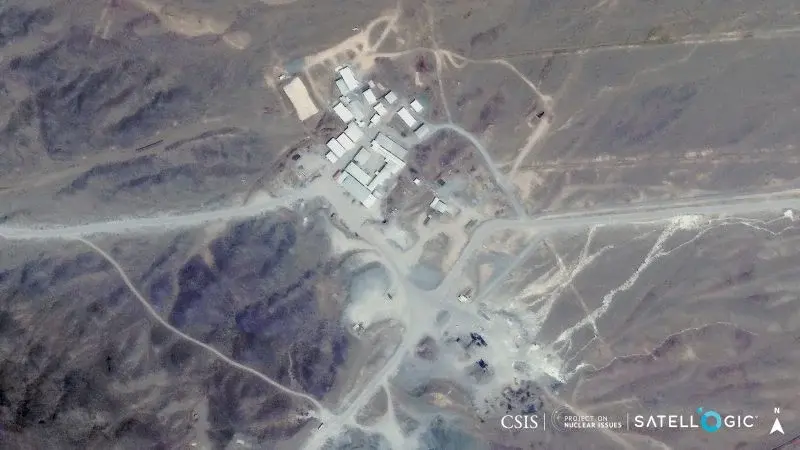
Satellite data shows a major surge in construction at Iran's Pickaxe Mountain nuclear site, prompting the US to accelerate development of new bunker-busting weapons to strike deep underground facilities.
Key points
- CSIS analysis of six years of satellite imagery reveals a significant increase in construction activity at Pickaxe Mountain in 2026, including hardened tunnel portals and paved internal roads.
- The US Defense Threat Reduction Agency signed an emergency $1.2 million contract in February 2026 to repair a subterranean test facility at White Sands Missile Range for live-fire tests against deeply buried targets.
- President Trump has threatened to strike Pickaxe Mountain, but current US munitions like the Massive Ordnance Penetrator may lack the depth-penetration capability to destroy the granite-buried facility.
- The US is developing a 'next generation penetrator' bomb to succeed the current MOP, with prototype work beginning in September 2025 and industry solicitations in June 2026.
- CSIS analysts caution that despite the construction surge, the site is likely not yet capable of uranium enrichment, as there is no evidence of increased internal security or non-construction vehicle activity.
Background
This development follows the June 2025 Operation Midnight Hammer strikes on Iranian nuclear sites, which failed to destroy the deeply buried Isfahan facility. In July 2026, a rift emerged between Trump and Netanyahu over strategy, with Netanyahu pushing for military action on Pickaxe Mountain while Trump favored diplomacy. The current surge in construction coincides with the ongoing six-month US-Iran conflict, during which US forces have largely focused on other targets.
How outlets are covering it
CNN and CSIS agree on the construction surge but differ on emphasis. CNN highlights the US military's urgent response, including the White Sands test and new bomb development, framing it as a critical capability gap. CSIS focuses on the technical analysis of the site's construction phases, noting that while activity has increased, the site is not yet operational for enrichment. CSIS also emphasizes the limitations of current US weapons against granite-buried targets, suggesting a need for diplomatic solutions, whereas CNN focuses on the military's efforts to overcome this limitation.
Why it matters
The inability to destroy deeply buried nuclear facilities with current weapons creates a strategic vulnerability for the US, potentially allowing Iran to preserve its nuclear program even after strikes. The development of new penetrator bombs and the urgency of the White Sands test indicate a shift in US military strategy to address this gap, which could influence future escalation in the US-Iran conflict and the broader regional security landscape.
What to watch
The US will likely continue testing and developing the next-generation penetrator bomb, with potential live-fire tests at White Sands. The US may also consider striking Pickaxe Mountain if the new weapons are deemed effective, though this remains uncertain. Iran may continue fortifying the site, and the US-Iran conflict could escalate if the US perceives the construction as a direct threat to its security.
- ‘Surge in construction’ at suspected Iranian nuclear site, analysts say, as US considers ways to strike deep underground CNN
- Iran said to step up work at Pickaxe Mountain, with US working to devise means of striking underground site The Times of Israel
- New Satellite Imagery Analysis Reveals an Uptick in 2026 Construction Activity at Pickaxe Mountain CSIS | Center for Strategic and International Studies
- CENTCOM destroys multiple Iranian oil tankers following an exchange of strikes overnight | LIVE BLOG i24NEWS
- Report: Iran accelerates construction at deeply buried nuclear site Ynetnews
Want the full story? Read the original reporting
Read on CNN