
Satellite Data Confirms Surge in Construction at Iran's Pickaxe Mountain Amid Oil Crisis
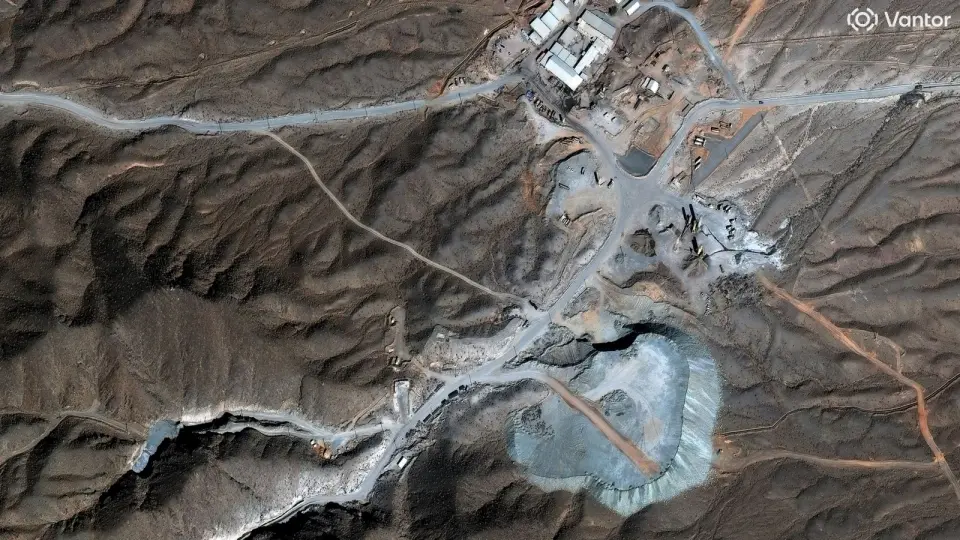
President Trump warned Iran against 'getting cute' with activity at Pickaxe Mountain, a suspected underground nuclear site near Natanz. Satellite analysis by CSIS confirms a historic surge in construction at the site, shifting from excavation to internal buildout. This escalation coincides with renewed attacks on tankers in the Strait of Hormuz, pushing Brent crude above $106 per barrel. While the US considers new weapons to strike deep-buried targets, analysts note the site is not yet capable of enrichment.
Key points
- Trump warned Iran at the Republican convention that activity at Pickaxe Mountain would be met with a hard response.
- CSIS satellite analysis shows 2026 activity at Pickaxe Mountain is the highest in the site's history, indicating a shift to internal construction.
- Brent crude prices surged past $106 per barrel following attacks on tankers near the Strait of Hormuz and Houthi advances in Yemen.
- The US is developing a 'next generation penetrator' bomb to potentially strike deeply buried facilities like Pickaxe Mountain.
- Iran denied seeking nuclear weapons but resumed ballistic missile production in underground facilities, according to the Wall Street Journal.
Background
This development follows earlier US strikes on Iranian nuclear sites in June 2025, known as Operation Midnight Hammer, which damaged Natanz, Fordow, and Isfahan. Previous coverage noted a rift between Trump and Netanyahu regarding the strategy for Iran's underground sites. The current escalation occurs against a backdrop of economic strain in Iran and rising oil prices due to the ongoing conflict.
How outlets are covering it
CNBC and CSIS emphasize the physical construction surge at Pickaxe Mountain, with CSIS noting the site is not yet capable of enrichment work. CNN highlights the US military's struggle to develop weapons capable of penetrating the granite mountain, detailing a new contract for a 'next generation penetrator' bomb. France 24 focuses on the broader regional impact, linking the nuclear tensions to the Houthi seizure of the Red Sea port of Mocha and the resulting spike in oil prices. While CSIS and CNN provide technical and military analysis, France 24 contextualizes the crisis within the wider energy market and regional instability.
Why it matters
The construction surge at Pickaxe Mountain represents a potential reconstitution of Iran's nuclear program, challenging US efforts to degrade Tehran's capabilities. The inability of current US munitions to effectively strike such deep-buried targets creates a strategic dilemma, potentially prolonging the conflict. Furthermore, the link between nuclear tensions and oil prices highlights the global economic risks of the US-Iran war, with energy costs driving inflation and influencing central bank policies.
What to watch
The US is expected to continue developing new weapons to address deeply buried targets, while Trump has indicated the war may not end until after the November midterm elections. Oil markets will likely remain volatile, with analysts watching Chinese buying behavior to determine if the current rally in crude prices has follow-through. Iran may continue to assemble missiles in underground facilities, while the IAEA faces pressure to report Iran to the UN Security Council.
- Trump warns Tehran over Pickaxe Mountain activity; U.S.-Iran exchange attacks on ships near Hormuz CNBC
- ‘Surge in construction’ at suspected Iranian nuclear site, analysts say, as US considers ways to strike deep underground CNN
- Middle East live: Yemen’s Houthi rebels seize Red Sea port city Mocha France 24
- New Satellite Imagery Analysis Reveals an Uptick in 2026 Construction Activity at Pickaxe Mountain CSIS | Center for Strategic and International Studies
- Trump says activity seen at Iran's Pickaxe Mountain, urges Tehran 'not to get cute' Reuters
Want the full story? Read the original reporting
Read on CNBC