
Mid-Cycle Redistricting Failed to Save GOP House Majority Despite Structural Gains
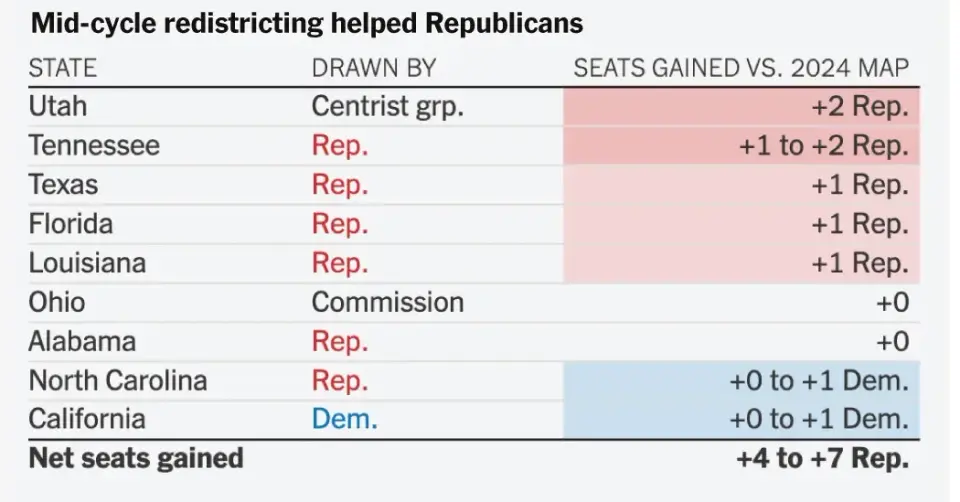
Republican efforts to redraw congressional maps in 2025 failed to secure a House majority in the 2026 midterms, as Democrats won a historic majority despite GOP-favored lines. While the new maps yielded a net gain of 4 to 7 seats for Republicans compared to 2024 boundaries, they underperformed relative to the party’s initial goal of gaining 10 seats. The Democratic victory was driven by a massive wave of voter turnout and dissatisfaction with President Trump, overwhelming the structural advantages created by gerrymandering in states like Texas, Florida, and North Carolina.
Key points
- Republicans redrew 15 congressional districts across nine states in 2025, aiming to gain up to 10 seats to hold the House.
- Democrats won a historic majority in the 2026 midterms, retaining 11 of the 15 targeted seats and gaining additional seats in other states.
- The New York Times analysis indicates Republicans gained a net 4 to 7 seats compared to 2024 maps, but lost ground compared to nonpartisan simulations.
- In Texas, Republicans won only one of the five redrawn districts, despite holding 65% of the state’s seats with 45% of the vote.
- North Carolina’s redistricting backfired as Democrats flipped up to six seats, resulting in a 10-4 Democratic advantage in the state delegation.
- Experts cite low approval of President Trump, high Democratic turnout, and strong candidate performance as key factors in overcoming map advantages.
Background
The 2026 midterms followed a period of aggressive mid-cycle redistricting by Republicans, which began in the summer of 2025 after the Supreme Court weakened federal restraints on gerrymandering in the Voting Rights Act. Prior to the election, analysts predicted that the new maps would provide a significant structural advantage for the GOP. However, the election results demonstrated that the political environment had shifted dramatically, with voters rejecting the party’s candidates despite the favorable district lines. This event marks a significant departure from the traditional decennial redistricting cycle, highlighting the limits of map manipulation in the face of widespread voter dissatisfaction.
How outlets are covering it
The New York Times emphasizes that while the redistricting effort failed to achieve its primary goal of securing a House majority, it still provided a net gain of 4 to 7 seats for Republicans compared to the previous maps. Time Magazine highlights the role of voter dissatisfaction with President Trump and the effectiveness of Democratic candidates in overcoming the map advantages, noting that the redistricting was based on outdated voter preferences. The Guardian argues that the failure of the redistricting effort was 'epic' and that the Democratic wave was strong enough to overwhelm the gerrymander, while also noting that the maps still provided a significant structural advantage for Republicans in terms of seat-to-vote ratio. Cook Political Report suggests that the backlash from the redistricting effort may make Republicans more cautious about future mid-cycle redistricting, as the party faces internal fractures and a need to reassess its strategy for 2028.
Why it matters
The 2026 midterms demonstrate that while gerrymandering can provide a structural advantage, it cannot guarantee electoral success in the face of a strong wave of voter dissatisfaction. The results suggest that the political environment can shift dramatically, rendering even well-crafted maps ineffective. This has implications for future redistricting efforts, as both parties may be more cautious about mid-cycle map changes. Additionally, the results highlight the importance of candidate quality and voter turnout in overcoming structural disadvantages, suggesting that the political landscape is more dynamic than previously thought.
What to watch
The 2026 midterms will likely lead to a reassessment of redistricting strategies by both parties. Republicans may be more cautious about mid-cycle map changes, while Democrats may focus on maintaining their majority and protecting their gains. The results will also have implications for the 2028 presidential election, as the political environment may shift back in favor of Republicans. Additionally, the results will likely lead to increased scrutiny of the Supreme Court’s decision in Louisiana v. Callais, which weakened federal restraints on gerrymandering.
- Did the Redistricting Wars Backfire on Republicans? In a Word, No. The New York Times
- Why Did Republican Redistricting Fail to Stop the Blue Wave? Time Magazine
- How Republican efforts to redraw congressional maps ‘failed epically’ The Guardian
- Could the Blue Wave Drown Out Mid-Decade Redistricting? Cook Political Report
- Republicans drew North Carolina to win two-thirds of its House seats — they may hold under a third Fortune
Want the full story? Read the original reporting
Read on The New York Times