
2026 Nobel Prize in Medicine Honors Optogenetics Pioneers for Brain Control Breakthrough
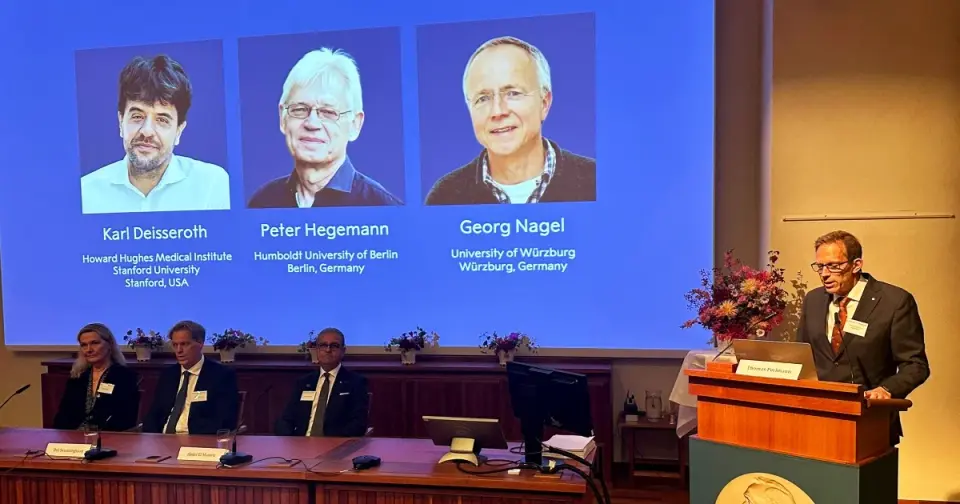
Karl Deisseroth, Peter Hegemann, and Georg Nagel have been awarded the 2026 Nobel Prize in Physiology or Medicine for developing optogenetics, a technique that allows scientists to activate or inhibit specific nerve cells in living brains using light. The prize, announced on October 5, 2026, recognizes their work in mapping neural circuits and understanding the biological basis of behaviors and disorders. The three laureates share a prize sum of 12 million Swedish crowns (approximately $1.2 million).
Key points
- The 2026 Nobel Prize in Physiology or Medicine was awarded to Karl Deisseroth, Peter Hegemann, and Georg Nagel.
- The award recognizes the development of optogenetics, a method that uses light to switch on or off individual nerve cells in a living brain.
- Karl Deisseroth is a 54-year-old American scientist, while Peter Hegemann and Georg Nagel are 71 and 73 years old, respectively, both from Germany.
- The prize sum is 12 million Swedish crowns, equivalent to approximately $1.2 million, shared among the three winners.
- The award was announced by the Nobel Assembly of Sweden’s Karolinska Institute on October 5, 2026.
- The technique is now used in laboratories worldwide to reveal the brain’s mysteries and map neural circuits.
Background
The 2026 Nobel Prize in Physiology or Medicine is the first of the annual Nobel announcements, with awards in physics, chemistry, literature, peace, and economics to follow. The prize has historically recognized influential scientific discoveries, such as Alexander Fleming’s work on penicillin in 1945 and Karl Landsteiner’s discovery of human blood groups in 1930. Last year, the prize was awarded to Mary Brunkow, Fred Ramsdell, and Shimon Sakaguchi for their work on the immune system. The Nobel Prizes were established under the will of Alfred Nobel and have been awarded since 1901, with the economics prize added in 1968.
How outlets are covering it
Both NBC News and AP News report the core facts of the award, including the names of the laureates, the technique recognized (optogenetics), and the prize amount. NBC News emphasizes the global impact of the technique, noting that it is now used in laboratories worldwide to reveal the brain’s mysteries. AP News, in its headline, highlights a personal detail about Karl Deisseroth, noting that he plans to make his children’s school lunches after winning the prize, which contrasts with the formal announcement of the award. Both sources agree on the significance of the work in mapping neural circuits and understanding behaviors and disorders.
Why it matters
The development of optogenetics represents a significant breakthrough in neuroscience, allowing researchers to control and study neural activity in living brains with unprecedented precision. This technique has the potential to lead to new treatments for neurological disorders, such as depression and blindness, by identifying specific brain circuits responsible for these conditions. The award highlights the importance of interdisciplinary research in advancing our understanding of the brain and its functions.
What to watch
The remaining Nobel Prizes in physics, chemistry, literature, peace, and economics are expected to be announced in the coming days. The laureates will receive their awards in ceremonies on December 10, the anniversary of Alfred Nobel’s death, attended by Sweden’s and Norway’s royal families. The celebrations will include gala banquets held in honor of the winners.
- 3 scientists win Nobel Prize in medicine for work unraveling the brain’s mysteries NBC News
- Nobel Prize in Physiology or Medicine Is Awarded for Discoveries in Neuroscience The New York Times
- Stanford professor surprises kids after winning Nobel Prize ABC News - Breaking News, Latest News and Videos
- California scientist wins a Nobel Prize, then makes school lunches for his kids AP News
- US and German scientists win Nobel medicine prize for work on light and brain Reuters
Want the full story? Read the original reporting
Read on NBC News