
Francis Halzen Wins 2026 Physics Nobel for IceCube Neutrino Observatory
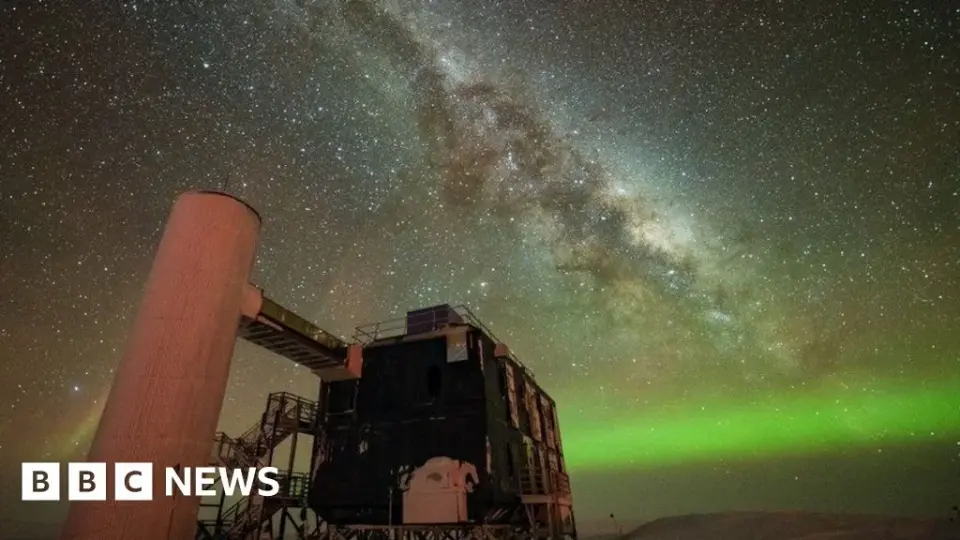
Belgian-born physicist Francis Halzen has been awarded the 2026 Nobel Prize in Physics for his foundational role in developing the IceCube Neutrino Observatory at the South Pole. The award recognizes his vision for using a cubic kilometer of Antarctic ice to detect high-energy neutrinos, particles that act as messengers from distant cosmic events. Halzen, now 82 and affiliated with the University of Wisconsin–Madison, first proposed the concept in 1988. The prize, worth 12 million Swedish kronor, highlights how IceCube has enabled a new form of astronomy by capturing signals from violent processes in the universe that traditional telescopes cannot observe.
Key points
- Francis Halzen won the 2026 Nobel Prize in Physics for his 'decisive contribution' to the IceCube Neutrino Observatory.
- The observatory uses a cubic kilometer of ice at the South Pole to detect high-energy neutrinos from distant galaxies.
- Halzen first proposed the idea in 1988, and the project involved embedding thousands of light sensors in the ice.
- The Royal Swedish Academy of Sciences cited his 'vision and scientific leadership' for opening a new window on the universe.
- The prize money is 12 million Swedish kronor (approximately $1.2 million).
Background
This award follows a period of significant advancements in space-based observation, including the recent launch and commissioning of NASA’s Nancy Grace Roman Space Telescope. While the Roman telescope focuses on mapping dark matter and exoplanets using infrared imaging, Halzen’s work addresses a different frontier: detecting neutrinos that pass through matter without interacting, offering insights into high-energy cosmic phenomena that light-based telescopes cannot capture.
How outlets are covering it
All three sources (BBC, The New York Times, and NBC News) agree on the core facts: Halzen won the prize for IceCube, and the observatory detects neutrinos. The BBC emphasizes the 'ghostly' nature of neutrinos and Halzen’s personal surprise at the award. The New York Times frames the achievement as the 'advent of neutrino astronomy,' highlighting the detection of particles from supermassive black holes. NBC News focuses on the practical aspect of Halzen’s age (82) and his comment that the prize might help approve a new proposal. The BBC and NYT both quote Nobel Committee Chair Mark Pearce praising Halzen’s 'tenacity' and 'vision,' while NBC News includes quotes from committee member Eva Olsson describing the neutrinos as 'messengers from the cosmos.'
Why it matters
The award validates a decades-long effort to detect particles that rarely interact with matter, providing a new method to study the most energetic and mysterious processes in the universe. It underscores the importance of large-scale, international scientific collaborations in advancing our understanding of cosmic origins and high-energy astrophysics.
What to watch
Halzen has indicated he is working on a new proposal and hopes the prize will help secure funding for it. The broader scientific community will continue to use IceCube to trace neutrinos to their sources, potentially identifying specific cosmic events like exploding stars or black hole environments. The remaining 2026 Nobel Prizes in Chemistry, Literature, Peace, and Economic Sciences are scheduled to be announced in the coming days.
- 'Ghost particles' from space telescope wins physics Nobel BBC
- Nobel Prize in Physics Is Awarded to Francis Halzen The New York Times
- Nobel Prize in Physics Awarded to Francis Halzen for Astronomy Breakthroughs WSJ
- Nobel Prize in physics to be awarded in Stockholm NBC News
- Francis Halzen wins 2026 Nobel Prize in Physics Reuters
Want the full story? Read the original reporting
Read on BBC