Tag

Neutrinos

All articles tagged with #neutrinos

Sterile Neutrino Hypothesis Fails the Latest Tests
science3 days ago

Sterile Neutrino Hypothesis Fails the Latest Tests

Decades of hints for a light sterile neutrino have collapsed after recent null results (KATRIN and MicroBooNE, plus reactor and gallium studies), effectively ruling out the simplest sterile-neutrino explanation for several anomalies. While the LSND/Miniboone/gallium puzzles remain unexplained, physicists are pursuing more complex neutrino scenarios and await data from JUNO, DUNE, and Isodar to map neutrino masses and oscillations.

Antarctic Radio Anomaly Deepens Mystery as ANITA Signals Defy Explanation
science11 days ago

Antarctic Radio Anomaly Deepens Mystery as ANITA Signals Defy Explanation

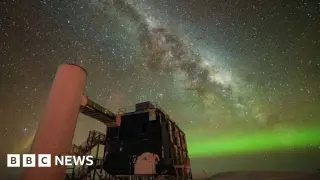
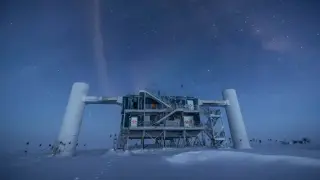
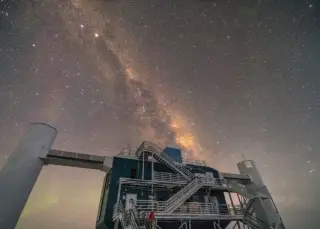
NASA’s ANITA detected unusual radio pulses from beneath the Antarctic ice (2016–2018). New analyses rule out simple neutrino explanations and cross-checks with the Pierre Auger Observatory and IceCube found no similar events, suggesting the anomaly isn’t new physics but a complex propagation effect near ice; a next‑gen detector, PUEO, may help resolve the mystery.

Blazar Jets as Cosmic Neutrino Engines? New Record Points to Extreme Galaxies
science28 days ago

Blazar Jets as Cosmic Neutrino Engines? New Record Points to Extreme Galaxies

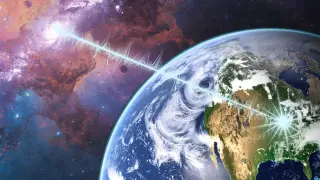
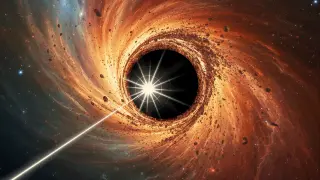
A Mediterranean KM3NeT/ARCA detector captured a 220 PeV neutrino—the most energetic yet—sparking a study that points to blazars (jets from supermassive black holes aligned toward Earth) as likely accelerators. The team cross-checked with IceCube and Fermi data and noted no electromagnetic counterpart, suggesting a diffuse background of multiple sources rather than a single cataclysmic event. With KM3NeT expanding to full size, researchers expect more high-energy neutrinos to sharpen the origin story.

Dark-Charge Black Holes May Explain Ultra-High-Energy Neutrino Burst
space2 months ago

Dark-Charge Black Holes May Explain Ultra-High-Energy Neutrino Burst

KM3NeT detected a 100 PeV neutrino (KM3-230213A) with no known source. A Physical Review Letters study proposes exploding quasi-extremal primordial black holes with a dark charge as a possible origin, invoking Hawking radiation that heavier, lighter PBHs would emit high-energy particles in a final burst. IceCube has not observed a comparable event, possibly due to its different energy window. If correct, such PBH evaporations could occur roughly every decade, linking ultra-high-energy neutrinos to PBH physics.

Dark-Charged Black Holes May Explain Ultra-Energetic Neutrino
science2 months ago

Dark-Charged Black Holes May Explain Ultra-Energetic Neutrino

A 2023 KM3NeT detection of a ~220 PeV neutrino challenges standard sources; researchers propose it came from a quasi-extremal primordial black hole carrying dark charge that evaporates via a dark Schwinger effect, discharging explosively and emitting high-energy neutrinos while spending most of its life dormant. If correct, such black holes could explain the IceCube–KM3NeT mismatch and potentially account for dark matter.

Ultra-energetic Neutrino Sparks Primordial Black Hole Hypothesis
science2 months ago

Ultra-energetic Neutrino Sparks Primordial Black Hole Hypothesis

A record-energy neutrino detected by the KM3NET underwater telescope could originate from the explosive end of a primordial black hole, a provocative link to dark matter. Kaiser and Klipfel model a scenario where a small asteroid-mass PBH exploded about 2,000 AU away to produce the neutrino, estimating roughly an 8% chance. While intriguing, the idea remains unproven and controversial among scientists.

Dark matter–neutrino interaction hints at a cosmology breakthrough
physics-and-mathematics2 months ago

Dark matter–neutrino interaction hints at a cosmology breakthrough

Researchers report a 3-sigma hint that dark matter and neutrinos may interact, transferring momentum and potentially reducing the universe’s observed clumpiness. If confirmed, this could require updates to the lambda-CDM model and help address the S8 tension between early- and late-universe measurements. The finding combines Planck/ACT early-universe data with BAO and cosmic-shear observations and simulations, but it remains unproven and will hinge on forthcoming data from surveys like the Vera Rubin Observatory for confirmation. A confirmed interaction would constitute a fundamental breakthrough in cosmology and particle physics.

Elusive Particles May Interact, Redrawing Our Cosmic Map
science2 months ago

Elusive Particles May Interact, Redrawing Our Cosmic Map

A new study suggests a possible though not yet proven interaction between dark matter and neutrinos with a coupling strength around 10^-4, which could help explain why the universe is less clumpy than early-universe data alone would predict. By analyzing cosmic shear data from both early and late universe observations (ACT, Planck, DES, and SDSS), researchers propose that such interactions could influence structure formation without overturning the ΛCDM model. The finding sits at about 3 sigma significance, far from definitive proof, but it offers a potential direction for future telescope surveys and laboratory experiments to probe dark matter properties further.

Dark Matter Might Interact with Cosmic Ghost Particles, Scientists Say
science3 months ago

Dark Matter Might Interact with Cosmic Ghost Particles, Scientists Say

New research suggests dark matter may interact with neutrinos, which could explain why the universe is less 'clumpy' than expected and challenge current cosmological models. Future observations, including cosmic microwave background studies and gravitational lensing, aim to test this hypothesis, potentially leading to a major breakthrough in understanding dark matter.