Tag

Icecube

All articles tagged with #icecube

Dusty Galaxy Emerges as Possible Source of Ghost Neutrinos
space-science15 days ago

Dusty Galaxy Emerges as Possible Source of Ghost Neutrinos

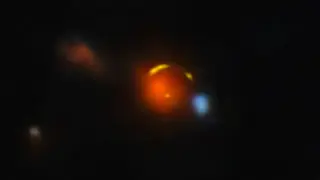
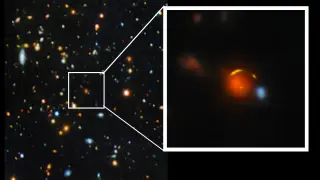
A high-energy neutrino detected by IceCube may have originated from Shadow Blaster, a dust-enshrouded, intensely star-forming galaxy 11 billion light-years away that is gravitationally lensed. This link, while tentative (about 1% chance of a random coincidence), suggests star-forming galaxies could contribute a significant fraction of the diffuse neutrino background, and motivates deeper multiwavelength follow-up with facilities like ALMA and JWST to pinpoint more such sources.

Dusty Galaxy Shadow Blaster Pinpoints Home of High-Energy Neutrino
science23 days ago

Dusty Galaxy Shadow Blaster Pinpoints Home of High-Energy Neutrino

Astronomers trace a high-energy neutrino detected by IceCube to Shadow Blaster, a dust-rich, strongly gravitationally lensed star-forming galaxy about 11 billion light-years away. This marks the first direct link between a single dusty galaxy and a high-energy neutrino, suggesting such galaxies can be significant sources of cosmic neutrinos and could contribute up to ~20% of the diffuse neutrino background; the finding, published in Nature Astronomy, relied on observations from JCMT, SMA, ALMA, and Gemini to map the galaxy’s dense, star-forming core and its lensing mass.

Earth-Directed Blazar Jets May Explain Record Ultra-High-Energy Neutrino
space1 month ago

Earth-Directed Blazar Jets May Explain Record Ultra-High-Energy Neutrino

A 220 PeV neutrino detected by KM3NeT in 2023 is examined for origins; a population of blazars—jets from active galactic nuclei aimed at Earth—could account for such events without exceeding the extragalactic gamma-ray background measured by Fermi, though no electromagnetic counterpart was found and IceCube’s non-detection constrains the scenario. The study shows the blazar-population model is plausible within a defined parameter range and highlights the need for future KM3NeT upgrades and more data to confirm or refute this diffuse-origin explanation.

Antarctic Radio Anomaly Deepens Mystery as ANITA Signals Defy Explanation
science3 months ago

Antarctic Radio Anomaly Deepens Mystery as ANITA Signals Defy Explanation

NASA’s ANITA detected unusual radio pulses from beneath the Antarctic ice (2016–2018). New analyses rule out simple neutrino explanations and cross-checks with the Pierre Auger Observatory and IceCube found no similar events, suggesting the anomaly isn’t new physics but a complex propagation effect near ice; a next‑gen detector, PUEO, may help resolve the mystery.

Scientists Trace Origins of Mysterious High-Energy Cosmic Rays
science1 year ago

Scientists Trace Origins of Mysterious High-Energy Cosmic Rays

Astronomers are making significant progress in identifying the origins of the highest energy cosmic rays, with evidence pointing to our own galaxy. Using detectors like IceCube and LHAASO, scientists have traced these particles back to sources such as pulsar wind nebulae, supernova remnants, and black holes within the Milky Way, advancing our understanding of cosmic particle acceleration and multi-messenger astronomy.

Sterile Neutrino Search Yields No Results
science1 year ago

Sterile Neutrino Search Yields No Results

The IceCube Collaboration has conducted a comprehensive search for sterile neutrinos using 10.7 years of data from their detector at the South Pole, but found no evidence of their existence. This result, published in Physical Review Letters, further lowers the probability of sterile neutrinos existing, consistent with the standard three-neutrino model. The study involved improved data modeling and analysis, contributing to the ongoing investigation into neutrino physics.

Ice Cube Counters Katt Williams' Allegations Over 'Friday After Next' Scenes and Casting
entertainment2 years ago

Ice Cube Counters Katt Williams' Allegations Over 'Friday After Next' Scenes and Casting

Comedians Kevin Hart and Ice Cube have responded to Katt Williams' critical comments from his appearance on the Club Shay Shay podcast. Ice Cube addressed Williams' remarks about their film "Friday After Next," clarifying that a rape scene involving Williams' character was never intended to be depicted in a certain way, and praised Williams for enhancing the role of Money Mike. Hart's response was more succinct and passive-aggressive, dismissing Williams' claims of Hart being an industry plant with a brief tweet suggesting Williams harbors unnecessary anger, while promoting his new Netflix movie "Lift."

Ice Cube Counters Katt Williams' Claims on 'Friday' Series and Addresses Allegations in Recent Interviews
entertainment2 years ago

Ice Cube Counters Katt Williams' Claims on 'Friday' Series and Addresses Allegations in Recent Interviews

Ice Cube has addressed Katt Williams' claims about a controversial rape scene and issues with pay in the "Friday" movie franchise. Ice Cube refuted the notion that he would include a rape scene in his movies, emphasizing that it's not his style, and explained that the budget for the films was mostly allocated to production costs, not cast pay. He also spoke on the casting process, highlighting Williams' contribution to the role of Money Mike and clarifying the decision to cast Rickey Smiley as Santa Claus instead. Williams had previously discussed these topics during an interview on the Club Shay Shay podcast, where he also criticized those who complained about their pay as "ungrateful bastards."

"Expanding IceCube and Building a Revolutionary Muon Collider: U.S. Particle Physics Roadmap Approved"
science-and-technology2 years ago

"Expanding IceCube and Building a Revolutionary Muon Collider: U.S. Particle Physics Roadmap Approved"

Scientists are recommending that the IceCube Neutrino Observatory in Antarctica be expanded to eight times its current size, in order to improve the detection and analysis of neutrinos. The expansion, known as ICECube-Gen2, is part of a series of recommendations made by the Particle Physics Project Prioritization Panel (P5) to advance astrophysics and particle physics research. The panel also recommended support for other experiments and projects, including the Deep Underground Neutrino Experiment and the development of next-generation telescopes. The recommendations are currently being reviewed by the U.S. Department of Energy.

"Expanding IceCube and Building a Revolutionary Muon Collider: Advancements in US Particle Physics"
science-and-technology2 years ago

"Expanding IceCube and Building a Revolutionary Muon Collider: Advancements in US Particle Physics"

Scientists are recommending that the IceCube Neutrino Observatory in Antarctica be expanded to be eight times bigger, as part of a draft report by the Particle Physics Project Prioritization Panel (P5). The report also recommends support for other projects in particle physics and astrophysics research, including the Deep Underground Neutrino Experiment, projects at CERN's Large Hadron Collider, the Vera C. Rubin Observatory, and the development of next-generation telescopes. The recommendations are aimed at maximizing limited funding and advancing the field of particle physics over the next decade. The report is currently being reviewed by the U.S. Department of Energy.

"Unveiling the Universe: Groundbreaking Revelations Await"
science-and-space3 years ago

"Unveiling the Universe: Groundbreaking Revelations Await"

Two major press conferences about the Universe are scheduled for Thursday, June 29th. The first announcement, by the North American Nanohertz Observatory for Gravitational Waves (NANOGrav), is expected to shed light on the detection of the gravitational wave background, which could revolutionize our understanding of the early Universe. The second announcement, by the IceCube Neutrino Observatory, will involve intriguing neutrino detection and has no connection to gravitational waves. Both discoveries have the potential to significantly advance our knowledge of the Universe.

"Neutrinos and Quantum Gravity: Latest Findings from IceCube and Fermi Data"
physics3 years ago

"Neutrinos and Quantum Gravity: Latest Findings from IceCube and Fermi Data"

Researchers from the University of Naples, the University of Wroclaw, and the University of Bergen have found preliminary evidence supporting quantum gravity models that predict a decrease in the speed of ultrarelativistic particles with rising energy. The investigation used gamma-ray bursts observed by the Fermi telescope and ultra-high-energy neutrinos detected by the IceCube Neutrino Observatory. This marks a significant milestone in the field of quantum gravity research since it is the first time that such a level of quantum gravity-supportive statistical evidence is found.