
Cosmic sugar discovery: four-carbon erythrulose detected in interstellar space
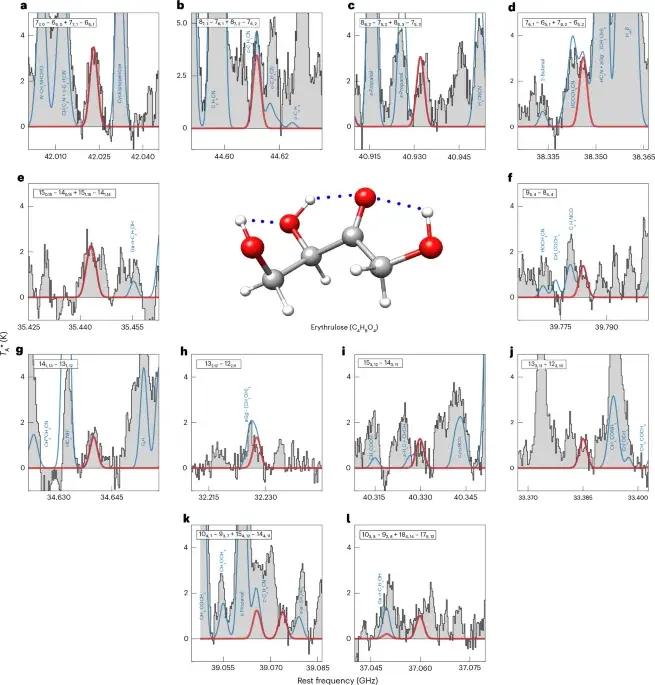
Ultrasensitive broadband spectral surveys with the Yebes 40 m and IRAM 30 m telescopes led to the first detection of erythrulose, a four‑carbon ketose, in the interstellar medium toward the Galactic Centre cloud G+0.693−0.027. Erythrulose is at least 8–17 times more abundant than the undetected C3 sugars in this cloud, and its formation is explained by grain-surface chemistry combining glycolaldehyde and ethylene glycol via fast hydrogen-abstracting reactions on icy dust grains, followed by an intersystem crossing to yield the chiral sugar. Astrophysical modeling (LTE fits and kinetic Monte Carlo simulations) reproduces its presence under typical Galactic Centre conditions, suggesting interstellar sugars could contribute to prebiotic inventories and potentially to the origin of biological homochirality on early Earth, linking ISM chemistry to meteoritic organics and solar-system material.
- Detection of a four-carbon sugar in interstellar space Nature
- A Sweet Surprise: Scientists Find Sugar Deep in Our Galaxy The New York Times
- In a sweet discovery, astronomers find sugar lurking in the space between stars AP News
- Space jam: astronomers detect ‘raspberry sugar’ on dust cloud in Milky Way The Guardian
- Something surprisingly sweet lurks near the Milky Way’s heart Scientific American
Want the full story? Read the original reporting
Read on Nature