
Dense Mega-Earth Gliese 523b Defies Planet Formation Theories with Polar Orbit
TL;DR
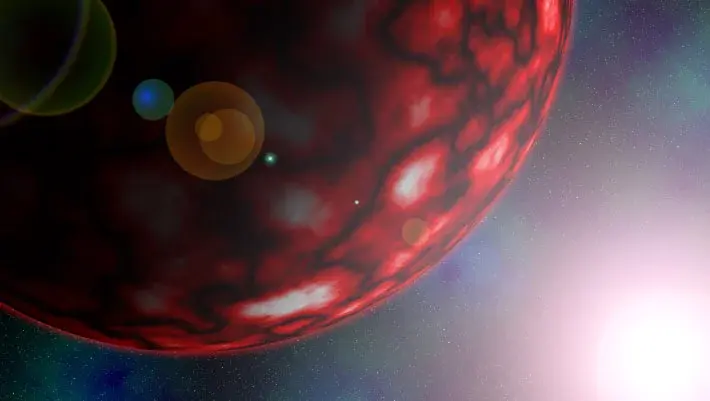
Astronomers confirm Gliese 523b—a dense meg-eath about 2.55 Earth radii and 23.5 Earth masses (density ~7.8 g/cm3) orbiting the young, ~169‑million‑year‑old star Gliese 523 every 17.75 days on a highly inclined, near-polar orbit (inclination ≥71°). With little or no atmosphere, it challenges standard formation models. The planetary nature was established using NEID radial‑velocity data and TESS transits. Its enigmatic characteristics have scientists exploring scenarios such as atmospheric stripping, warped protoplanetary disks, undetected outer companions, or giant impacts that prevented thick atmosphere formation.
- Astronomers Discover Rare ‘Mega-Earth’ Exoplanet: Gliese 523b Sci.News
- Astronomers discover a giant, rocky 'mega-Earth' 23 times more massive than our planet Space
- Astronomers found a 'mega Earth' that shouldn't exist. This alien world is breaking the rules of planet building BBC Sky at Night Magazine
- New 'mega-Earth' found in space. What did astronomers discover? Detroit Free Press
- Researchers identify ‘Mega-Earth,’ prompting questions of how it formed NewsNation
Want the full story? Read the original reporting
Read on Sci.News