
October 6 Lunar Occultation Hides Jupiter and Its Moons in Rare Pre-Dawn Spectacle
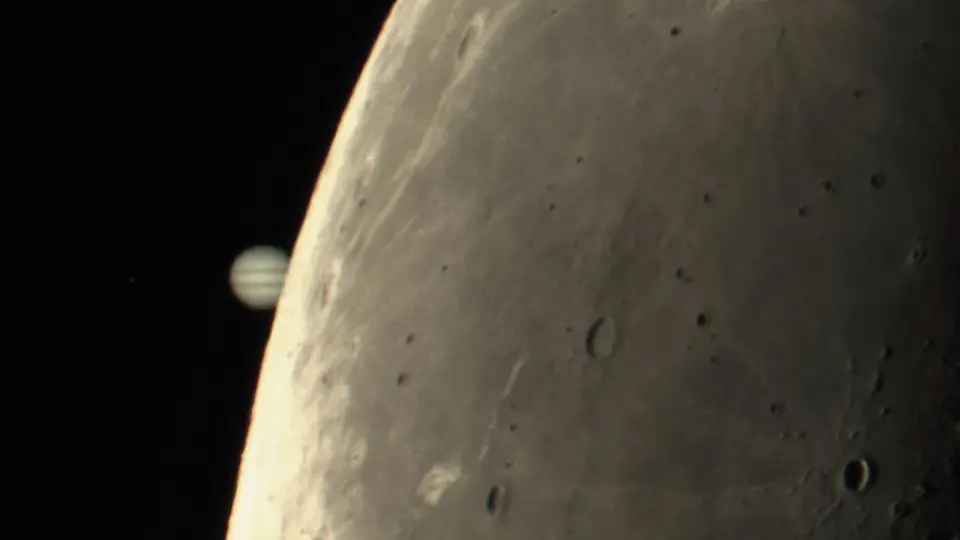
On October 6, 2026, a waning crescent Moon passed in front of Jupiter, hiding the gas giant and its four Galilean moons for approximately one hour. Visible across eastern North America, parts of Canada, and the Atlantic, the event offered a rare pre-dawn spectacle. While the full occultation was visible in darkness for many, observers in western regions saw only Jupiter’s reappearance from the Moon’s dark limb. The event, occurring roughly once every 13 years for a specific location, drew significant attention from astrophotographers who captured detailed images of the alignment.
Key points
- The occultation occurred on October 6, 2026, with the Moon passing directly in front of Jupiter.
- Jupiter and its four Galilean moons (Io, Europa, Ganymede, and Callisto) were hidden for about an hour.
- The event was visible in darkness across eastern and central North America, with partial views in the west.
- Astrophotographers captured images using specialized equipment to balance the brightness of the Moon and Jupiter.
- The next dark-sky occultation of Jupiter visible from North America is expected in 2034 or 2037.
Background
This event follows previous coverage of October 2026 sky guides, which noted the lunar occultation of Jupiter on October 6 as a key celestial event. Earlier reports highlighted the rarity of such alignments, occurring roughly once every 13 years for a specific location. The October 6 occultation was part of a broader series of skywatching opportunities in 2026, including Saturn’s opposition and the Orionid meteor shower.
How outlets are covering it
Space.com emphasized the visual spectacle and featured astrophotographs from Peter Zay and Steven Bellavia, highlighting the technical challenges of capturing the event. BBC Sky at Night Magazine focused on the visibility of Jupiter’s Galilean moons and the use of Earthshine to illuminate the Moon’s dark side. Astronomy.com provided detailed viewing times and locations, noting the rarity of the event and the specific conditions for partial occultations. Live Science highlighted the once-in-a-decade nature of the alignment, stressing its significance for skywatchers.
Why it matters
The October 6 lunar occultation of Jupiter is a rare celestial event that offers a unique opportunity for skywatchers and astrophotographers to observe the gas giant and its moons in a dramatic alignment. The event’s rarity, occurring roughly once every 13 years for a specific location, makes it a significant moment for astronomy enthusiasts. Additionally, the detailed images captured by astrophotographers provide valuable insights into the technical challenges of observing such events, contributing to the broader understanding of celestial mechanics and observational astronomy.
What to watch
The next dark-sky occultation of Jupiter visible from North America is expected in September 2034, with another event in November 2037. In the meantime, skywatchers can look forward to other celestial events in 2026, including Saturn’s opposition in October and the Orionid meteor shower in late October. Astrophotographers and amateur astronomers are encouraged to continue capturing and sharing images of these rare alignments, contributing to the growing body of knowledge in observational astronomy.
- The moon hides Jupiter in spectacular photographs of October's lunar occultation Space
- Five moons, one image. Photographer captures view of this week's crescent Moon and Jupiter. Look closer to see how good this shot really is BBC Sky at Night Magazine
- See the Moon occult Jupiter October 6 Astronomy.com
- The moon and Jupiter are about to do something that won't happen again for 11 years Live Science
- Moon and Jupiter pics here! A cosmic hide-and-seek EarthSky
Want the full story? Read the original reporting
Read on Space