
James Webb Space Telescope Reveals Early Universe's Galactic Evolution.
TL;DR Summary
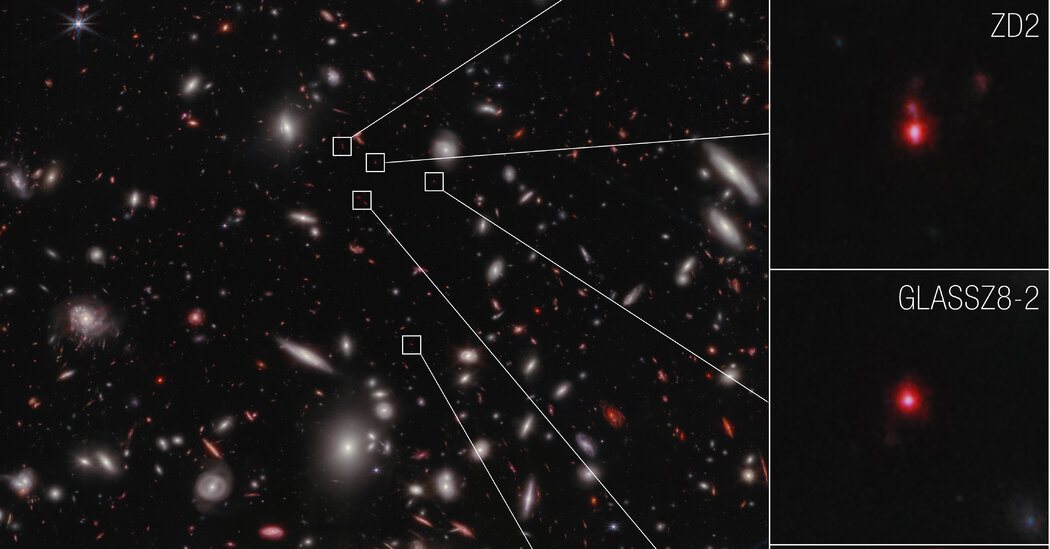
The James Webb Space Telescope has identified a group of seven baby galaxies dating back to 13 billion years ago, just 650 million years after the Big Bang. These galaxies could potentially grow into one of the biggest conglomerations of mass in the universe, a vast cluster of thousands of galaxies and trillions of stars. Spectroscopic measurements with the Webb telescope confirmed that the seven dots were galaxies and were all equally far from Earth. According to calculations based on prevailing models of the universe, gravity will eventually draw these galaxies together into a massive cluster containing at least a trillion stars.
Topics:science#astronomy#baby-galaxies#cosmology#early-universe#james-webb-space-telescope#super-mega-galactic-cluster
- Back Then, Baby Galaxies. Next, a Super-Mega Galactic Cluster? The New York Times
- James Webb Space Telescope spots huge protocluster in early universe (photo) Space.com
- James Webb Space Telescope captures ‘baby years’ of huge galaxy cluster The Indian Express
- Pillars of Creation Seen In 4K Via James Webb Space Telescope msnNOW
- Webb observations of distant galaxy allow astronomers to probe the early Universe BBC Sky at Night Magazine
Reading Insights
Total Reads
0
Unique Readers
23
Time Saved
3 min
vs 4 min read
Condensed
87%
757 → 102 words
Want the full story? Read the original article
Read on The New York Times