
Methane, aerosols and a warm nightside on a planet circling a white dwarf
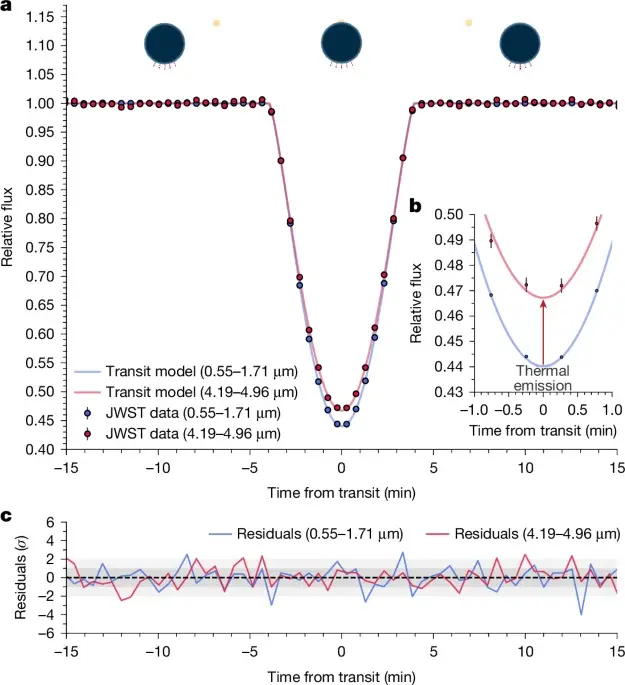
JWST/NIRSpec PRISM transmission spectra of WD 1856 b, a Jupiter-sized planet transiting a nearby white dwarf, reveal methane and other hydrocarbons, a scattering aerosol haze, and a nightside thermal emission. The atmosphere is metal-rich (CH4 at a few percent to ~7–20% in retrievals) with an opaque cloud deck near 100 mbar, and the planet’s nightside temperature is about 390–412 K, much warmer than the 160 K equilibrium expected for this system. Mass is constrained to ~4.3–10.9 Jupiter masses. The data imply a reheating event during migration into the white dwarf phase, most consistent with high-eccentricity migration and tidal circularization rather than common-envelope evolution, offering a rare window into the fate of giant planets around Sun-like stars after stellar death.
- Aerosols and hydrocarbons in the atmosphere of a white dwarf planet Nature
- Webb studies how a planet survived the death of its star European Space Agency
- The sun’s violent death could look like this Popular Science
- 'The fate of Earth depends on a delicate balance': Our planet may survive the death of the sun after all, new models hint Live Science
- Scientists Just Found a Planet That Got a Second Life After Its Star Died ScienceAlert
Want the full story? Read the original reporting
Read on Nature