Tag

Jwst

All articles tagged with #jwst

Tiny Space Rocks, Big Risks: The Decameter Asteroid Threat
science11 days ago

Tiny Space Rocks, Big Risks: The Decameter Asteroid Threat

MIT researchers warn that decameter-scale asteroids (tens of meters across) strike Earth every few decades, potentially causing 8–10 megaton airbursts, disrupting satellites and possibly triggering the Kessler debris cascade; detection is hard due to low reflectivity, but JWST has aided tracking and Vera Rubin will find more, while MIT is building a follow-up telescope network—though there is currently no global framework to defend against such threats.

Saturn's Spin Mystery Solved: Webb Uncovers a Planetary Heat Pump
space12 days ago

Saturn's Spin Mystery Solved: Webb Uncovers a Planetary Heat Pump

Astronomers using the James Webb Space Telescope show Saturn’s apparent, inconsistent rotation is an illusion created by a self-sustaining loop between auroral heating and the planet’s upper atmosphere. By tracking the infrared glow of the H3+ molecule across Saturn’s northern aurora for a full Saturnian day, researchers mapped temperature and winds, revealing that auroral heating drives winds which power currents that sustain the aurora—effectively a planetary heat pump. This two-way coupling between atmosphere and magnetosphere could change how scientists interpret signals from gas giants and exoplanets.

Ultra-Short-Period Exoplanet Defies Atmosphere Expectations, JWST Finds
space18 days ago

Ultra-Short-Period Exoplanet Defies Atmosphere Expectations, JWST Finds

JWST observations of TOI-561 b, a rocky world with a ~10-hour orbit close to its star, reveal a volatile-rich atmosphere and heat redistribution consistent with a magma-ocean–atmosphere cycle. This challenges the long-held view that such irradiated planets shed their atmospheres and revises the idea of the cosmic shoreline separating atmospheric from airless worlds.

JWST Dots May Be Young Globular Clusters, Not Baby Black Holes
space18 days ago

JWST Dots May Be Young Globular Clusters, Not Baby Black Holes

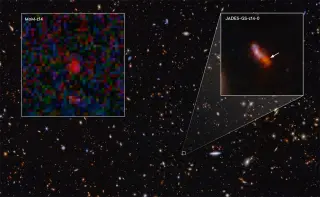
A Space.com analysis of James Webb Space Telescope data suggests the mysterious “Little Red Dots” from the early universe could be newborn globular clusters rather than proto-black holes. A new arXiv study proposes these LRDs host very young stellar populations, potentially powered by an extremely massive, short‑lived star, which could explain their distinctive V‑shaped spectrum. The observed redshift range aligns with metal‑poor globular clusters, and the team estimates a global formation density around 0.3 per cubic megaparsec, similar to the number of globular clusters today. If confirmed, this would provide a direct window into early globular cluster formation, though future spectroscopy tracking chemical signatures (like helium and nitrogen enhancements, and specific element anti-correlations) will be crucial to test the hypothesis.

Astronomers map 45 rocky exoplanets as prime targets in the search for habitable worlds
science21 days ago

Astronomers map 45 rocky exoplanets as prime targets in the search for habitable worlds

Researchers using Gaia data and the NASA Exoplanet Archive identify 45 rocky exoplanets in the habitable zone (plus 24 near-edge worlds) that could sustain Earth-like conditions, spotlighting planets such as Proxima Centauri b and TRAPPIST-1 d–g. The list should guide observations with JWST, the Roman Space Telescope, ELT, LIFE and other missions to study atmospheres, test habitability limits, and refine the definition of the habitable zone.

Brightest FRB traced to nearby galaxy, reshaping FRB origins
space26 days ago

Brightest FRB traced to nearby galaxy, reshaping FRB origins

Astronomers localized FRB 20250316A (RBFLOAT), the brightest fast radio burst to date, to a region in the nearby spiral galaxy NGC 4141 using the CHIME/FRB Outrigger VLBI network. JWST follow-up detected a faint infrared signal at the same location. The burst did not repeat in hundreds of hours of CHIME data, challenging the idea that all FRBs are repeaters and offering new constraints on their origins.

MIT’s JWST-Powered Detect-and-Track System Aims to Shield Space Infrastructure
space28 days ago

MIT’s JWST-Powered Detect-and-Track System Aims to Shield Space Infrastructure

MIT researchers unveil a JWST-based method to detect and track decameter-scale asteroids that are too faint for ground-based telescopes, enabling earlier threat assessment to protect satellites and space infrastructure; the approach, demonstrated with asteroid 2024 YR4, is part of a broader planetary-defense effort that leverages collaborations with observatories like Vera Rubin and MIT facilities to accelerate detection-to-mitigation.

Webb nails down asteroid YR4's near-miss with the Moon
space1 month ago

Webb nails down asteroid YR4's near-miss with the Moon

JWST observations show asteroid 2024 YR4 will pass about 14,229 miles (22,900 km) from the Moon, with a margin of error of ±497 miles, effectively ruling out a lunar impact and easing previous fears of a Moon collision; the measurements also demonstrate Webb’s growing role in planetary defense by tracking a tiny, fast-moving asteroid and refining its orbit for future risk assessment.

Habitable Zone Reimagined: Water Might Thrive Beyond Old Boundaries
astronomy1 month ago

Habitable Zone Reimagined: Water Might Thrive Beyond Old Boundaries

A new study argues the habitable zone is not a rigid boundary. For tidally locked exoplanets around M- and K-dwarfs, heat from the day side can be transported to the night side, allowing liquid water to persist there, and even very cold worlds could harbor subsurface water beneath thick ice. This broadened view aligns with JWST findings of water in warm, close-in exoplanets and expands the range of environments considered potentially life-friendly.

JWST-Driven update clears Moon-impact risk for asteroid 2024 YR4 in 2032
science1 month ago

JWST-Driven update clears Moon-impact risk for asteroid 2024 YR4 in 2032

NASA, aided by James Webb Space Telescope observations, has ruled out any lunar impact risk from asteroid 2024 YR4 in 2032, lowering the earlier 4.3% chance to zero and predicting a close approach about 13,200 miles from the Moon on December 22, 2032; the ~200-foot rock was discovered in 2024 by ATLAS, and concerns about a potential lunar collision have been put to rest.

Moon-safe: Asteroid 2024 YR4 will miss the Moon in 2032 after JWST orbit refinements
astronomy1 month ago

Moon-safe: Asteroid 2024 YR4 will miss the Moon in 2032 after JWST orbit refinements

Astronomers using the James Webb Space Telescope refined the orbit of asteroid 2024 YR4, ruling out a collision with the Moon and showing it will pass about 13,200 miles (21,200 km) above the lunar surface in 2032. This closes the earlier 4.3% Moon-impact risk that existed due to orbital uncertainty, with Gaia-star measurements helping to nail down the asteroid’s path.

Could JWST’s Tiny Dots Hint at the Universe’s First Monster Stars
science1 month ago

Could JWST’s Tiny Dots Hint at the Universe’s First Monster Stars

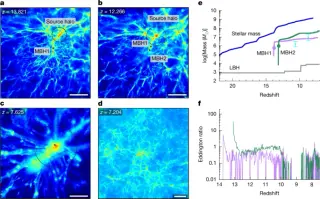
A study linked to the James Webb Space Telescope’s “little red dots” proposes they could be the first generation of supermassive stars (Population III) rather than powered black holes. The team modeled metal-free supermassive stars approaching a million solar masses and found their brightness and spectral features match two observed dots, MoM-BH*-1 and The Cliff, suggesting these stars might eventually collapse into the universe’s first supermassive black holes. If correct, these stars would live only a very short time (around 10,000 years at such masses), limiting how often we might see them; lack of X-ray signals could fit the star scenario, though accreting black holes remain an alternative. Future radio observations could decisively test the idea by detecting emission that would escape if black holes power the dots.

Webb Finds the Earliest Jellyfish Galaxy Drifting Through a Young Cosmos
space1 month ago

Webb Finds the Earliest Jellyfish Galaxy Drifting Through a Young Cosmos

Astronomers using the James Webb Space Telescope have identified the farthest known jellyfish galaxy, at redshift z=1.156 (about 8.5 billion years old), in the COSMOS field. The galaxy shows blue, newly formed stars in long trailing gas streams created by ram-pressure stripping as it speeds through a dense cluster, implying harsh cluster environments existed earlier in the universe and potentially reshaping ideas about how galaxies evolved billions of years ago.