
New Theory Places Solar System Edge at 3.8 Light-Years
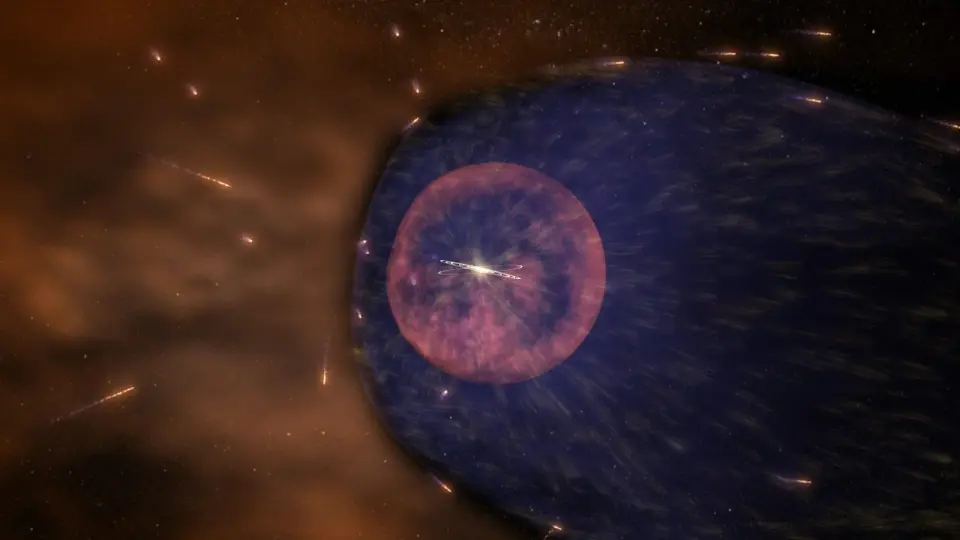
Scientists Jim Green and Ed Belbruno argue the solar system’s gravitational boundary extends to 3.8 light-years, not the traditional heliopause. They propose that Milky Way gravity and dark matter create a diffuse edge, with Lagrange points acting as portals for interstellar objects.
Key points
- Jim Green and Ed Belbruno published a new theory in the August 2026 issue of ROOM - the Space Journal of Asgardia.
- The theory suggests the solar system’s gravitational frontier reaches 241,000 astronomical units, or 3.8 light-years.
- This distance is comparable to the separation between neighboring stars, challenging traditional definitions of the solar system’s edge.
- The researchers describe the boundary as a complex interaction of forces rather than a sharp line.
- They propose that Solar Lagrange points L1 and L2 could act as portals for capturing interstellar objects.
Background
This debate follows earlier discussions about the solar system’s boundaries, such as the reclassification of Pluto and the search for Planet Nine. The new theory expands the scope of these discussions by incorporating galactic gravity and dark matter into the definition of the solar system’s edge.
How outlets are covering it
Space.com and Inside Outer Space highlight the theoretical nature of the new boundary, emphasizing the 'complex dance' of forces. UA.NEWS focuses on the practical implications, such as the potential for capturing interstellar objects and the role of dark matter. All sources agree on the 3.8 light-year figure but differ in emphasis: Space.com and Inside Outer Space stress the theoretical framework, while UA.NEWS highlights the observational opportunities and Belbruno’s prior work on weak stability boundaries.
Why it matters
Redefining the solar system’s edge could impact how we understand interstellar travel, the capture of rogue planets, and the distribution of dark matter in the Milky Way. It also opens new avenues for research using existing spacecraft like New Horizons.
What to watch
Jim Green is in discussions with the New Horizons team to observe the newly calculated Lagrange points. Future missions may explore these regions to verify the theory and search for captured interstellar objects.
Want the full story? Read the original reporting
Read on Space