
Thianthrenium Salts Enable Safe, Versatile Cyclopropanation via Iron Catalysis
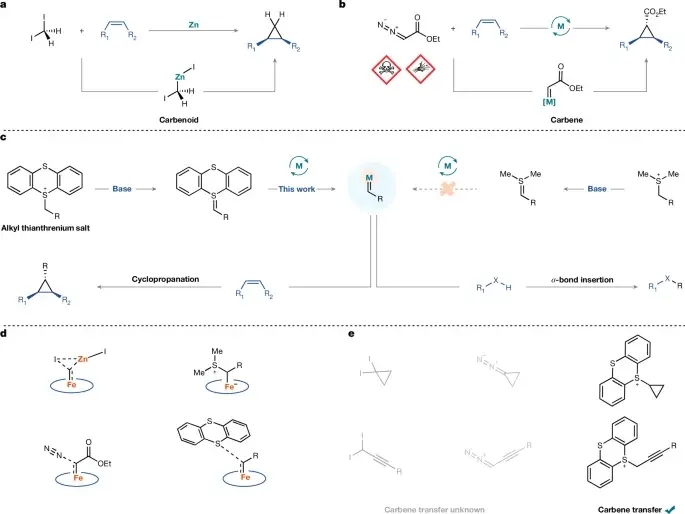
Researchers have developed a new method for synthesizing cyclopropanes using alkylthianthrenium salts as carbene precursors. Unlike traditional diazo compounds or diiodomethane, which pose significant safety risks, thianthrenium salts offer a safer profile with no detectable exotherm. The reaction, catalyzed by iron phthalocyanine, allows for diverse olefin and carbene partners, overcoming limitations of previous methods that restricted substrate scope. The approach also enables scale-up via mechanochemistry (ball milling) and extends to other carbene-transfer reactions like sigma-bond insertion.
Key points
- Alkylthianthrenium salts serve as efficient carbene donors for metal-catalyzed reactions, including cyclopropanation, sigma-bond insertion, and sigmatropic rearrangements.
- The method uses iron phthalocyanine (Fe(Pc)) as a catalyst, which is more effective than conventional iron porphyrin catalysts (Fe(TPP)Cl) due to higher electrophilic reactivity.
- Thianthrenium salts exhibit a superior safety profile compared to diazo compounds and diiodomethane, showing no detectable exotherm even when heated to 180 degrees Celsius.
- The reaction tolerates a wide range of olefins, including unactivated 1,2-disubstituted and trisubstituted olefins, which are difficult to cyclopropanate with other modern methods.
- Scale-up is feasible through mechanochemistry (ball milling) in the solid state, achieving yields comparable to solution-phase reactions without the need for solvents.
- The low Lewis basicity and steric bulk of thianthrene prevent the formation of energetically low-lying intermediates that hinder carbene transfer in conventional sulfonium salts.
Background
Cyclopropanes are valuable in drug and agrochemical development due to their strained three-membered ring structure. Traditional methods like the Simmons-Smith reaction (using diiodomethane) and diazoalkane-based reactions (using ethyl diazoacetate) have long been used but suffer from safety hazards, including explosive intermediates and toxicity. Modern approaches have improved substrate diversity but often restrict olefin scope to activated substrates like styrenes. This new method addresses these limitations by providing a safer, more versatile platform for carbene transfer.
Why it matters
This advancement provides a safer and more versatile tool for synthesizing cyclopropanes, which are crucial in pharmaceutical and agrochemical development. By overcoming the safety and scope limitations of traditional carbene precursors, this method enables the synthesis of complex cyclopropane motifs that were previously difficult to access. The ability to scale up via mechanochemistry and the broad functional group tolerance make this approach highly practical for industrial and academic applications.
What to watch
Further exploration of thianthrenium salts in other carbene-transfer reactions, including sigma-bond insertion and sigmatropic rearrangements, is expected. Researchers may also investigate the application of this method in asymmetric catalysis and its integration into continuous-flow processes for industrial-scale production. The safety profile and scalability suggest potential for widespread adoption in synthetic chemistry.
Want the full story? Read the original reporting
Read on Nature