
Trisat-S Nanosatellite Captures 'Black Sun' Effect to Validate Autonomous Navigation
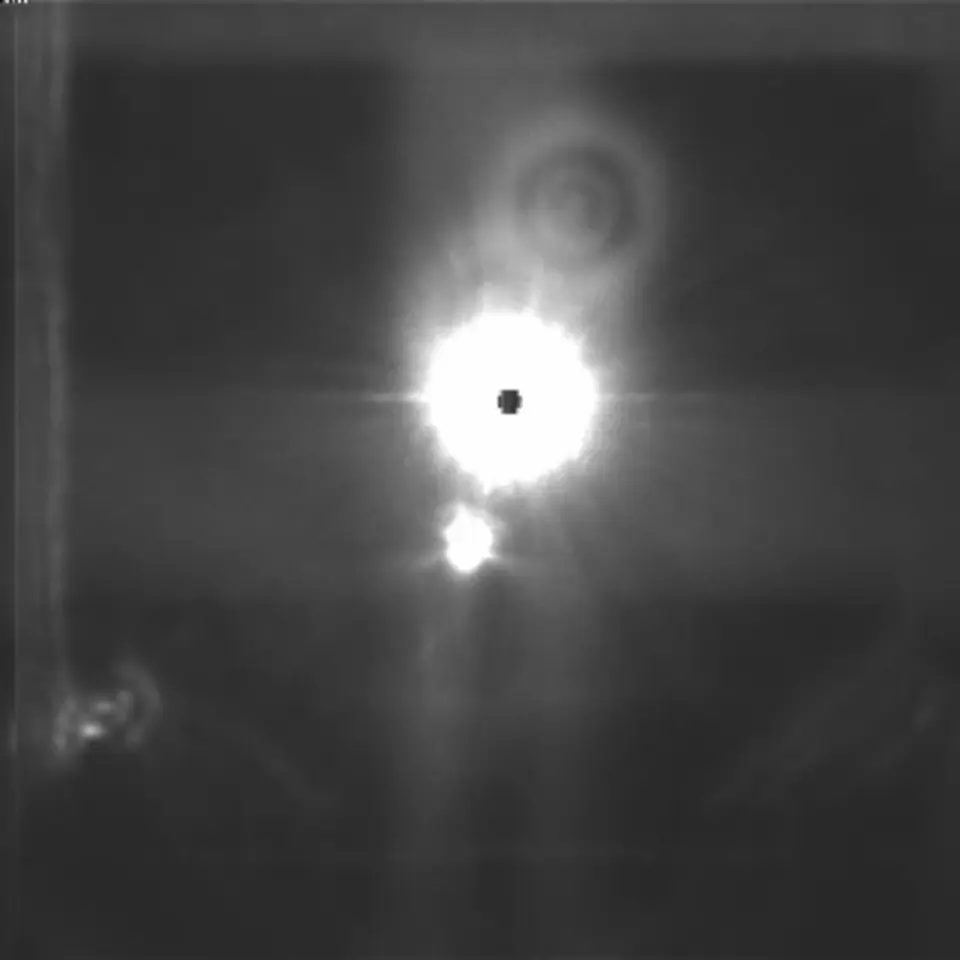
The Trisat-S nanosatellite, launched in September 2026, successfully captured an image of the Sun exhibiting the 'Black Sun' effect, where extreme brightness causes sensor pixels to appear dark. This visual artifact, rather than a failure, serves as a critical reference point for determining a spacecraft's attitude and orbit. The mission, led by the University of Maribor and SkyLabs, aims to develop miniaturized imaging technology for autonomous navigation in deep space. The satellite also tested advanced hibernation technologies and was launched by Isar Aerospace, marking the first European company to reach orbit with its own launch vehicle.
Key points
- The Trisat-S nanosatellite, a CubeSat launched in September 2026, captured an image of the Sun showing a black dot at its center due to the 'Black Sun' effect, where over-saturation of pixels in bright areas results in dark imagery.
- Principal investigator Iztok Kramberger of the University of Maribor explained that this effect is a useful visual feature for spacecraft to determine their attitude and orbit, serving as a reference alongside observations of Earth and the Moon.
- Trisat-S carries six miniature cameras to provide simultaneous observations from low Earth orbit, allowing for comparison with ground-based simulations to refine visual awareness models.
- The mission is a follow-up to Trisat-R, which operated in medium Earth orbit with two cameras, and includes testing of advanced spacecraft hibernation technologies for long-duration missions.
- The imaging technology was previously tested in CERN’s Charm facility to evaluate radiation protection mechanisms, ensuring sensor functionality under harsh space-like conditions.
- Trisat-S was launched on Isar Aerospace’s Spectrum launcher, making Isar the first European company to reach orbit with its own launch vehicle and complete ESA’s European Launcher Challenge.
Background
This development follows earlier discussions on the long-term evolution of the Sun, which may render Earth uninhabitable in a billion years, and unrelated cultural references to 'Black Sun' in music and media. The current focus is on technological applications of solar imaging for navigation rather than astronomical or cultural phenomena.
Why it matters
The success of the Trisat-S mission demonstrates a viable method for autonomous spacecraft navigation using miniaturized imaging technology. By leveraging the 'Black Sun' effect as a reference point, future missions can reduce reliance on traditional navigation systems, enabling more independent operations far from Earth. This advancement is crucial for long-duration missions and deep space exploration, where real-time communication with Earth is impractical.
What to watch
The mission team will continue to analyze the data from Trisat-S's six cameras to validate visual awareness models and refine hibernation technologies. Future missions may integrate these miniaturized imaging systems for autonomous navigation in deep space, building on the success of Trisat-S and Trisat-R.
Want the full story? Read the original reporting
Read on European Space Agency (ESA)