
Webb’s Deep Past: Early Galaxies Show Mature Structures and Unexpected Dust
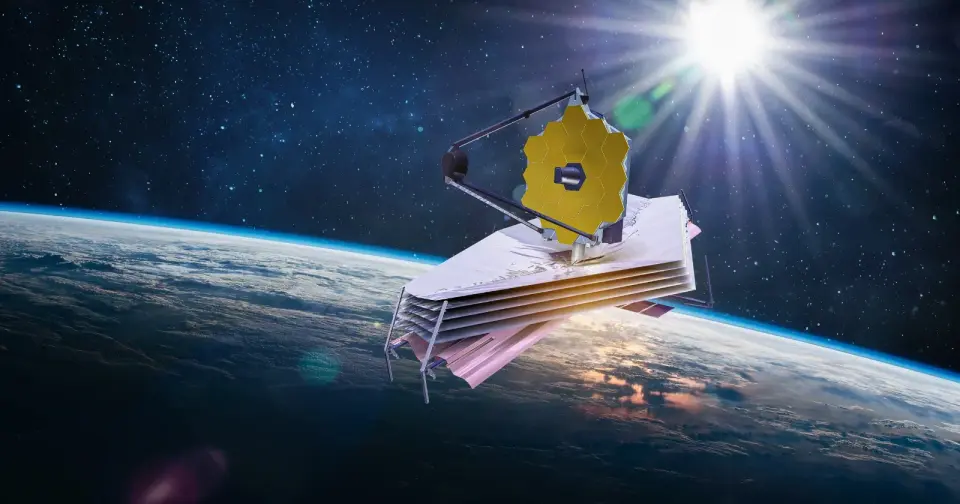
The James Webb Space Telescope (JWST) is revealing that the early universe contained galaxies far more mature and chemically complex than predicted. By observing light from over 13 billion years ago, JWST captures galaxies as they existed just hundreds of millions of years after the Big Bang. Recent findings indicate these ancient systems possessed advanced structures, such as nuclear disks and stellar bars, and produced dust earlier than models allowed. This challenges standard cosmological timelines, suggesting galaxy evolution occurred more rapidly in the cosmos's infancy.
Key points
- JWST’s infrared capability allows it to detect light from galaxies existing less than 300 million years after the Big Bang, acting as a time machine to the 'Cosmic Dawn' era.
- The galaxy MoM-z14, seen 13.5 billion years ago, is brighter and more chemically enriched than pre-Webb models predicted, with surveys finding over 100 times more bright galaxies at similar redshifts.
- In the nearby dwarf galaxy Sextans A, a proxy for early-universe conditions, JWST detected metallic iron and silicon carbide dust in stars with only 1-7% solar metallicity, contradicting models that predicted negligible dust production at such low metallicities.
- Astronomers identified a nuclear disk in the galaxy CEERS-4031, located 9 billion light-years away, showing that complex central structures and stellar bars existed just 4.5 billion years after the Big Bang.
- These discoveries suggest that star formation and galactic maturation happened faster than anticipated, potentially resolving the 'dust budget crisis' where early galaxies contained more dust than theoretical models could account for.
Background
Previous JWST findings, such as the 'Big Wheel' spiral galaxy and massive early black holes, already hinted that the early universe was more structured than expected. The current reports expand on this by providing specific evidence of rapid chemical evolution and structural complexity in galaxies from the first few hundred million years of cosmic history.
How outlets are covering it
Space Daily emphasizes the conceptual shift from viewing telescopes as magnifiers to time machines, highlighting the sheer distance and age of the light observed. The Times of India focuses on the 'maturity' of early galaxies, questioning if star formation began sooner or proceeded more efficiently than simulations predicted. Tech Times provides a technical deep-dive into the 'dust budget crisis,' detailing how JWST’s MIRI instrument identified iron dust in metal-poor environments, challenging the timeline for dust production. CPG Click Oil and Gas highlights the structural maturity of galaxies, specifically the discovery of nuclear disks and stellar bars in CEERS-4031, suggesting that galactic centers formed much earlier than traditional models allowed. While all sources agree that JWST is revealing an unexpectedly complex early universe, they differ in focus: Space Daily and The Times of India look at the broad implications for cosmology, while Tech Times and CPG Click focus on specific chemical and structural anomalies that require model revisions.
Why it matters
These findings force a re-evaluation of how galaxies formed and evolved in the first few hundred million years after the Big Bang. If galaxies were more mature and chemically active earlier than thought, it impacts our understanding of star formation rates, the origin of dust in the early universe, and the growth of supermassive black holes. This could lead to significant updates in cosmological models and simulations of the 'Cosmic Dawn' era.
What to watch
Astronomers plan to use JWST to observe more metal-poor galaxies, such as Sextans B and I Zw 18, to determine if the iron dust production seen in Sextans A is common or an outlier. Further studies of CEERS-4031 will track gas and star movement to understand how stellar bars feed galactic cores. These observations will help refine models of galaxy evolution and resolve the dust budget crisis.
- When the James Webb telescope peers into space, it sees not just far away but far back in time: its images catch galaxies as they were just a few hundred million years after the Big Bang, more than 13 billion years ago spacedaily.com
- The universe is 13.8 billion years old. Webb is finding galaxies that look like they've been quietly forming stars for billions of years inside a cosmos that was, at the time of observation, only a few hundred million years old spacedaily.com
- James Webb Space Telescope found surprisingly mature galaxies in the young universe, forcing scientists to rethink how the first stars formed The Times of India
- JWST Catches Metal-Poor Galaxy Forging Iron Dust Earlier Than Models Allow Tech Times
- James Webb observes the birth of the heart of a galaxy 9 billion light-years away and reveals a structure that emerged much earlier than expected. CPG Click Oil and Gas
Want the full story? Read the original reporting
Read on spacedaily.com