
Reactive CO2 Capture Could Bridge the Gap Between Industrial Emissions and Green Chemicals
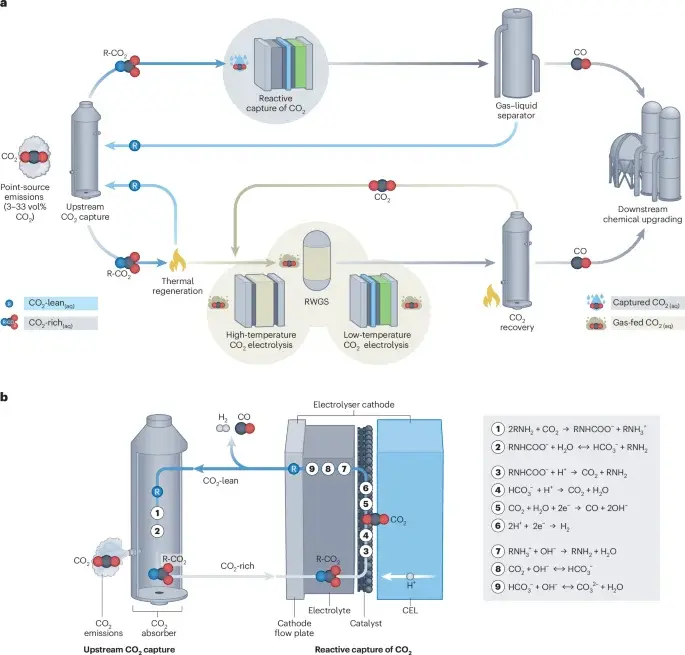
A new perspective in Nature Energy argues that reactive capture of CO2 (RCC) offers a viable path for early industrial adoption by integrating carbon capture directly with electrolysis. Unlike traditional methods that separate capture and conversion, RCC feeds CO2-rich liquids directly into electrolyzers, bypassing energy-intensive thermal regeneration. This approach tolerates industrial impurities and produces high-purity gaseous outputs, potentially making it cost-competitive with other electrified routes if stability and scale barriers are overcome.
Key points
- RCC integrates CO2 capture and conversion by feeding liquid capture solutions directly into electrolyzers, eliminating the need for thermal regeneration steps.
- The method offers greater tolerance to industrial impurities compared to gas-fed electrolyzers, making it suitable for direct integration with industrial CO2 feedstocks.
- Current RCC electrolysers lag behind gas-fed counterparts in development, but the authors argue they could become viable for early adoption if specific engineering hurdles are addressed.
- Key technical challenges include engineering solvent-tolerant cathodes, formulating electrolysis-compatible capture fluids, and improving the efficiency, scalability, and durability of bipolar membranes.
- The authors provide performance targets necessary for RCC to become cost-competitive with alternative conversion technologies, emphasizing the need for a fully electrified chemical synthesis process.
Background
This perspective builds on prior research in electrochemical CO2 conversion, including studies on coupling electrochemical conversion with capture (2021) and the use of amine-based capture solutions as electrolytes (2021). It also references recent advancements in tandem amine scrubbing and CO2 electrolysis (2025) and the economic viability of integrated capture and conversion (2024). The article positions RCC as a potential bridge technology for the energy transition, supporting the production of low-carbon chemicals and fuels while integrating with current energy infrastructure.
Why it matters
RCC could accelerate the deployment of electrified CO2 capture and conversion technologies by simplifying process integration and reducing energy losses associated with thermal regeneration. By addressing stability and scale barriers, RCC may enable a fully electrified chemical synthesis process that is more compatible with existing industrial infrastructure, potentially making low-carbon chemicals and fuels more accessible and cost-effective in the near term.
What to watch
Future progress will depend on advancements in solvent-tolerant cathodes, electrolysis-compatible capture fluids, and bipolar membrane technology. Researchers and industry stakeholders will need to meet the performance targets outlined in the perspective to ensure RCC becomes cost-competitive with alternative conversion technologies. Further studies on scalability and durability will be critical for transitioning from laboratory-scale demonstrations to industrial applications.
Want the full story? Read the original reporting
Read on Nature