
Brazilian Fossil Discovery Suggests Dinosaur Ancestors Persisted for 11 Million Years Before Major Evolutionary Shifts
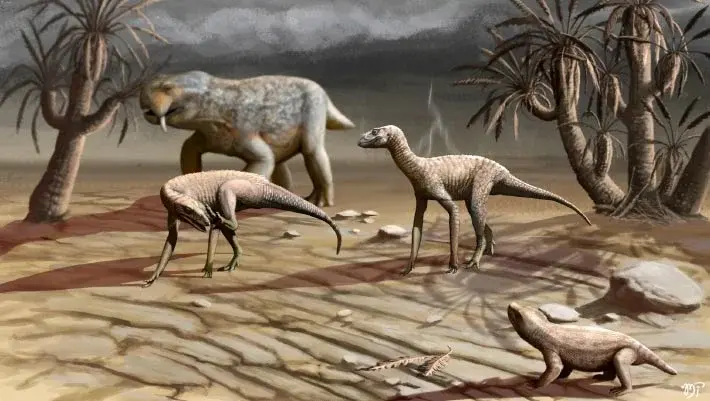
A new species of silesaurid, Itaguyra occulta, identified from Brazilian fossils, fills a significant gap in the fossil record, suggesting these early dinosaur relatives persisted for 11 million years through major ecological changes.
Key points
- Two reddish-brown bones previously labeled 'indeterminate' in a Brazilian fossil collection have been identified as belonging to a new silesaurid species, Itaguyra occulta.
- The fossils were found at the Schoenstatt Sanctuary site in Santa Cruz do Sul, Rio Grande do Sul, within the Santa Cruz Sequence, which has a maximum depositional age of about 236 million years (Early Carnian).
- The discovery fills an 11-million-year gap in the fossil record for silesaurids in southern Brazil, showing their continuous presence from the Ladinian to the Early Norian.
- Silesaurids are a puzzling group of Triassic animals closely related to dinosaurs, with some paleontologists considering them the sister group to dinosaurs and others seeing them as early ornithischians.
- The persistence of silesaurids through major ecological changes, including the disappearance of tusked dicynodonts and the rise of rhynchosaurs, indicates a high capacity for adaptation.
- The phylogenetic analysis places Itaguyra occulta among the earliest ornithischians, suggesting that dinosaurs may have originated earlier than the end of the Ladinian (241 million years ago).
Background
Recent discoveries in paleontology, such as the new sauropodomorph Nyana rooiwalensis from South Africa and the armored dinosaur species from Utah, highlight ongoing efforts to fill gaps in the fossil record and understand early dinosaur evolution. These findings, along with the new silesaurid species, contribute to a broader understanding of how early dinosaur lineages evolved and adapted to changing environments.
Why it matters
The discovery of Itaguyra occulta provides crucial evidence for the adaptive capabilities of silesaurids and their role in early ecosystems. It challenges existing timelines for the origin of dinosaurs and highlights the importance of continuous fossil records in understanding evolutionary history. This finding may reshape our understanding of how early dinosaur relatives coexisted with other dominant land animals before the rise of 'typical' dinosaurs.
What to watch
Further research and fossil discoveries will be needed to confirm the phylogenetic placement of silesaurids and their role in the early diversification of dinosaurs. Additional studies may explore the ecological adaptations of silesaurids and their interactions with other Triassic animals, providing deeper insights into the evolutionary history of dinosaurs.
Want the full story? Read the original reporting
Read on Sci.News