
BepiColombo reaches Mercury despite thruster glitch, setting stage for dual-probe science campaign
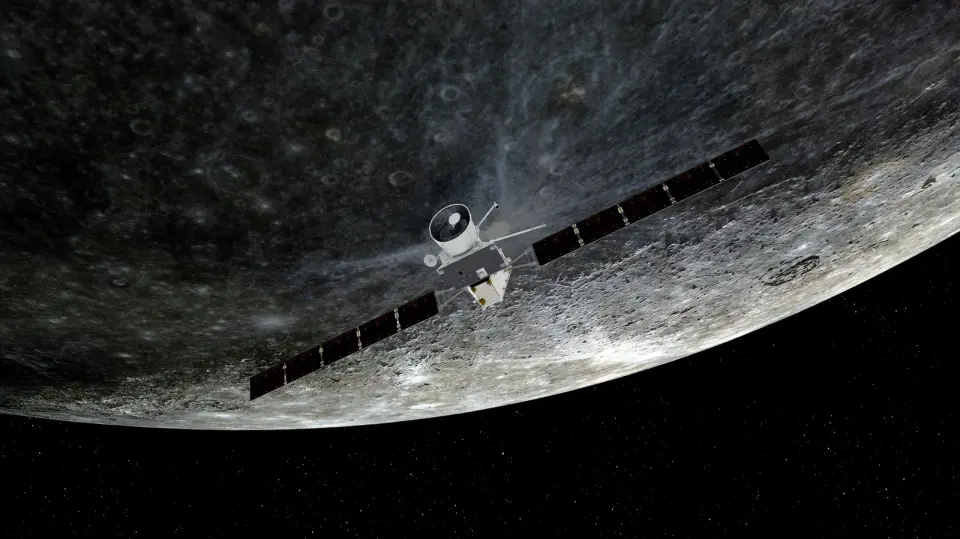
The joint European-Japanese BepiColombo mission successfully entered orbit around Mercury on November 21, 2026, after an eight-year journey covering approximately 6 billion miles. Although a software glitch caused a premature thruster shutdown during the orbital insertion burn, the spacecraft is safe and will separate into two probes in December to begin science operations in April 2027.
Key points
- BepiColombo became the second spacecraft in history to orbit Mercury, following Mariner 10 and MESSENGER.
- A software issue caused a shorter-than-planned thruster burn, potentially leaving the spacecraft in a higher, less stable orbit, but ESA confirmed the mission is safe.
- The spacecraft will separate into the European Mercury Planetary Orbiter (MPO) and the Japanese Mercury Magnetospheric Orbiter (MIO) in December 2026.
- Science operations are scheduled to begin in April 2027, with the two probes studying Mercury's magnetic field, surface, and interior structure from different polar orbits.
- The mission aims to resolve long-standing mysteries about Mercury's unusually large iron core, its magnetic field, and its formation history.
Background
Previous archive coverage confirms that BepiColombo's arrival on November 21, 2026, marked the first orbital visit to Mercury in over a decade. The mission, which launched in October 2018, is a joint effort between the European Space Agency (ESA) and Japan's space agency JAXA. The two orbiters, MPO and MIO, are designed to provide comprehensive data on Mercury's interior, surface, and space environment, addressing questions that previous missions like Mariner 10 and MESSENGER could not fully answer.
How outlets are covering it
SpaceNews highlights the thruster glitch as a significant issue that could affect the mission's stability, while The Guardian and National Geographic emphasize the scientific importance of the mission and the excitement surrounding its arrival. The Guardian notes the complexity of reaching Mercury due to its proximity to the sun, while National Geographic focuses on the unresolved mysteries of Mercury's formation and the potential for new insights from BepiColombo's data. All sources agree on the timeline for the separation of the two orbiters and the start of science operations in April 2027.
Why it matters
BepiColombo's arrival at Mercury is a landmark achievement in planetary science, offering the first opportunity to study the planet with two spacecraft simultaneously. The mission's data could resolve long-standing debates about Mercury's formation, its magnetic field, and its dense core, providing insights that may inform our understanding of planet formation in other solar systems. The thruster glitch, while concerning, does not appear to jeopardize the mission's primary objectives, and the spacecraft is expected to proceed with its planned science campaign.
What to watch
The two orbiters will separate in December 2026 and adjust their orbits over the following months. Science operations are scheduled to begin in April 2027, with the MPO mapping Mercury's surface and composition, and the MIO measuring its magnetic field and exosphere. The mission is expected to continue for about three years before the spacecraft run out of fuel and crash into Mercury's surface.
- Thruster glitch clouds BepiColombo arrival at Mercury SpaceNews
- BepiColombo safely in Mercury orbit despite unexpected challenge ESA
- Spacecraft reaches Mercury on second-ever mission to enter its orbit The Guardian
- A New Mission Arrives at Mercury, the Solar System's Most Mysterious Planet National Geographic
- Mercury spacecraft BepiColombo 'on track' despite glitch, ESA says Reuters
Want the full story? Read the original reporting
Read on SpaceNews