
Balog’s 2015 Greenland Footage Remains the Definitive Visual Record of Rapid Glacial Collapse
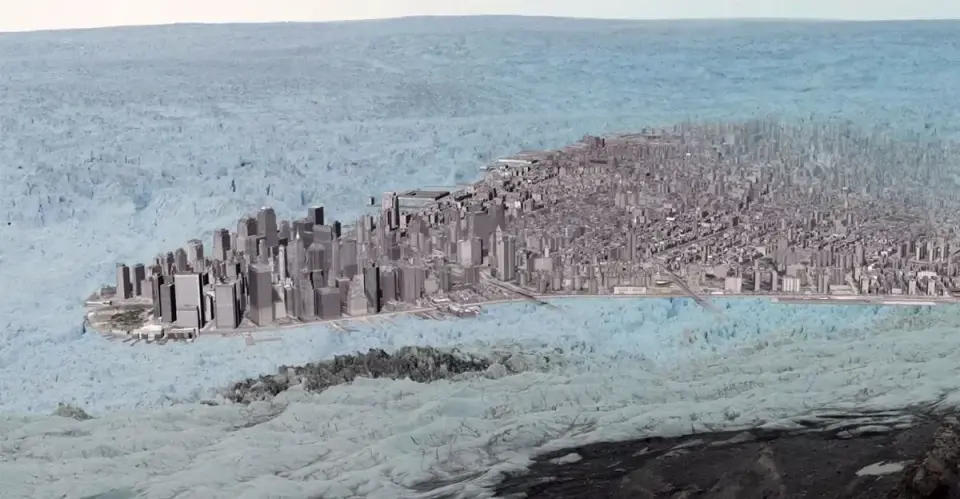
Photographer James Balog’s 2015 time-lapse footage of a massive glacier calving event in Greenland remains the most significant visual proof of rapid climate change. The event, which captured a chunk of ice equivalent in size to lower Manhattan but with greater vertical volume, occurred during the Extreme Ice Survey. Balog, initially skeptical of anthropogenic climate change, converted to a believer after observing tangible evidence in Arctic ice cores in 2005. The survey concluded in 2022, archiving over 1.5 million images at the National Snow and Ice Data Center, and was documented in the documentary 'Chasing Ice' and its follow-up 'Chasing Time'.
Key points
- Balog’s team filmed the largest glacier calving event ever recorded, lasting 75 minutes, where a massive ice section detached and slid into the ocean.
- The detached ice mass was compared to the size of lower Manhattan but with a vertical volume two to three times taller, highlighting the scale of the loss.
- Balog was a climate skeptic until 2005, when a National Geographic expedition to the Arctic provided tangible physical evidence of environmental shifts beyond natural variation.
- The Extreme Ice Survey ran for 15 years, concluding in 2022, and archived over 1.5 million images at the National Snow and Ice Data Center.
- The project was featured in the 2012 documentary 'Chasing Ice' and the follow-up 'Chasing Time,' which premiered on PBS’s POV series.
Background
This story revisits a 2015 event that serves as a critical baseline for understanding glacial retreat. While recent archive entries focus on new climate crises, such as the Chicxulub asteroid impact analysis or Amazon’s Texas AI data center emissions, Balog’s work provides a long-term photographic record of observable changes. The archive notes that more Arctic landmass melted in the last 20 years than in the previous 10,000, a trend Balog’s survey documented through continuous monitoring. His shift from skepticism to advocacy illustrates the impact of direct observation on scientific consensus, contrasting with the abstract projections he initially dismissed.
Why it matters
The footage serves as an undeniable, real-time record of climate change, moving the issue from abstract future projections to immediate, observable reality. It highlights the accelerating pace of glacial loss, with recent data indicating that Arctic melting rates in the last two decades exceed those of the previous ten millennia. Balog’s work provides a historical benchmark for future generations, documenting the state of the planet’s ice sheets during a period of significant environmental transition. The archived images and documentaries continue to serve as educational tools, emphasizing the tangible consequences of global warming and the importance of long-term scientific monitoring.
What to watch
The Extreme Ice Survey has concluded, but the archived data remains a critical resource for climate scientists and the public. Balog’s legacy continues through the National Snow and Ice Data Center, where the 1.5 million images are preserved. Future research may utilize this extensive visual record to model glacial behavior and assess the long-term impacts of climate change on global sea levels and ecosystems. The documentaries 'Chasing Ice' and 'Chasing Time' remain available for public viewing, serving as primary sources for understanding the human and environmental dimensions of the crisis.
Want the full story? Read the original reporting
Read on upworthy.com