
Astronomers Reconstruct Seven-Year Stellar Merger in Andromeda Galaxy
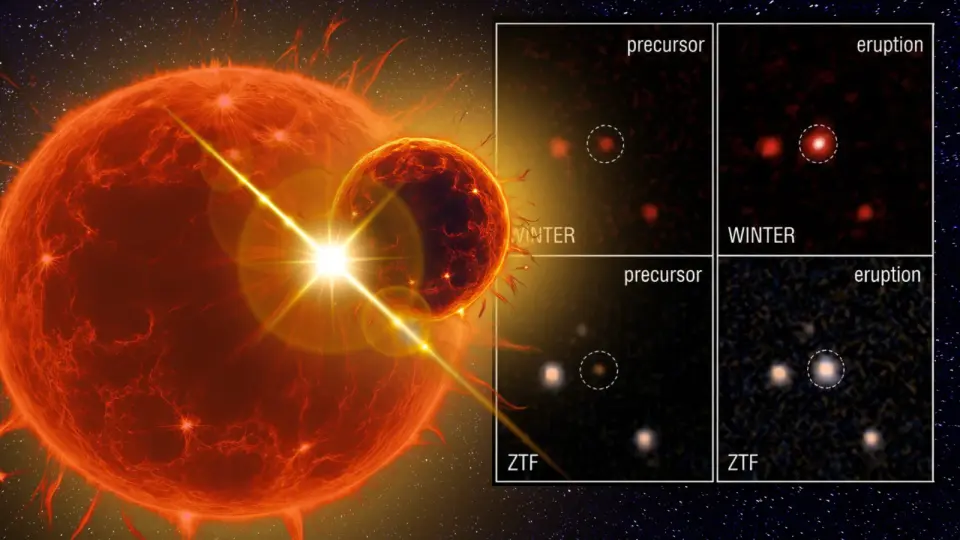
A team led by Viraj Karambelkar at Columbia University has published a peer-reviewed reconstruction of AT2025abao, a rare stellar merger in the Andromeda galaxy. The event involved a 7-solar-mass red giant, nicknamed 'Big Bao,' engulfing a 0.7-solar-mass companion, 'Little Bao.' After a seven-year brightening phase, the system erupted on October 17, 2025. The study, published in Nature on November 18, 2026, provides the first direct observational evidence of common-envelope evolution, where a companion star spirals through a giant's convective envelope before merging.
Key points
- The merger occurred in the Andromeda galaxy, approximately 2.5 million light-years from Earth.
- The primary star, Big Bao, is seven times the mass of the Sun and 18,000 times brighter.
- The companion star, Little Bao, had a mass of roughly 70% of the Sun's mass.
- The eruption ejected material at speeds of up to 1.8 million miles per hour (800 km/s).
- The event was observed by NEOWISE, SPHEREx, JWST, ZTF, and WINTER instruments.
Background
Our archive from late October and early November 2026 noted the initial detection of AT2025abao as a 'first real-time view' of a giant star swallowing its companion. Those earlier reports highlighted the October 2025 eruption and the subsequent confirmation by the James Webb Space Telescope. The current news cycle focuses on the detailed reconstruction of the seven-year precursor phase and the publication of the findings in Nature.
How outlets are covering it
Space.com and Gizmodo emphasize the dramatic nature of the event, using the 'Bao bun' metaphor to describe the red giant devouring its companion. The Watchers provides a more technical perspective, focusing on the 'common-envelope efficiency parameter' and the frictional drag that dissipated orbital energy. While Space.com notes the companion spiraled into the core in fewer than 10 orbits, The Watchers highlights the seven-year inspiral through the convective envelope. All sources agree on the core facts: the merger, the eruption date, and the involvement of multiple telescopes.
Why it matters
This event provides the first direct observational evidence of common-envelope evolution, a long-theorized phase of binary-star evolution. It offers empirical constraints on how orbital energy is dissipated and how stellar envelopes are unbound, which is crucial for understanding the fate of binary star systems and the formation of compact binaries or mergers.
What to watch
Astronomers plan to continue monitoring the remnant of AT2025abao to test how the post-eruption object evolves. Future wide-field optical and infrared surveys are expected to detect more stellar systems before eruption, allowing researchers to determine if the behavior observed in AT2025abao is common or a rare evolutionary pathway.
- Astronomers watch a red giant star greedily devour a stellar 'Bao bun' before erupting: 'We couldn't quite believe our luck' Space
- Astronomers Watch a Giant Dying Star Devour Its Smaller Companion Gizmodo
- Astronomers trace seven-year stellar inspiral inside a giant star in Andromeda The Watchers - Watching the world evolve and transform
Want the full story? Read the original reporting
Read on Space