
Cerebellar granule cells rotate neural trajectories to distinguish overlapping tasks
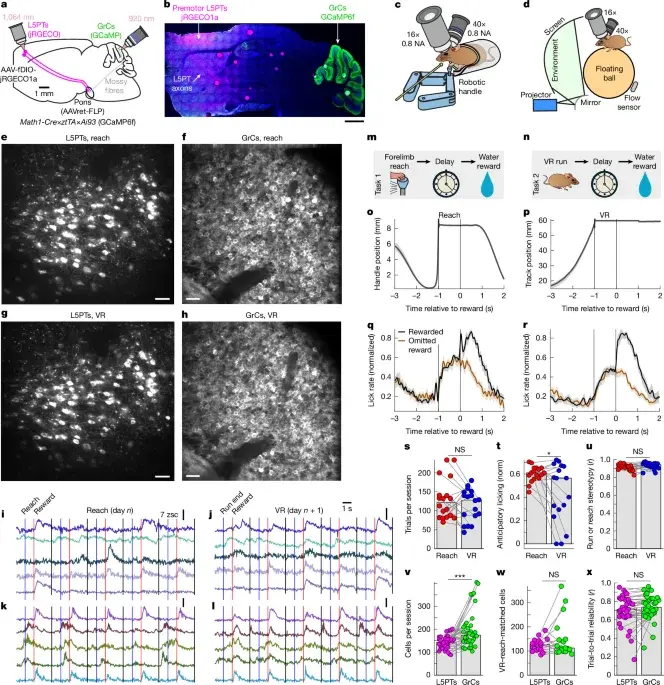
A new study in Nature reveals how the brain balances generalization and context separation during multi-task learning. Researchers found that while the cortex maintains stable, low-dimensional neural patterns to generalize across similar skills, cerebellar granule cells actively reorient these patterns to distinguish between specific contexts. This division of labor allows animals to learn multiple tasks efficiently without confusing them.
Key points
- Simultaneous imaging of premotor cortex and cerebellar granule cells in mice revealed distinct roles in learning two skills with shared temporal structures.
- Cortical layer 5 pyramidal tract neurons generalized activity patterns across tasks, maintaining low-dimensional dynamics to facilitate smooth learning.
- Cerebellar granule cells did not simply expand neural representations but instead 'rotated' their low-dimensional trajectories to separate the two contexts.
- This trajectory reorientation preserved the underlying cortical geometry while enabling the brain to distinguish between the two tasks, with divergence increasing as mice became experts.
- The findings suggest a fundamental architectural division of labor: the cortex provides invariant dynamic primitives, while the cerebellum reconfigures them for context-specific output.
Background
Previous research established that neural manifolds in the neocortex support generalization by constraining activity to task-relevant axes, while cerebellar granule cells were thought to facilitate context separation through high-dimensional expansion. This study builds on earlier work regarding cortico-cerebellar coupling and pattern separation, providing direct evidence for how these systems interact during parallel learning of distinct but related skills.
Why it matters
This research clarifies a long-standing debate in neuroscience about how the brain balances generalization with specificity. By demonstrating that cerebellar granule cells reorient rather than expand neural trajectories, the study offers a new mechanistic explanation for efficient multi-task learning. This insight could inform the development of artificial neural networks and improve our understanding of motor learning disorders, highlighting the cerebellum's critical role in organizing complex behavioral repertoires.
What to watch
Future research may explore how this trajectory reorientation mechanism applies to other brain regions or more complex cognitive tasks. Additionally, investigating the specific synaptic mechanisms underlying this coherent remapping could reveal new targets for therapeutic interventions in conditions involving impaired motor learning or context confusion.
Want the full story? Read the original reporting
Read on Nature