
Rubin Observatory Unveils Hidden Dwarf Planet Candidate 2026 ED138
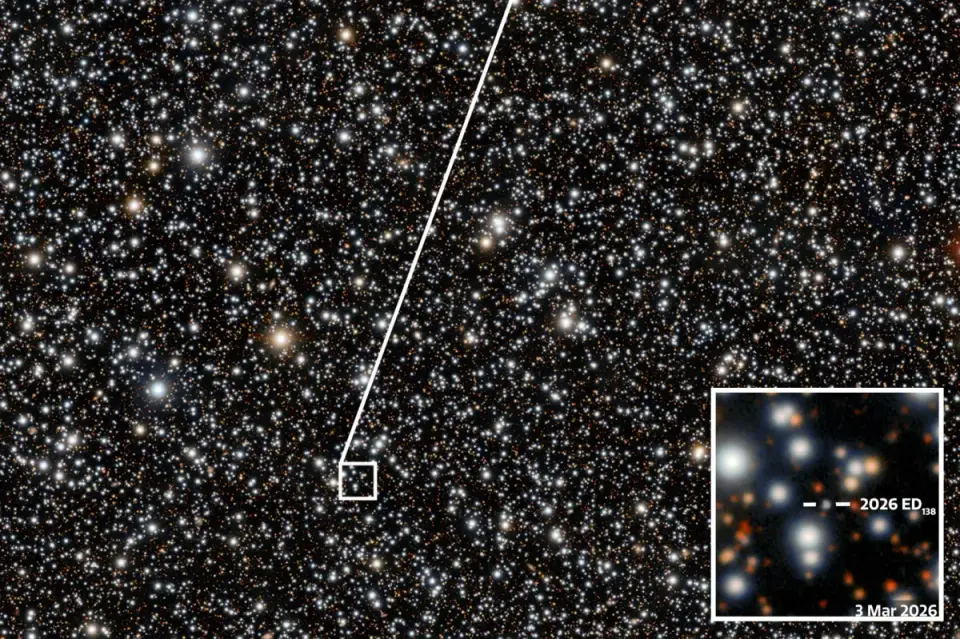
Astronomers have identified a new dwarf planet candidate, 2026 ED138, orbiting beyond Pluto. Discovered using data from the Vera C. Rubin Observatory in Chile, the object is estimated to be between 600 and 1,500 kilometers in diameter. If confirmed, it would join the five recognized dwarf planets: Ceres, Pluto, Haumea, Makemake, and Eris. The discovery was made by Matthew Holman and Mario Jurić, who found archival observations dating back to 2016. The object’s large size and bright appearance suggest it may be spherical, a key criterion for dwarf planet status, though infrared measurements are needed for final confirmation.
Key points
- Matthew Holman of the Harvard-Smithsonian Center for Astrophysics identified the object on October 13, 2026, while analyzing data from the Vera C. Rubin Observatory.
- The object, designated 2026 ED138, has an estimated diameter of 600 to 1,500 kilometers, potentially rivaling the size of dwarf planets like Makemake and Haumea.
- Rubin Observatory detected the object 30 times across 20 nights between March 4 and July 11, 2026, with earlier detections by the Dark Energy Camera dating back to 2016.
- The object orbits the Sun at a distance of approximately 46 astronomical units, with an orbital period of about 281 years and an inclination of 24.5 degrees.
- Confirmation of its dwarf planet status requires further infrared observations to determine its physical size and shape, as current data only reflects sunlight.
Background
The Vera C. Rubin Observatory, located on Cerro Pachón in Chile, began its main survey, the Legacy Survey of Space and Time, in June 2026. It features the largest digital camera ever built for astronomy, capable of imaging the entire southern sky every three days. Previous surveys had missed 2026 ED138 due to its high orbital inclination and faintness, but Rubin’s repeated scanning has made it possible to detect such objects.
How outlets are covering it
All four sources agree on the discovery of 2026 ED138 and its potential status as a dwarf planet. The New York Post emphasizes the object’s rarity and the significance of Rubin’s ability to detect faint, slow-moving bodies. CNN highlights the collaborative effort between Holman and Mario Jurić, and the need for further observations to confirm the object’s size. CBC focuses on the technical aspects of the discovery, including the use of ALMA for infrared measurements. Space.com notes the object’s brightness and the possibility of future discoveries by Rubin. There is no significant disagreement among the sources, but they emphasize different aspects of the discovery and its implications.
Why it matters
The discovery of 2026 ED138 underscores the potential of the Vera C. Rubin Observatory to uncover hidden objects in the solar system. If confirmed as a dwarf planet, it would expand our understanding of the Kuiper Belt and the formation of the solar system. The object’s large size and bright appearance suggest it may have a spherical shape, a key criterion for dwarf planet status. Further observations will help determine its physical characteristics and potentially reveal more about the outer solar system.
What to watch
Astronomers plan to use infrared observations, potentially from the James Webb Space Telescope or ALMA, to determine the physical size and shape of 2026 ED138. If confirmed as a dwarf planet, the object will be assigned a permanent number and name. The Vera C. Rubin Observatory will continue its survey, potentially uncovering more objects like 2026 ED138 in the coming years.
- Giant new dwarf planet discovered in our own solar system — hiding in plain sight New York Post
- ‘It’s big’: Astronomers make startling discovery of a possible dwarf planet beyond Pluto CNN
- New Vera C. Rubin telescope spots possible new dwarf planet beyond Pluto CBC
- Astronomers found a mysterious object beyond Neptune, and it could be a new dwarf planet Space
- Astronomers may have just discovered our solar system’s sixth dwarf planet Scientific American
Want the full story? Read the original reporting
Read on New York Post