
Brazilian Fossil Shows Early Dinosaurs Outlasted Ecosystem Shifts
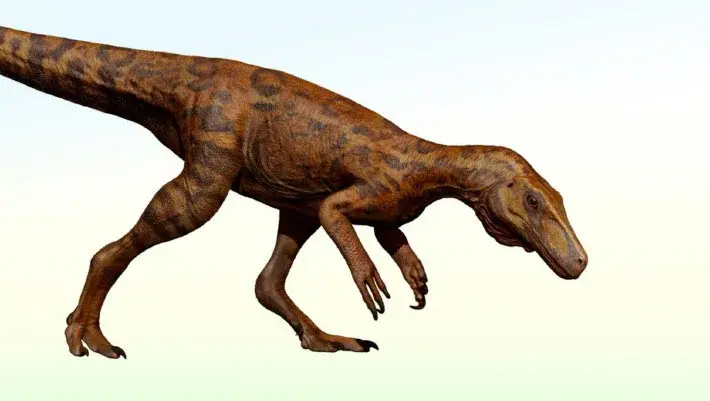
A single hip bone found in southern Brazil proves that herrerasaurids, among the first large meat-eating dinosaurs, survived a major shift in their ecosystem. Previously, scientists believed these predators died out when their primary prey, rhynchosaurs, declined. This new fossil, dated to the Late Triassic period, shows they persisted even as mammal-like cynodonts became more common, suggesting they were adaptable top predators rather than ecologically specialized hunters.
Key points
- A fragment of a herrerasaurid pubis (hip bone), catalogued as CAPPA/UFSM 0539, was discovered near Agudo, Rio Grande do Sul, Brazil.
- The fossil comes from the Santa Maria Formation, a rock layer previously thought to lack herrerasaurids because it is dominated by Exaeretodon, a pig-sized cynodont.
- Herrerasaurids lived roughly 230 million years ago during the Carnian age and were bipedal hunters with serrated teeth and large claws.
- Previous evidence suggested herrerasaurids went extinct when rhynchosaurs declined, but this find indicates they survived the transition.
- The study, published in The Science of Nature on October 19, 2026, suggests herrerasaurids were adaptable enough to thrive in changing environments.
- Dr. Rodrigo Temp Müller notes that absolute dating of the Brazilian strata is still needed to confirm if this is the youngest known herrerasaurid record.
Background
This discovery adds to a growing body of evidence regarding dinosaur evolution and survival strategies. Recent findings, such as the 66-million-year-old feather in dinosaur dung, have highlighted how specific adaptations allowed certain lineages to survive mass extinction events. Similarly, new fossils from China, like Norellraptor barsboldi, have challenged previous assumptions about the evolution of flight, suggesting independent development rather than a shared ancestral trait. The herrerasaurid find in Brazil parallels these themes by demonstrating that early dinosaurs possessed greater ecological flexibility than previously assumed, allowing them to persist through significant faunal changes in the Late Triassic.
Why it matters
This finding reshapes our understanding of early dinosaur resilience. It suggests that herrerasaurids were not narrowly specialized predators dependent on a single prey type, but rather flexible hunters capable of adapting to new ecological niches. This challenges the hypothesis that they went extinct due to the decline of rhynchosaurs and implies they may have been the dominant predators in their environment even as mammal-like ancestors became more abundant. Understanding this adaptability helps scientists better model how early dinosaurs responded to environmental pressures and competition.
What to watch
Researchers must conduct absolute dating of the Brazilian rock layers to establish a precise chronological framework. This will determine if the CAPPA/UFSM 0539 specimen is indeed the youngest herrerasaurid known. Further excavation in the Santa Maria Formation may yield more fossils that clarify the ecological role of herrerasaurids during the transition from rhynchosaur-dominated to cynodont-dominated faunas.
Want the full story? Read the original reporting
Read on Sci.News