
Weizmann-led team publishes study on faintest recorded supernova
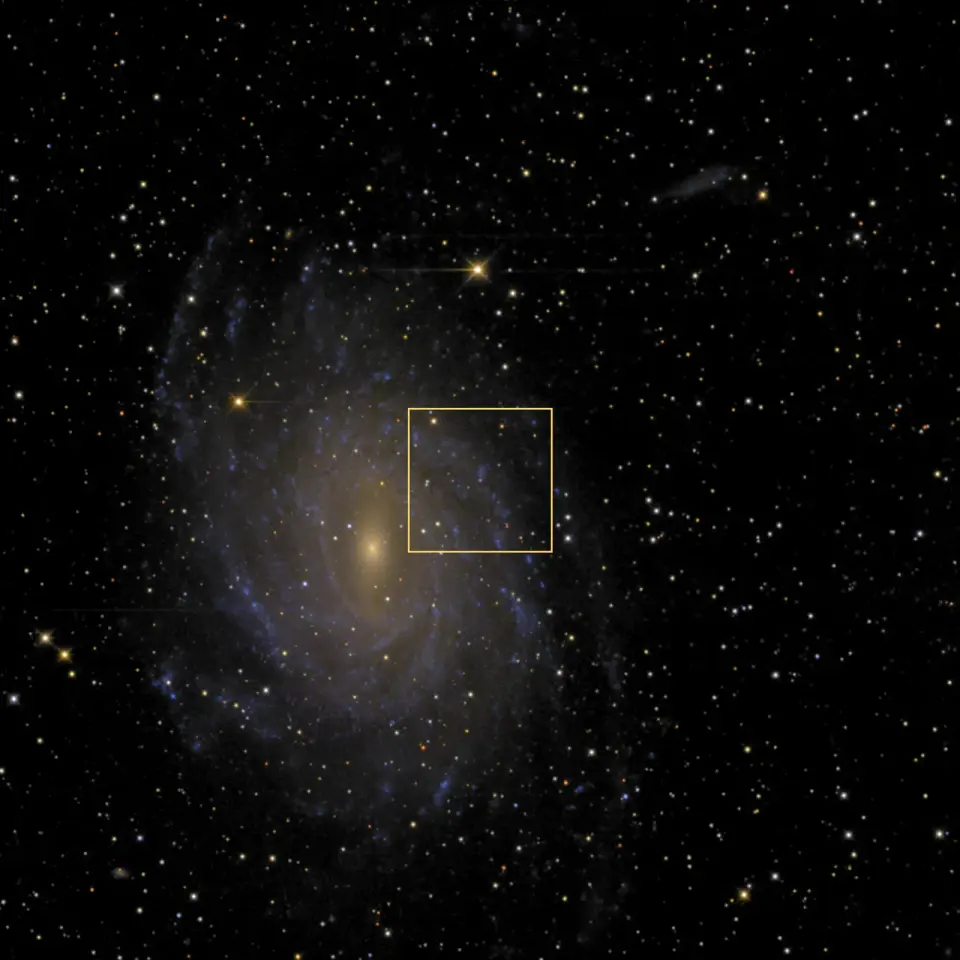
An international team led by the Weizmann Institute of Science published a study in Nature Astronomy on November 26, 2026, detailing the discovery of SN 2024vjm, a stellar explosion in the galaxy NGC 6744 located 30 million light-years away. The event, detected by the BlackGEM telescope array in Chile, is considered a candidate for the faintest supernova ever recorded. The research challenges the Phillips relation, a 30-year-old astrophysical rule, by showing that this faint explosion faded more slowly than expected due to its weak energy output and dense, slowly expanding ejecta.
Key points
- The supernova SN 2024vjm was detected in September 2024 by the BlackGEM telescope in Chile's Atacama Desert and is located in the galaxy NGC 6744, approximately 30 million light-years from Earth.
- The explosion is classified as a Type Iax supernova, a subclass of thermonuclear white dwarf explosions, and is roughly 400 times fainter than standard Type Ia supernovae at peak brightness.
- Pre-explosion images from the Euclid space telescope, taken 11 months prior, showed no bright star at the explosion site, suggesting the progenitor was a faint binary system, possibly involving a white dwarf and a dim companion or two white dwarfs.
- The supernova defied the Phillips relation, which predicts that fainter supernovae fade faster; instead, SN 2024vjm continued to shine for over 70 days because its ejecta expanded slowly and remained dense, trapping radioactive nickel radiation.
- The study, led by Erez Zimmerman and Avishay Gal-Yam of the Weizmann Institute, utilized data from BlackGEM, Euclid, the James Webb Space Telescope, and the Very Large Telescope to analyze the event's spectrum and brightness.
Background
The Weizmann Institute of Science has previously been involved in high-profile scientific discoveries, including a 2026 study on a blood test for early breast cancer detection. In the field of astrophysics, the discovery of SN 2024vjm builds on earlier findings regarding Type Iax supernovae, such as SN 2012Z, which had a visible progenitor star, and SN 2008ha, another faint event. The current study provides new insights into the progenitor systems of faint supernovae, which differ from the bright stars typically associated with more energetic explosions.
How outlets are covering it
The Times of Israel emphasized the potential for the research to develop new software and technologies for space observation, highlighting the practical applications of the findings. Nature, the journal publishing the study, focused on the scientific implications for the progenitor system of Type Iax supernovae, noting that the faintness of the progenitor challenges existing models. Martin Cid Magazine highlighted the reversal of the Phillips relation, a key cosmological tool, and the specific brightness limits that ruled out massive stars. The IEEC, a participating institution, stressed the collaborative nature of the discovery and the role of ground-based and space-based telescopes in uncovering the secrets of exploding stars.
Why it matters
The discovery of SN 2024vjm challenges long-held assumptions about the behavior of dying stars and the physics governing supernova brightness and fading. It provides evidence that faint supernovae can originate from dim binary systems rather than bright stars, and it reveals that the Phillips relation, a critical tool for measuring cosmic distances, may not apply to the faintest events. This finding could lead to new methods for observing and understanding stellar explosions, potentially improving our knowledge of the universe's expansion and the origins of chemical elements.
What to watch
The research team expects future surveys, such as the Vera C. Rubin Observatory's Legacy Survey of Space and Time, combined with deep imaging from Euclid and the Nancy Grace Roman Space Telescope, to detect more faint Type Iax supernovae. Deep infrared observations with the James Webb Space Telescope may also help identify the surviving remnants and dust from these explosions, further refining our understanding of stellar evolution.
- Stellar discovery: Israeli researchers may have found faintest supernova ever recorded The Times of Israel
- A faint progenitor system for the faint Iax supernova 2024vjm Nature
- A supernova 400 times fainter than usual fades slowly, reversing a cosmic-ruler rule Martin Cid Magazine
- The faintest supernova ever observed refused to fade due to its weak explosion Institut d'Estudis Espacials de Catalunya - IEEC
- Possibly Faintest Supernova Trapped Radiation 70 Days; Euclid Image Points to White Dwarf Tech Times
Want the full story? Read the original reporting
Read on The Times of Israel