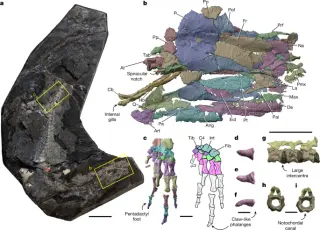
Scientists scanned a skin-preserved 289-million-year-old Captorhinus aguti fossil from Oklahoma with neutron CT, revealing the oldest known rib-based breathing system in amniotes and offering key insight into how early land-dwelling vertebrates evolved more efficient respiration.
A fossil long hailed as the oldest octopus, Pohlsepia mazonensis from Mazon Creek (~311–306 million years ago), has been re-examined with advanced imaging. Using synchrotron X-ray, micro-CT, SEM, and multispectral imaging, researchers found no octopus features (no eight-arm anatomy, no internal shell, no ink sac, no hooks) and no ocular pigments. They identified a preserved radula and dental pattern that match nautiloids, revealing it died, decomposed, and was flattened into mud, preserving soft tissue as two-dimensional stains. This makes Pohlsepia the oldest confirmed nautiloid soft-tissue fossil in the Paleozoic, and the study suggests other Mazon Creek fossils could yield similar revelations.
Researchers analyzed a 252–250 million-year-old Lystrosaurus fossil egg found in South Africa and, using synchrotron imaging at the ESRF, revealed a curled embryo whose jaw bones suggest it was still in an egg. This proves therapsids (the precursor to mammals) laid eggs (oviparous) rather than giving live birth, offering clues about embryo development, egg size, and survival strategies after the Great Dying. The large, leathery eggs likely reduced desiccation and supported precocial hatchlings, informing our understanding of early mammalian reproduction and the evolution of lactation.
A 300-million-year-old fossil once hailed as the world’s oldest octopus has been reclassified as a nautiloid after new analyses, including synchrotron imaging and detailed geochemistry. The researchers found a radula with many rows of teeth inconsistent with octopuses, explaining why the fossil looked octopus-like as it decomposed. Discovered at the Mazon Creek site near Chicago, Pohlsepia mazonensis’ true identity underscores how advanced technologies are reshaping paleontology by revealing hidden anatomy that old methods missed.
A 250-million-year-old Lystrosaurus fossil preserves a soft-shelled egg and a tiny embryo, providing the first direct evidence that mammal ancestors laid eggs; synchrotron X-ray imaging revealed an unfused jaw and an embryo that likely died inside the egg, suggesting large yolk-rich eggs and precocial hatchlings aided survival after the End-Permian extinction and reshaped ideas about mammalian origins.
Harvard researchers re-examined a Utah fossil, naming Megachelicerax cousteaui as the oldest chelicerate at about 500 million years old, roughly 20 million years earlier than previously known, with distinctive three-segmented chelicerae and a horsehoe crab–like body, pushing back the origin of spiders and kin to the Cambrian.
A 289-million-year-old mummy fossil of Captorhinus aguti from Oklahoma shows a complete rib cage and cartilage sternum, preserved in three dimensions, providing the oldest evidence of costal (rib-based) respiration in amniotes and suggesting this rib-powered breathing system underpins modern reptiles, birds, and mammals; neutron tomography enabled the reconstruction of its early breathing apparatus.
A 328-million-year-old fossil once hailed as the oldest octopus, Pohlsepia mazonensis, has been reclassified after researchers used cutting-edge techniques including synchrotron imaging to uncover features inconsistent with octopuses (such as multiple radula teeth). The findings show it is actually a decomposed nautiloid, a relative of modern nautiluses, highlighting how new technologies are advancing paleontology and revising our view of ancient cephalopods.
New synchrotron imaging of the 300-million-year-old fossil Pohlsepia mazonensis shows it is a nautiloid relative, not an octopus. The fossil reveals a nautilus-like radula with 11 tooth-like elements per row and other features, leading researchers to reclassify the find and push octopus origins into the Mesozoic era (late Jurassic at latest). Published in Proceedings of the Royal Society B, the study also provides the oldest soft-tissue evidence of a nautiloid, reshaping our understanding of cephalopod evolution.
Scientists examining a Polycotylus fossil in Alabama found an 80-million-year-old Xiphactinus tooth embedded in its neck, revealed by CT scans and 3D modeling; the bite appears to be a direct strike, not a feeding trace, showing a deadly predator clash in the Western Interior Seaway and challenging simple ideas about top predators.
A new study using advanced imaging of Weng’an Biota fossils from Southern China shows embryo-like specimens are not early animal embryos but belong to a different multicellular group, prompting a reevaluation of when animal life began and suggesting animal diversification occurred after these fossils were deposited; findings, published in Biology Letters, rely on synchrotron tomography to map internal structures and cell counts, and researchers plan further comparisons with accepted animal embryos to refine the timeline.
A new study across 44 insect species shows that the tracheal system in insects wouldn’t need dramatic expansion as size increases, meaning the ancient giants like Meganeuropsis permiana could still deliver oxygen efficiently. The finding undermines the long-held oxygen-constrain hypothesis and suggests giant bugs weren’t blocked by atmospheric oxygen after all; other factors—predation by aerial vertebrates, heat buildup during flight, molting/structural constraints, and open circulation—likely helped limit insect size, with future research exploring the role of air sacs in ventilation.
Researchers exploring the flooded Bender’s Cave in Comal County, Texas, using snorkels, uncovered a dense underwater fossil bed spanning 21 areas and including mastodons, giant ground sloths, ancient camels, and pampatheres dating to about 100,000 years ago during the last interglacial, suggesting a rich warmer-epoch ecosystem and offering new insights into Texas’ prehistoric life.
Researchers in Egypt have identified Masripithecus, a 17–18 million-year-old ape relative found in the Wadi Moghra region, implying that modern apes and possibly the human lineage may have originated in Afro-Arabia rather than exclusively in East Africa; the find expands the geographic scope of early hominoid evolution, though experts caution that more fossils are needed to pinpoint the crown ancestor.
Australian and New Zealand scientists uncovered a fossil-rich Waitomo cave dating about 1 million years, including a newly identified parrot relative to the kakāpō and an extinct takahē ancestor, showing diverse birds and other fauna shaped by climate shifts and volcanic eruptions long before humans arrived.