
North Sea Drill Cores Reveal Plesiosaur Vomit and Feeding Habits
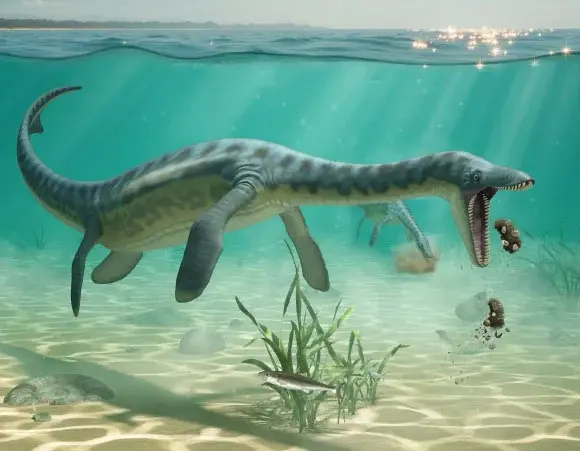
Dr. Dirk Knaust of Equinor ASA has identified fossilized vomit, or regurgitalites, from Jurassic-era plesiosaurs in North Sea drill cores. These fossils, found near the Troll oil field, contain shells of bivalves, worms, and crinoids that require full ocean salinity, yet they were deposited in freshwater delta sediments. This mismatch suggests plesiosaurs foraged in deep, salty waters and swam to shallow, brackish areas to regurgitate indigestible remains. Knaust formally names this new trace fossil type 'Vomitus' and attributes the remains to the Cryptoclididae family. The findings, published in the Geological Magazine, offer the first systematic classification of plesiosaur vomit and provide rare insights into the feeding behavior of these long-necked marine reptiles.
Key points
- Dr. Dirk Knaust identified over 20 fossilized vomit clumps, or regurgitalites, in Middle to Upper Jurassic rock cores from the Horda Platform near the Troll oil field in the North Sea.
- The regurgitalites contain tightly packed, corroded shells of bivalves, serpulid worms, and crinoids, along with bits of fossilized wood, indicating they passed through a predator's digestive system.
- The prey species found in the vomit require full ocean salinity, but the fossils were deposited in freshwater delta sediments, suggesting the predator transported the food from offshore to shallower, brackish waters before regurgitating.
- Knaust attributes the regurgitalites to the Cryptoclididae family of plesiosaurs, based on tooth shape, feeding style, and preserved stomach contents from related species.
- Knaust formally names the new trace fossil type 'Vomitus,' with three varieties distinguished by their dominant contents: bivalve shells, serpulid worm tubes, and crinoid fragments.
- The findings, published in the Geological Magazine, represent the first systematic classification of plesiosaur vomit and the first such fossils documented in continuous drill-core material.
Background
This discovery builds on earlier research into fossilized vomit, or regurgitalites, which have been recognized for a century but only recently become better understood and systematically described. Previous studies have focused on vertebrates eating other vertebrates, but this research highlights the importance of invertebrate remains in understanding predator behavior. The findings also align with broader research on fossil record biases, which show that sedimentation rates and fossilization conditions can significantly impact how past ecosystems are reconstructed. Additionally, the discovery of plesiosaur regurgitalites in the North Sea adds to the growing body of evidence that Jurassic marine reptiles had complex feeding behaviors and ranged across different environments.
How outlets are covering it
Sci.News and Popular Science both highlight the significance of the fossilized vomit in understanding plesiosaur feeding behavior, but they emphasize different aspects. Sci.News focuses on the technical details of the regurgitalites and the formal naming of the new trace fossil type 'Vomitus,' while Popular Science draws parallels between plesiosaur behavior and modern animals like owls, fur seals, and marine crocodiles. Popular Science also notes that some of the regurgitalites are as large as mangoes, adding a tangible scale to the findings. Yahoo's coverage, while less detailed, emphasizes the broader implications of the discovery for understanding extinct marine reptiles. All three sources agree on the core findings but differ in their emphasis and the level of detail provided.
Why it matters
The discovery of fossilized vomit from plesiosaurs provides a rare window into the feeding behavior of these long-necked marine reptiles, which lived over 140 million years ago. By analyzing the contents and location of the regurgitalites, researchers can infer that plesiosaurs foraged in deep, salty waters and swam to shallower, brackish areas to regurgitate indigestible remains. This behavior is similar to that of modern animals like fur seals and marine crocodiles, offering insights into the evolutionary continuity of feeding strategies. The findings also highlight the importance of invertebrate remains in understanding predator behavior and the broader implications of fossil record biases in reconstructing past ecosystems. Overall, the discovery adds to our understanding of Jurassic marine life and the complex behaviors of extinct animals.
What to watch
Dr. Dirk Knaust suggests that this is just the beginning of what can be learned from fossilized vomit. He plans to continue analyzing regurgitalites from other parts of the world to further understand the feeding behavior of plesiosaurs and other extinct marine reptiles. The formal naming of the new trace fossil type 'Vomitus' will likely lead to more systematic studies of fossilized vomit in the future, potentially revealing new insights into the diets and behaviors of various predators. Additionally, the findings may prompt further research into the environmental conditions that led to the preservation of these fossils, which could provide clues about the paleoenvironment of the North Sea during the Jurassic period.
- Fossilized Vomit Reveals How Plesiosaurs Dined on Jurassic Seafloor Sci.News
- The swimming dinosaur that vomited like an owl Popular Science
- Queasy plesiosaurs swam to shore to vomit, Jurassic fossils reveal Phys.org
- Probes of fossilized vomit reveal giant, extinct marine reptiles Yahoo
- New research reveals sick sea monsters swam to shore to vomit Iosco County News Herald
Want the full story? Read the original reporting
Read on Sci.News