
Stiff Axial Columns Reveal Early Tetrapods Lacked Neck Mobility
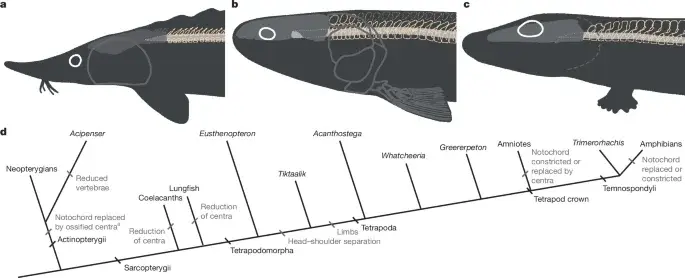
Researchers used sturgeon axial columns to model early tetrapod necks, finding they were too stiff for significant head movement, challenging theories that neck mobility drove the transition to land.
Key points
- Researchers modeled early tetrapod neck mobility using material tests on lake sturgeon, an extant species with a similar notochord-dominated axial column.
- The study found that stem tetrapods like Eusthenopteron and Tiktaalik could achieve less than 6 degrees of lateral flexion and less than 3 degrees of extension.
- Head rotation was effectively impossible for these early species due to high torsional stiffness in the axial column.
- Mobility did not increase when the skull separated from the shoulder girdle, contradicting the hypothesis that neck mobility drove the move to terrestrial habitats.
- Forelimb-driven locomotion, rather than neck mobility, is proposed as the primary functional driver for the anatomical separation of the head and shoulder.
Background
Previous theories suggested that the separation of the skull from the shoulder girdle in early tetrapods allowed for increased neck mobility, facilitating the transition from aquatic to terrestrial life. This study provides new biomechanical evidence that challenges this view by demonstrating that early tetrapod necks remained highly rigid despite this anatomical change.
Why it matters
This research reshapes our understanding of vertebrate evolution by showing that the tetrapod neck evolved as a byproduct of shoulder girdle changes for locomotion, not as an adaptation for head mobility. It highlights the importance of using extant analogues to test paleontological hypotheses when fossil evidence is incomplete.
What to watch
Future research will likely focus on how later tetrapods developed greater neck mobility through longer necks and mobile intervertebral joints, as well as further testing the role of forelimb-driven locomotion in the water-to-land transition.
Want the full story? Read the original reporting
Read on Nature