
Spain’s Aug. 12 Eclipse: A Golden Corona and the Art of Capturing It
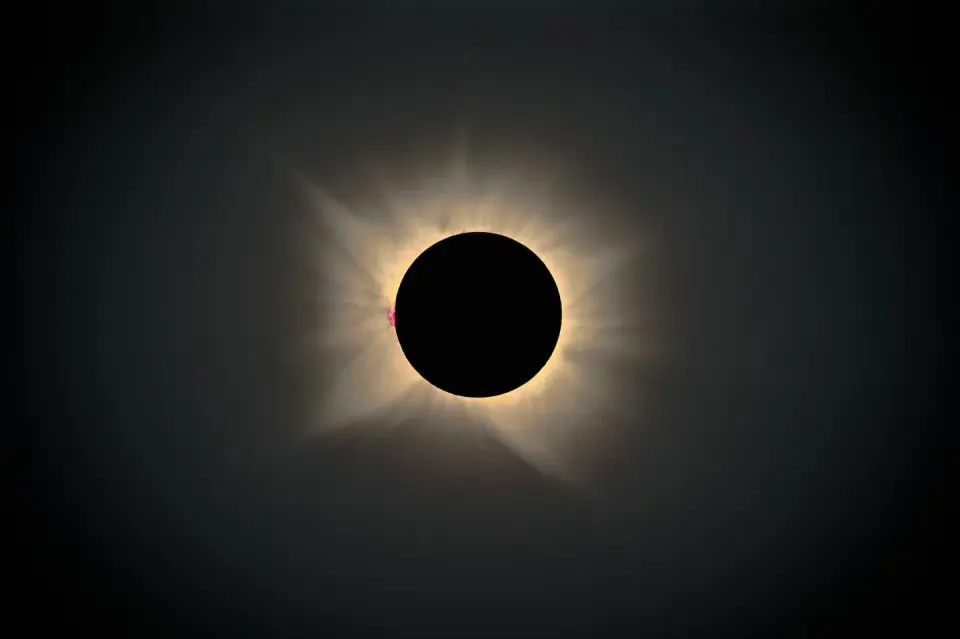
On August 12, 2026, a total solar eclipse crossed eastern Greenland, western Iceland, and Spain. While the event offered a rare view of the sun's corona, conditions in Spain created an unusual golden hue due to low sun angles and smoke from forest fires. Meteorologist Matthew Cappucci detailed the technical challenges of capturing the corona from Tórtoles de Esgueva, while NASA highlighted the scientific interest in the color shift. Ars Technica reported on the ground-level experience in Duratón, noting the clear skies caused by drought and the presence of local crowds.
Key points
- The eclipse path included eastern Greenland, western Iceland, and Spain, with totality lasting over 1.5 minutes in Duratón.
- The solar corona appeared unusually golden in Spain due to the sun being near the horizon and smoke from nearby forest fires scattering blue light.
- Matthew Cappucci used multiple exposures and manual alignment to create a composite image of the corona from Tórtoles de Esgueva.
- A hydrogen-glowing prominence on the sun's left edge retained its bright pink color despite the golden corona.
- Drought conditions in Spain provided clear skies for viewing, though the landscape was described as a tinderbox.
Background
Recent solar research has focused on the sun's surface dynamics, including Kelvin-Helmholtz instabilities observed by the Inouye Solar Telescope. The August 12 eclipse provided a unique opportunity to observe the corona, which is typically only visible during total eclipses. Previous coverage noted that spacecraft, including NASA's ISS and ESA's Proba-3, captured the event from orbit, while millions across Europe witnessed the shadow.
How outlets are covering it
The Washington Post emphasized the technical difficulty of photographing the corona, with Matthew Cappucci describing the need for multiple exposures and manual alignment to capture the sun's atmosphere. NASA's Astronomy Picture of the Day focused on the scientific aspect of the golden corona, attributing the color to the low sun angle and smoke from forest fires. Ars Technica highlighted the human experience, describing the clear skies due to drought and the presence of local crowds in Duratón. Space.com featured a roundup of views from space, including images from the ISS and ESA's Proba-3 mission.
Why it matters
The eclipse provided a rare opportunity to observe the sun's corona, which is typically only visible during total eclipses. The unusual golden hue in Spain offered insights into how atmospheric conditions can affect the appearance of the corona. The event also highlighted the technical challenges of capturing such images and the human experience of witnessing a total solar eclipse.
What to watch
The next total solar eclipse in the continental United States is not expected until 2044. For many regions in Europe, the next total eclipse will be decades away. Continued research into solar dynamics, including the Kelvin-Helmholtz instabilities, may provide further insights into the sun's behavior and its impact on space weather.
- Column | How I captured an image of the sun’s atmosphere during a solar eclipse The Washington Post
- See gorgeous views of the Aug. 12 total solar eclipse captured from space Space
- APOD: 2026 August 17 - A Golden Corona Eclipse NASA Science (.gov)
- The Moon’s shadow raced across the heart of Spain, and I was there to see it Ars Technica
- Ring of Fire in the Sky Kottke.org
Want the full story? Read the original reporting
Read on The Washington Post