
James Webb Telescope reveals surprising insights into early galaxies.
TL;DR
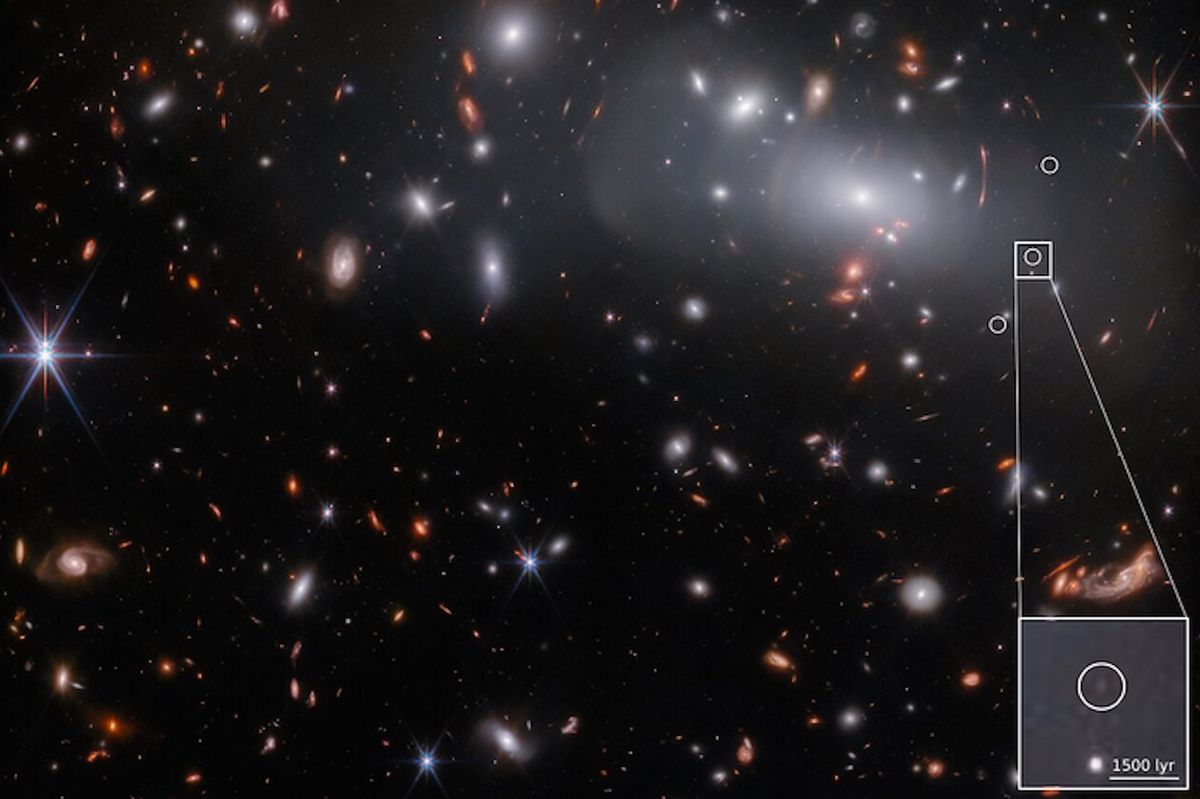
The James Webb Space Telescope has discovered a tiny galaxy in the early universe that is growing rapidly as it forms stars at a tremendous rate, revealing more about the progenitors of galaxies such as our own. The galaxy, referred to as RX J2129-z95, is seen at a redshift of 9.51, meaning that we are seeing it as it existed just 510 million years after the Big Bang. Despite being tiny compared to the Milky Way, RX J2129-z95's rate of star formation is the same as our galaxy's, meaning it is much more intense. The findings were published on April 13 in the journal Science.
Topics:sciencescience-and-astronomy#cosmic-dark-ages#early-universe#galaxy-formation#james-webb-space-telescope#science-and-astronomy#star-formation
- James Webb Space Telescope finds tiny early galaxy packing big star-forming punch Space.com
- James Webb Space Telescope images challenge theories of how universe evolved Phys.org
- Cosmic Time Travel: Webb Unveils Physical Properties of Compact Galaxy From the Early Universe SciTechDaily
- Ancient Galaxies Are a 'Stress Test' for Established Physics, Study Says VICE
- Researchers discover tiny galaxy with big star power using James Webb telescope Phys.org
Want the full story? Read the original reporting
Read on Space.com