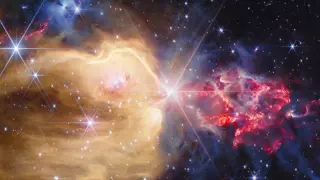
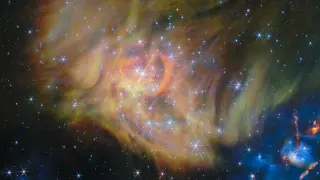
The James Webb Space Telescope has released a new near-infrared image of the Flower Bud Nebula (NGC 7129), revealing over 100 young protostars forming within a dense cloud of gas and dust located 3,300 light-years away.
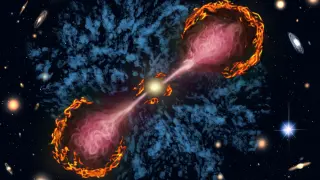
A new study reveals that supermassive black holes suppress star formation in their host galaxies by launching plasma jets that heat and disrupt the circumgalactic medium (CGM). This gas reservoir, which extends 10-20 times beyond the visible galaxy, provides the raw material for new stars. By ionizing this gas along specific paths, black holes prevent it from cooling and collapsing into stars, effectively 'killing' the galaxy's growth. The findings, published in the Astrophysical Journal Letters, solve a long-standing mystery regarding why large galaxies do not produce more stars despite being surrounded by vast amounts of potential fuel.
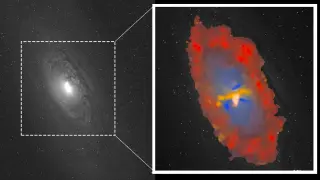
Astronomers mapped nine nearby galaxies with active galactic nuclei to trace how energy from feeding supermassive black holes drives shocks in the surrounding gas, revealing that AGN outflows can spark rings of star formation 2,600 to 20,000 light-years from galactic centers. This study outlines a complex accretion–outflow feedback cycle that shapes galaxy evolution and was based on VLT/MUSE data; findings published in The Astrophysical Journal.
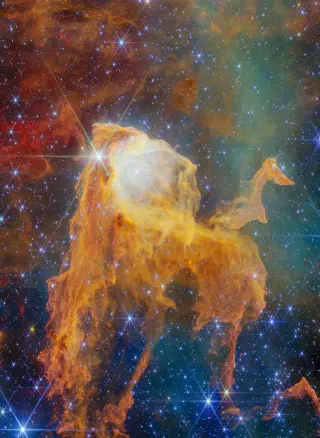
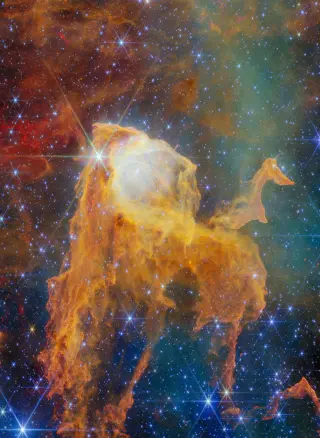
NASA’s James Webb Space Telescope images a dust pillar in the Carina Nebula about 7,500 light-years away, revealing a compact cluster of roughly 70 very young stars—including a massive star ~19 solar masses—formed under winds and radiation from nearby Eta Carinae; the pillar’s head is being excavated by ongoing star formation, effectively creating a “treasure chest” of newborn stars.
A James Webb image of a dust pillar in the Carina Nebula (≈7500 light-years away) reveals a compact cluster of ~70 young stars, about 1.3 million years old, including a massive ~19-solar-mass star. The pillar’s “treasure chest” is carved by winds and radiation from nearby Eta Carinae.
NASA's James Webb Space Telescope captured a stunning image of the star-forming region IC 348, about 1,000 light-years away, showing wisps of gas and dust where new stars are forming; the snapshot is part of a program to hunt for brown dwarfs—objects between planets and stars—using infrared light to spot them and understand how these faint objects form and vary across space.
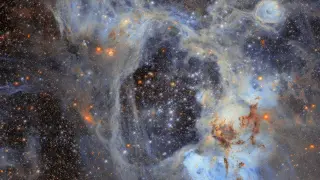
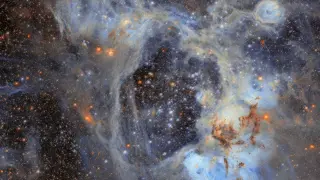
A new Hubble image of LHA 120-N44 in the Large Magellanic Cloud reveals a 210-by-140 light-year superbubble filled with almost 30,000 newborn stars, showing how massive stars carve out cavities with winds and supernovas while compressing surrounding gas to trigger new star formation—the cosmic cycle of destruction and creation.
APOD highlights M83, a 12-million-light-year-old spiral galaxy in Hydra nicknamed the Southern Pinwheel (also Thousand-Ruby Galaxy); its dusty spiral arms host blue star clusters and red star-forming regions, the galaxy spans about 40,000 light-years, and its core glows in X-rays from neutron stars and black holes formed in a past starburst.
APOD presents a deep-exposure image of the Pelican Nebula (IC 5070) showing active star formation where newborn stars ionize surrounding gas, creating a bright ionization front amid dark dust filaments. The Utah-shot 25-hour image highlights the boundary with cold gas and dust (bounded by dark nebula LDN 935) near the North America Nebula, with the nebula's appearance expected to evolve over millions of years as gas and stars rearrange.
The Hubble Space Telescope imaged LHA 120-N44 (N44), a star-forming nebula in the Large Magellanic Cloud, revealing a colossal central cavity dubbed a “superbubble” that spans about 210 by 140 light-years. The glowing, ionized gas is likely carved out by winds from young stars or past supernovae, with ongoing star formation continuing around the shell in this neighboring galaxy about 160,000 light-years away.
New Gaia data show the initial mass function—the distribution of newborn star masses—varies with local environmental conditions such as gas density and chemical composition. This challenges the idea of a universal IMF used to infer total galaxy masses from bright stars, potentially lowering past estimates and helping explain JWST's observations of massive galaxies forming early in the universe.
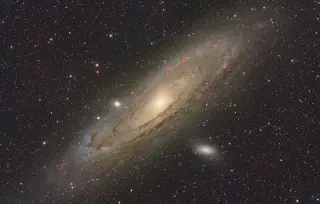
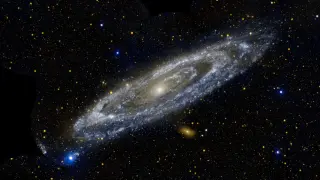
A Hubble-based study of Andromeda (M31) using PHAT/PHAST surveys finds its star formation has declined for about 500 million years, with a sharper drop in the last 40 million, especially on the side near the satellite galaxy M32. While not proven, M32 is the leading candidate for helping slow star birth. The work highlights Andromeda as a Milky Way analog and points to future Roman Space Telescope observations that could map the entire disk and add hundreds of millions of stars to the record.
Hubble observations show the Andromeda galaxy’s rate of turning gas into stars has dramatically slowed in the last ~40 million years, with the slowdown most pronounced on the side facing its tiny neighbor M32. While researchers acknowledge they can’t prove M32 caused the decline, it is the leading suspect, possibly due to a past collision. The study mapped Andromeda’s history across two-thirds of its disk, finding current star formation at about 0.2 solar masses per year (roughly one-fifth the Milky Way’s rate). The Nancy Grace Roman Space Telescope will help measure more of Andromeda’s stars to further test the M32-link in the coming years.
Space.com's space photo of the day spotlights a James Webb Space Telescope image of the Carina Nebula, nicknamed the “Treasure Chest,” revealing about 70 young stars (the most massive around 19 solar masses) nestled in a 7,500-light-year cloud. The star cluster is estimated to be about 1.3 million years old, a revision from earlier 100,000-year figures, illustrating how JWST observations refine our understanding of star formation and cluster evolution in massive nebulae.
NASA/ESA/CSA's James Webb Space Telescope highlights a cometary globule in the Carina Nebula nicknamed the Treasure Chest, housing about 70 young stars (the most massive about 19 solar masses) within a ~1.3-million-year-old cluster still embedded in dust; its distinctive shape is shaped by nearby Eta Carinae and Trumpler 16, and Webb's NIRCam reveals the glow of newly formed stars as gas and dust are gradually dispersed.