
MIT Researchers Use Electrochemical Cell to Drive Hydrogen Separation in Dehydrogenation Reactions
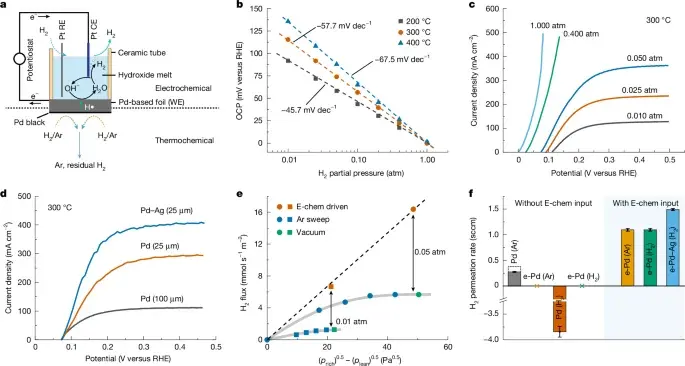
A new study from MIT demonstrates that using a palladium-based membrane as the anode in a molten-hydroxide electrochemical cell can significantly enhance thermochemical dehydrogenation. By applying a low anode potential, the system actively pumps hydrogen out of the reaction zone without requiring a pressure differential, overcoming limitations of traditional membrane reactors. This approach improves single-pass yields for reactions like ammonia and methylcyclohexane dehydrogenation at moderate temperatures.
Key points
- Traditional hydrogen-selective membranes rely on partial pressure differentials, which often result in limited hydrogen flux and reduced mechanical stability.
- The new construct uses a hydrogen-selective palladium membrane as the anode of a molten-hydroxide electrochemical cell with a hydrogen-evolving cathode.
- This setup enables electrochemically driven hydrogen separation at dehydrogenation temperatures without needing a pressure differential.
- The method was tested on ammonia and methylcyclohexane dehydrogenation, showing enhanced reaction rates and yields.
- The research was conducted by Rui Zeng, Julian Ufert, Bryan Y. Tang, Ryan P. Bisbey, and Yogesh Surendranath at MIT.
Background
Dehydrogenation reactions are critical for fuel processing, chemical synthesis, and hydrogen storage. Many of these reactions are endothermic and kinetically inhibited by the presence of hydrogen, leading to low single-pass yields at moderate temperatures. Previous approaches integrated catalysts with hydrogen-selective membranes to remove hydrogen in situ, but these often suffered from limited flux and stability issues. This new study builds on earlier work in catalytic membrane reactors and electrochemical hydrogen production, aiming to solve the equilibrium limitations of dehydrogenation reactions.
Why it matters
This innovation could lead to more efficient and cost-effective methods for producing hydrogen and other chemicals from dehydrogenation reactions. By eliminating the need for pressure differentials, the system may be easier to scale and more robust than traditional membrane reactors. This could have significant implications for the hydrogen economy and industrial chemical production, potentially reducing energy costs and improving yield at lower temperatures.
What to watch
The researchers will likely explore the scalability and long-term stability of this electrochemical membrane system. Further studies may investigate its application to other dehydrogenation reactions and optimize the molten-hydroxide electrolyte composition. The team has also filed a patent application based on this work, indicating potential for commercial development.
Want the full story? Read the original reporting
Read on Nature