
Endeavour’s 12-Mile LA Move Took 68 Hours Due to Extreme Clearance Constraints
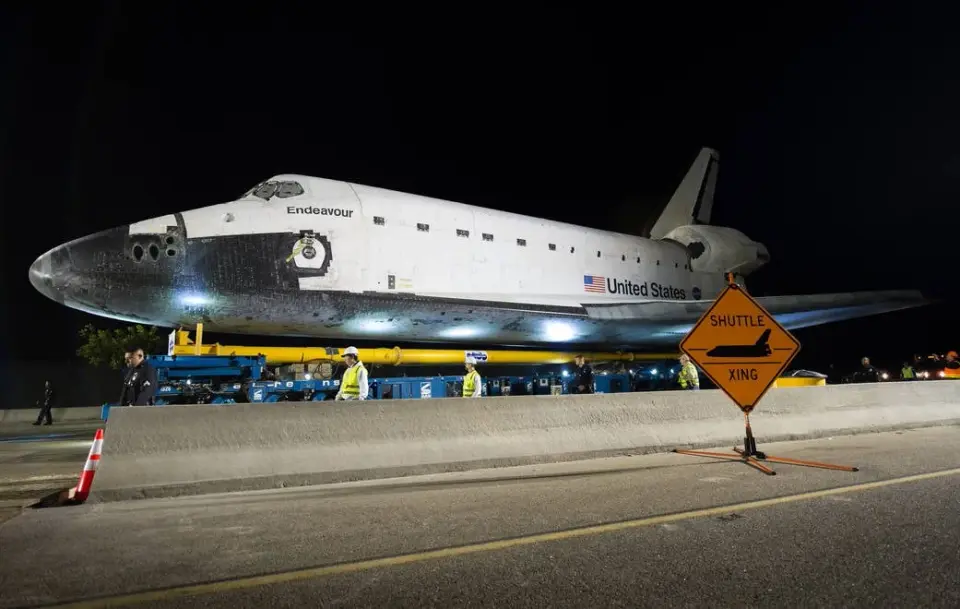
Space Shuttle Endeavour’s final 12-mile journey from Los Angeles International Airport to the California Science Center in October 2012 took 68 hours, moving at no more than 2 mph. The orbiter’s 78-foot wingspan required crews to stop frequently to trim trees and adjust clearances, with some gaps measured in inches. This slow, meticulous transport operation followed Endeavour’s cross-country flight on a modified Boeing 747 and marked its 'Mission 26,' concluding its 25 orbital flights.
Key points
- Endeavour’s 12-mile ground transport from LAX to the California Science Center took 68 hours between October 12 and 14, 2012, averaging roughly 0.176 mph due to frequent stops.
- The orbiter’s 78-foot wingspan and 122-foot length created severe clearance issues, requiring crews to trim over 400 trees and remove about 220 traffic signals along the route.
- Endeavour weighed approximately 170,000 pounds in its transport configuration, riding on a refurbished Over Land Transporter originally used for shuttle ground tests at Edwards Air Force Base.
- The move was part of 'Mission 26,' a ceremonial designation for Endeavour’s final journey after 25 orbital flights, including the first Hubble servicing mission and ISS assembly tasks.
- Approximately 1,000 police officers lined the route to manage crowds and ensure safety, as the operation required precise coordination to avoid damaging the orbiter, city infrastructure, or the public.
Background
This event occurred in 2012, following the end of the Space Shuttle program. Endeavour had previously flown across the United States on a modified Boeing 747 Shuttle Carrier Aircraft, landing at LAX in September 2012 before being prepared for its museum display. The California Science Center later planned to display the orbiter vertically with an external tank and solid rocket boosters, a separate engineering challenge in earthquake-prone Los Angeles. Endeavour’s 25 orbital missions included significant contributions to the Hubble Space Telescope and International Space Station, accumulating nearly 123 million miles of travel in space.
Why it matters
The Endeavour transport highlighted the complex engineering and civic coordination required to move large, irreplaceable artifacts through urban environments. It demonstrated how historical aerospace hardware, designed for open sky, poses unique challenges for ground transport due to its dimensions and weight. The event also underscored the trade-offs between urban infrastructure preservation and the display of national heritage, as significant tree removals and utility adjustments were necessary to accommodate the orbiter’s path.
What to watch
Endeavour was displayed horizontally at the California Science Center initially, with plans for a vertical launch-stack configuration involving an external tank and solid rocket boosters. The museum continued to integrate authentic shuttle hardware into its exhibits, addressing structural challenges in earthquake-prone Los Angeles. No further major transport operations for Endeavour are anticipated, as the orbiter remains a static exhibit.
Want the full story? Read the original reporting
Read on Space Daily