
Sheffield researchers replicate 1,600-year-old Roman dichroic glass recipe
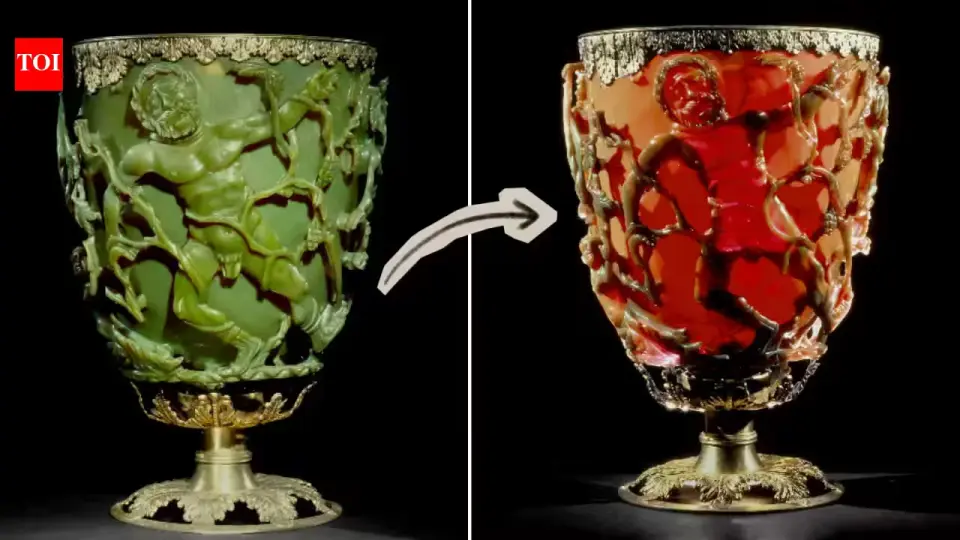
University of Sheffield scientists have successfully recreated the optical properties of the fourth-century Lycurgus Cup, a Roman artifact that shifts from green to red depending on lighting. By embedding gold and silver nanoparticles into a modern glass recipe, researchers produced a repeatable method for creating dichroic glass. The new material will be featured in a contemporary sculpture by artist Elliot Walker, set for display at the university's Festival of the Mind in November 2026.
Key points
- The Lycurgus Cup, held at the British Museum, is a fourth-century Roman drinking cup made of dichroic glass that appears green in reflected light and red when backlit.
- University of Sheffield technician Dr. Lisa Hollands and Professor Caroline Jackson developed a repeatable recipe using modern materials to mimic ancient Roman glassmaking techniques.
- The color-changing effect is caused by gold and silver nanoparticles embedded in the glass, which interact with light wavelengths to block or scatter specific colors.
- The team experimented with various furnace types, oxygen levels, and ingredients, including sugar, to achieve the precise optical effect.
- Glass artist Elliot Walker created a contemporary sculpture using the new recipe, inspired by the Lycurgus myth and the Farnese Atlas sculpture.
- The sculpture will be unveiled at Sheffield’s Millennium Gallery during the Festival of the Mind (November 6-15, 2026) and will later be permanently displayed at the Turner Museum of Glass.
Background
The Lycurgus Cup has long fascinated scientists due to its unique color-shifting properties. In 2007, researchers identified gold and silver nanoparticles as the cause of the effect. Previous attempts to replicate the glass, including a 1960s NASA project and a 2020 Dutch nanocomposite, lacked the consistency or precision of the Sheffield team’s new recipe. The cup is one of only 40 surviving Roman glass cage cups and is considered one of the seven glass wonders of the world.
How outlets are covering it
The Times of India emphasizes the scientific achievement and the broader applications of the research in fields like solar energy and healthcare diagnostics. Smithsonian Magazine highlights the historical significance of Roman ingenuity and the challenge of replicating the ancient technique, noting that the color was highly sensitive to furnace conditions. Ars Technica focuses on the artistic collaboration with Elliot Walker and the technical details of the nanoparticle interaction, comparing the effect to 19th-century daguerreotypes and photonic crystals. All sources agree on the success of the Sheffield team in creating a repeatable recipe, but they differ in emphasis: The Times of India and Smithsonian Magazine stress the scientific and historical aspects, while Ars Technica highlights the artistic and technical nuances.
Why it matters
The successful replication of the Lycurgus Cup’s dichroic glass demonstrates a deep understanding of ancient Roman craftsmanship and provides a new method for creating advanced photonic materials. This knowledge could lead to innovations in solar energy, quantum technologies, and the safe storage of radioactive waste. Additionally, the project bridges the gap between ancient history and modern science, offering a tangible connection to the past through contemporary art.
What to watch
The new sculpture by Elliot Walker will be unveiled at Sheffield’s Millennium Gallery during the Festival of the Mind from November 6 to 15, 2026. After the festival, the piece will be permanently displayed at the university’s Turner Museum of Glass. Researchers will continue to explore the applications of dichroic glass in various technological fields.
- A 1,600-year-old Roman cup turns green or ruby red depending on how light hits it; after years of experim The Times of India
- Technician cracks 1,600-year-old mystery to replicate color-changing effect of Roman glass masterpiece Phys.org
- Romans Made Color-Changing Glass With Ancient Nanotechnology. Scientists Just Discovered How to Replicate the 1,600-Year-Old Marvel Smithsonian Magazine
- Sculpture re-creates odd optical effects of famed Lycurgus Cup Ars Technica
- News - Rare Roman Glass Re-created Archaeology Magazine
Want the full story? Read the original reporting
Read on The Times of India