
Green Bank, West Virginia: The 13,000-Square-Mile Zone Where Cell Phones Are Illegal to Protect Radio Astronomy
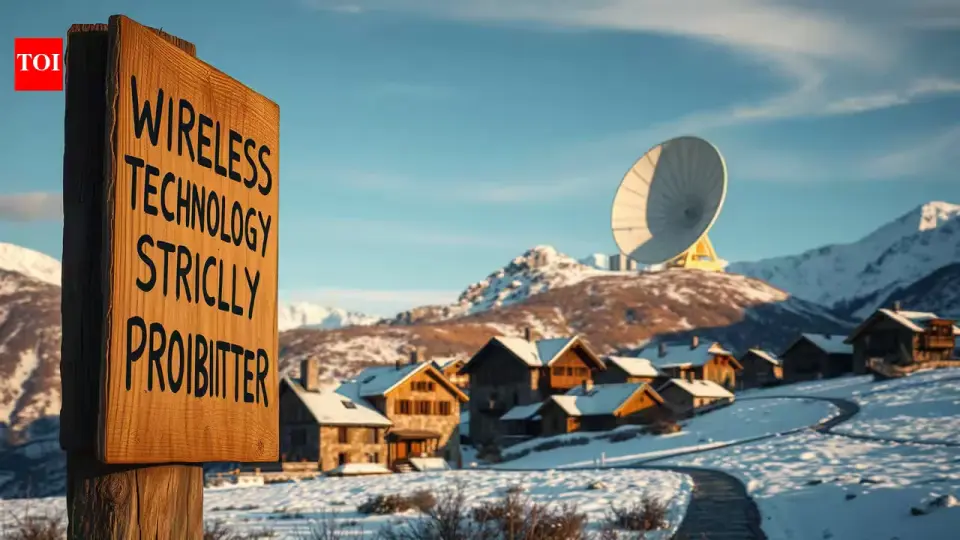
Green Bank, West Virginia, is a 150-person town at the center of a 13,000-square-mile National Radio Quiet Zone established in 1958. To protect the Robert C. Byrd Green Bank Telescope from interference, the area enforces strict bans on cell phones, Wi-Fi, and microwaves. The telescope detects signals so faint that even a distant cell phone would overwhelm its data. Enforcement involves active monitoring by observatory staff, who often resolve interference issues cooperatively with residents. While landlines and cable internet remain available, the zone attracts some individuals seeking to avoid electromagnetic exposure, though this condition lacks mainstream medical recognition. The site remains crucial for studying cosmic phenomena like pulsars and the Milky Way’s structure, requiring a unique trade-off between modern connectivity and scientific precision.
Key points
- The National Radio Quiet Zone covers 13,000 square miles across eastern West Virginia and parts of Virginia, established by the FCC in November 1958 to protect the Robert C. Byrd Green Bank Telescope and a Navy receiving facility.
- Green Bank, a town of approximately 150 residents, enforces strict local laws prohibiting the operation of cell phones, Wi-Fi routers, and microwaves within 10 miles of the telescope to prevent interference with faint cosmic signals.
- The telescope detects signals measured in milli- or micro-Janskys, energy levels so low that a single cell phone, even from Mars, would produce more interference than many astronomical signals researchers aim to study.
- Enforcement is conducted through active monitoring by National Radio Astronomy Observatory staff who drive a 20-mile radius to identify interference sources, typically resolving issues cooperatively with equipment owners rather than through immediate legal action.
- The zone attracts a small number of residents who believe they suffer from electromagnetic hypersensitivity, a condition not recognized by mainstream medical science, while most residents rely on landlines, cable internet, and satellite television for connectivity.
Background
This story highlights the ongoing tension between modern wireless technology and sensitive scientific infrastructure. While previous archive articles focused on unrelated topics such as regenerative dentistry, cancer immunotherapy, and Alzheimer's research, the Green Bank case illustrates a unique regulatory approach to electromagnetic spectrum management. It contrasts with typical remote monitoring methods used elsewhere in the US, emphasizing a hands-on, community-based enforcement model. The zone’s establishment in the 1950s reflects early 20th-century efforts to isolate radio astronomy from emerging consumer electronics, a challenge that has intensified with the proliferation of wireless devices in the 21st century.
Why it matters
The Green Bank case underscores the critical need for protected zones to advance fundamental scientific research in radio astronomy. As wireless technology becomes ubiquitous, the risk of interference with sensitive instruments grows, potentially hindering discoveries about the universe’s structure and faint cosmic phenomena. The zone’s existence demonstrates a rare, large-scale compromise between public convenience and scientific necessity, offering a model for managing electromagnetic pollution. Additionally, it highlights the social and practical impacts on local communities, who must adapt to a lifestyle devoid of modern wireless connectivity, raising questions about the balance between technological progress and environmental or scientific preservation.
What to watch
The National Radio Quiet Zone is expected to remain in place, with continued enforcement by observatory staff and federal regulators. As wireless technology evolves, the FCC and state authorities may need to update regulations to address new sources of interference. The observatory will likely maintain its active monitoring and cooperative enforcement approach, while the scientific community will continue to rely on the Green Bank Telescope for research into pulsars, the Milky Way, and other faint cosmic signals. There is no indication of changes to the zone’s boundaries or restrictions in the near term, but ongoing dialogue between regulators, scientists, and local residents will be essential to balance scientific needs with community concerns.
Want the full story? Read the original reporting
Read on The Times of India