
CERN’s Large Hadron Collider Simulates Cosmic Ray Showers Using Oxygen Proton Collisions
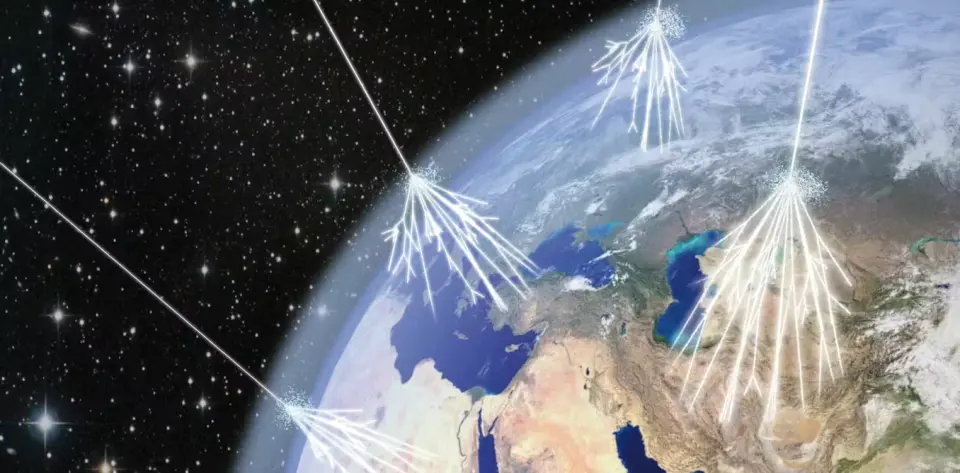
Physicists at CERN have successfully recreated the initial moments of cosmic ray showers in a laboratory setting for the first time. By colliding oxygen atoms with protons at the Large Hadron Collider, researchers generated data that is ten times more precise than existing computer models. This new experimental approach aims to resolve long-standing discrepancies in how scientists understand the formation of particle rainstorms in Earth's atmosphere and the composition of high-energy cosmic matter.
Key points
- A team led by New York University physicist Jesse Liu utilized CERN’s Large Hadron Collider to simulate cosmic ray interactions.
- The experiment, conducted on July 1, 2025, marked the first time oxygen atoms were collided with protons at the facility.
- In this setup, the proton beam represented the incoming cosmic ray, while the oxygen beam mimicked the atoms of Earth's atmosphere.
- The ATLAS experiment captured over 200 million images daily, measuring particle counts and energies with high precision.
- The resulting data is ten times more accurate than predictions from current computer simulations of atmospheric particle showers.
- The findings were published in Physical Review Letters and aim to clarify the composition and origins of cosmic rays.
Background
Cosmic rays, discovered by Victor Hess in the early 20th century, are high-energy particles from space that strike Earth's atmosphere, creating showers of secondary particles. While these phenomena have been studied for over a century, scientists lack a precise understanding of their formation mechanisms. Previous methods involved large ground-based arrays like the Telescope Array in Utah, but computer models often disagreed on how these showers develop. This new laboratory approach bridges particle physics and astrophysics, offering a controlled environment to test theories that were previously difficult to verify through observation alone.
Why it matters
Accurate data on cosmic ray showers is essential for understanding the extreme events in the universe that generate them, such as supernovae and supermassive black holes. By resolving discrepancies in computer models, this research improves our ability to determine the composition of cosmic rays, specifically the ratio of hydrogen to heavier atoms. This knowledge could provide critical clues about the origins of these high-energy particles and enhance the precision of applications that rely on cosmic rays, such as carbon dating and geological imaging.
What to watch
Researchers hope these results will improve the scientific community's understanding of cosmic rainstorms and help unravel the most extreme events in the universe. The collaboration between particle physics and high-energy astrophysics is expected to grow, as both fields share significant overlap and historical connections. Future studies may use this data to refine models of atmospheric particle interactions and further investigate the sources of cosmic radiation.
Want the full story? Read the original reporting
Read on The Conversation