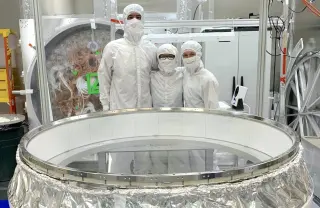
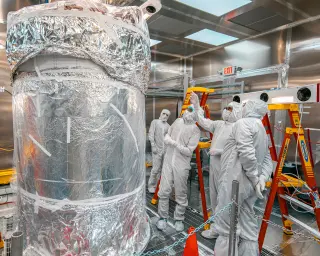
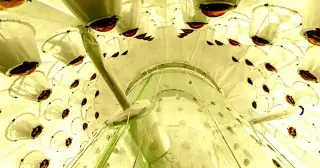
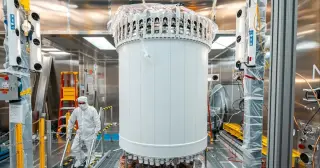
The XENONnT experiment at Italy’s Gran Sasso National Laboratory has successfully measured solar neutrinos via elastic neutrino-electron scattering at energies as low as 17 keV. This achievement, reported in a preprint, demonstrates the detector’s capability to probe low-energy particle interactions with a five-sigma confidence level, though it does not constitute a dark matter discovery.
Physicists at Brookhaven National Laboratory have detected an unexpected pattern in gold atom collisions that may signal the long-sought 'critical point' of nuclear matter. By smashing gold nuclei together at nearly the speed of light, researchers created quark-gluon plasma, a state of matter believed to have existed microseconds after the Big Bang. While analyzing the spray of particles, they observed a dip in the variation of sideways particle ejection as collision energy changed. This non-smooth behavior suggests a transition point where nuclear matter changes how it transforms between states. The findings, published in Physical Review Letters, are statistically significant but described as a hint rather than definitive proof. This experiment aims to map the 'equation of state' of nuclear matter, which governs conditions in extreme environments like neutron star cores.
Physicists at TU Wien have provided new theoretical support for the f0(1710) particle as a glueball, a state made primarily of gluons. By using a holographic model that accounts for realistic meson masses, researchers explained why f0(1710) decays into strange quarks, a pattern that previously contradicted glueball predictions. While experimental data from the BESIII collider aligns with this theory, definitive confirmation remains elusive due to the complex mixing of gluonic and quark-antiquark states.
A Duke-led team used a trapped-ion quantum simulator to model 'string breaking,' a process where energy creates new particle pairs. Published in Nature Physics, the study reveals that new charges form at the edges of the string before spreading inward, differing from traditional theories. This work joins similar experiments by Google and QuEra, marking a key step in using quantum hardware to simulate high-energy physics.
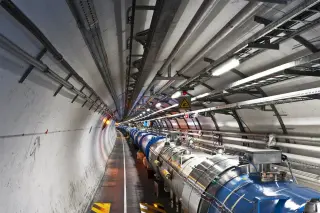
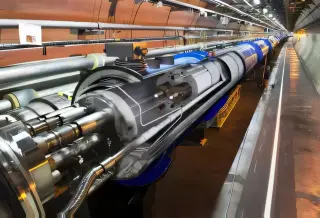
CERN has initiated the third long shutdown of the Large Hadron Collider by disconnecting its aging inner triplet magnets. These components, installed between 2005 and 2007, will be replaced by new niobium-tin superconducting magnets that generate fields 40% stronger. This upgrade aims to increase collision rates for the ATLAS and CMS experiments, significantly boosting data collection for fundamental physics research.
A new theoretical paper proposes that accelerating atomic nuclei in particle accelerators could create pairs of axions, hypothetical particles that may constitute dark matter. Researchers Stefan Evans and Ralf Schützhold suggest that the rapid motion of nuclei in ultraperipheral heavy-ion collisions could trigger a dynamical Casimir effect, converting vacuum fluctuations into real axions. This mechanism relies on the fact that atomic nuclei alter the effective mass of axions within the quantum vacuum. While the probability of producing these particles depends heavily on their unknown mass, the study suggests existing technology might allow for experimental tests, though detection remains a significant challenge.
CERN’s CMS and ATLAS experiments have found no evidence of microscopic black holes in recent proton collisions, but they have significantly narrowed the energy range where such objects could exist. Using 138 inverse femtobarns of data from 2016-2018, CMS excluded semiclassical black holes below 9.0 to 11.4 TeV, while ATLAS’s 2022-2024 data excluded models up to 9.4 TeV. These null results, achieved through new machine learning techniques, constrain theories involving extra dimensions and help resolve the hierarchy problem by eliminating viable parameter spaces for quantum gravity.
Physicists with CERN's ATLAS collaboration found strong evidence that Z bosons produced in Higgs decays remain quantum-entangled, rejecting a nonentangled alternative at 4.7 sigma (just shy of the 5-sigma discovery threshold). By analyzing the Z bosons’ spin states via four-lepton decays and angular distributions, the result supports Standard Model predictions and demonstrates entanglement at the electroweak scale with massive, short-lived particles. This extends collider tests of quantum information to new regimes and could sharpen future precision tests as more Run 3 and High-Luminosity LHC data become available.
Berkeley and LLNL researchers are part of the LZ dark matter experiment, a 10-ton liquid xenon detector buried about a mile underground in a former South Dakota mine. Analysis of roughly 220 days of data yielded one unusual xenon recoil that could hint at a dark matter interaction, but the result is only 2.6 sigma—not near the 5-sigma threshold for discovery. Scientists caution against over-interpreting a single event and will continue collecting data, with cross-checks from PandaX and XENONnT as they seek more events to strengthen the signal.
A single xenon recoil detected by the LZ Experiment a mile underground in South Dakota could be a dark-matter signal, but its 2.6-sigma significance is below the five-sigma threshold for discovery, so researchers caution against conclusions and await replication by PandaX and XENONnT; if confirmed, it would lend support to the WIMP dark-matter hypothesis and could transform our understanding of fundamental physics.
A global team analyzing data from the LUX-ZEPLIN (LZ) detector reports a potential dark matter signal—the strongest hint yet but not a discovery. The event, observed in 2023, has about 2.6-sigma significance with a 0.5% chance of being caused by known background, and researchers are expanding the analysis to ~700 days of data with bias-reduction techniques. Confirmation would require ~5-sigma; independent experiments like XENONnT and PandaX-4T could verify the signal if more events appear.
Physicists treated Earth’s magnetic field (2012–2022 data from the British Geological Survey) as a giant detector for dark matter, finding candidate signals that could be axions or dark photons. They identified 65 axion candidates (25 after stricter filters) and up to 342 dark-photon candidates (31 after tighter criteria). A key test is whether signals vary with location: axion signals should track Earth’s magnetic field and be weaker at the poles and stronger near Southeast Asia, while dark-photon signals would not depend on the field. Current results come from a single UK observatory, so global confirmation is needed. The work is published across Progress of Theoretical and Experimental Physics (axion studies) and Physical Review D (dark photon study).
Physicists running the LZ dark matter detector in South Dakota report a 2023 event—a previously unobserved interaction in seven tons of liquid xenon that produced a flash of light. While the team says it could be a dark-matter signal, it yielded more energy than standard WIMP models predict, and the odds of it being a fluke are about 1 in 400—far below the five-sigma threshold—so independent confirmation from PandaX and XENONnT is planned before any firm claim.
Scientists analyzing 220 days of data from the LUX-ZEPLIN (LZ) underground xenon detector in South Dakota report a single unexplained event that could resemble a dark-matter interaction, but they stress it is not a confirmed detection; if real, it would be the strongest hint yet and will require further verification, as researchers continue to study dark matter and related phenomena, while NASA pursues dark matter research with the Roman Space Telescope.
Physicist Sarah Demers of Yale discusses how AI can accelerate experimental work (e.g., Mu2e at Fermilab) and data analysis in particle physics, while raising concerns about attribution and intellectual-property in AI tools. She’s helping draft an American Physical Society policy on AI use, emphasizes preserving the core practices of physics, and notes she personally avoids using language models for writing emails; the piece also highlights the Genesis Mission funding that supports AI-enabled scientific workflows and contemplates how AI may reshape training and collaboration in the field.