Tag

Large Hadron Collider

All articles tagged with #large hadron collider

LHC May Hint at Macroscopic Dark Matter
science26 days ago

LHC May Hint at Macroscopic Dark Matter

Researchers propose that macroscopic dark matter candidates called axion quark nuggets could pass through Earth and generate a faint acoustic disturbance that dislodges dust in the LHC, causing beam-loss events detectable by the collider’s existing monitors. They urge reanalyzing past unidentified falling object (UFO) events for a fingerprint of three or more correlated disturbances in the 27-km tunnel, suggesting a new way to search for dark matter without hardware changes. Publication is planned in Physical Review D.

India’s CERN Partnership Drives Dark Matter Quest and Higgs Legacy
world-news1 month ago

India’s CERN Partnership Drives Dark Matter Quest and Higgs Legacy

India’s six-decade partnership with CERN puts it at the center of the LHC upgrade and the global hunt for dark matter, with Indian labs contributing to magnet systems, cryogenics, detectors and high-performance computing that underpinned the Higgs boson discovery and will push physics beyond the Standard Model as CERN restarts after a $1.5B upgrade in 2030.

CERN to upgrade the LHC to HiLumi, boosting collisions by about 10x through 2030
science1 month ago

CERN to upgrade the LHC to HiLumi, boosting collisions by about 10x through 2030

The Large Hadron Collider at CERN has entered a four-year Long Shutdown 3 to upgrade into the High-Luminosity LHC, which will raise collision rates by about tenfold and enable roughly 380 million Higgs bosons over its lifetime. The upgrade, which involves replacing thousands of magnets and other components, aims to deliver a much larger data set to probe the Higgs, dark matter, and the early universe. Operations are slated to resume in 2030 and continue into the 2040s, after which a new, higher-energy accelerator may replace it.

CERN Detects Excited Bc*+ Meson at the LHC
physics3 months ago

CERN Detects Excited Bc*+ Meson at the LHC

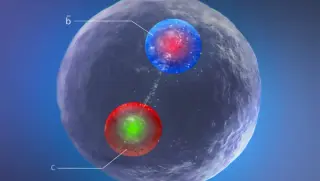
ATLAS physicists at CERN observed the excited Bc*+ meson, a heavy-quark bound state (charm quark with a bottom antiquark), produced in high-energy proton-proton collisions at the LHC. The Bc*+ rapidly decays to a Bc+ meson and a photon, which was identified indirectly when the photon converted into an electron–positron pair in the detector. The measured mass difference between Bc*+ and Bc+ is 64.5 ± 1.4 MeV, consistent with theoretical expectations and providing new data to refine models of heavy-quark dynamics and the strong force. Publication is set for Physical Review Letters.

Primordial Soup Demonstrated: Quark-Gluon Plasma Flows as a Liquid in LHC Collisions
science6 months ago

Primordial Soup Demonstrated: Quark-Gluon Plasma Flows as a Liquid in LHC Collisions

MIT and CERN recreated early-universe conditions by colliding lead ions at near-light speed in the LHC, tracing how quarks slow and generate a wake in quark-gluon plasma, providing definitive evidence that this primordial soup behaves like a liquid rather than a gas, with implications for understanding the birth of matter.

Quark leaves wake in lab-made primordial plasma, hinting at a soupy early universe
science6 months ago

Quark leaves wake in lab-made primordial plasma, hinting at a soupy early universe

Physicists at CERN’s Large Hadron Collider (CMS collaboration) detected a subtle dip (less than 1%) in backward particle production as a high-energy quark moved through a tiny droplet of quark-gluon plasma, revealing a wake formed by energy transfer to the primordial fluid. By using Z bosons as clean markers, researchers could isolate this effect and gain a lab-side glimpse into the hot, liquid-like plasma that filled the early universe microseconds after the Big Bang.

Primordial Soup Confirmed: Quark-Gluon Plasma Flows Like a Liquid
physics-and-chemistry6 months ago

Primordial Soup Confirmed: Quark-Gluon Plasma Flows Like a Liquid

Physicists analyzing LHC data from CERN used Z bosons as markers to track quarks moving through quark-gluon plasma, confirming that this primordial soup behaves like a liquid and creates wake patterns as it’s disturbed, a finding that supports long-standing theories about the early universe and provides new ways to study the properties of this exotic fluid.

Large Hadron Collider Temporarily Ceases Operations
science7 months ago

Large Hadron Collider Temporarily Ceases Operations

The Large Hadron Collider (LHC) in Switzerland will be shut down starting June for about five years to undergo major upgrades to increase its collision capacity, with the goal of enabling more advanced experiments. During this period, CERN is also planning the development of the Future Circular Collider, a much larger and more powerful accelerator, although its future is uncertain due to high costs and scientific debates. The LHC's shutdown is part of ongoing efforts to deepen our understanding of fundamental physics, including the universe's origins.

New Insights Unveiled in Higgs Boson Research
science1 year ago

New Insights Unveiled in Higgs Boson Research

Researchers at the Max Planck Institute have announced new findings on the Higgs boson, enhancing our understanding of its interactions with W and Z bosons, which are crucial to the Standard Model of particle physics. These discoveries, presented at the International Conference on High Energy Physics, confirm theoretical predictions and set the stage for future research at the High-Luminosity Large Hadron Collider. The findings not only validate existing theories but also open possibilities for discovering new particles or forces, potentially reshaping our understanding of the universe.