
The 1842 Eclipse Mystery: Why Shadow Bands Still Defy Full Explanation
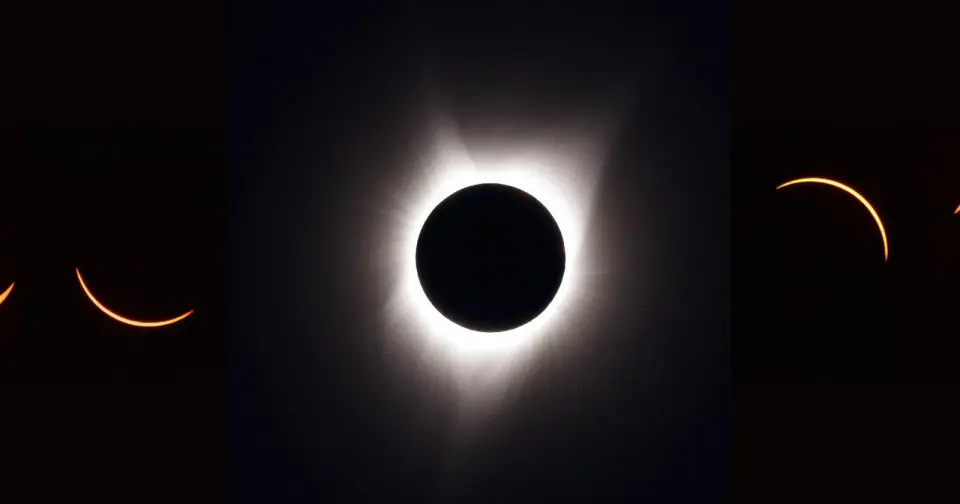
Shadow bands, rippling light patterns seen before total solar eclipses, remain partially unexplained. While atmospheric turbulence is the standard model, recent balloon experiments and new geometric theories suggest the physics are more complex than currently understood.
Key points
- Shadow bands are faint, moving light and shadow patterns observed in the final minutes before totality, first well-documented during the 1842 eclipse.
- The standard explanation, formalized in 1986, attributes the effect to atmospheric scintillation of the narrowing solar crescent.
- A 2017 balloon experiment suggested bands originate above the planetary boundary layer, but a 2024 flight found no such signal, creating conflicting data.
- A 2026 preprint proposes a geometric-optical model based on Young's double-slit experiment, arguing current turbulence models fail to predict band spacing and motion.
- The phenomenon's existence is undisputed, but its precise physical mechanics remain unresolved pending further peer-reviewed research.
Background
The August 2026 total solar eclipse, which swept across Greenland, Iceland, and northern Spain, provided a recent opportunity for observers to witness celestial phenomena. While the 2026 event focused on corona visibility and Perseid meteor showers, it highlighted the ongoing interest in eclipse-related optical effects. The 1842 eclipse, which crossed Europe and Central Asia, remains a key historical reference for shadow band documentation, with totality lasting over four minutes near its center.
How outlets are covering it
Space Daily emphasizes the discrepancy between the 2017 and 2024 balloon experiments, noting that the 2024 results undercut the higher-altitude origin theory. They also highlight the 2026 preprint's critique of turbulence models. CNN's coverage, though largely obscured by technical code in the provided source, focuses on the testing of theories during recent eclipse events, aligning with the experimental approach described by Space Daily. Both sources agree that while a general mechanism exists, specific predictive models are lacking.
Why it matters
Understanding shadow bands improves our knowledge of atmospheric optics and light propagation. Resolving this 184-year-old mystery could refine models of how light interacts with Earth's atmosphere, with potential applications in precision optics and atmospheric science. It also serves as a reminder that even well-documented phenomena can have unresolved underlying physics.
What to watch
Future total solar eclipses will provide opportunities for additional balloon flights and ground-based photometry to resolve the discrepancy between the 2017 and 2024 experiments. Researchers aim to test the geometric-optical model against real-world data on band spacing and motion. Peer review of the 2026 preprint and independent replication of balloon experiments are critical next steps.
- During the total solar eclipse of July 8, 1842, an astronomer watched the ground itself start to ripple — thin bands of light chasing each other across open earth in the last seconds before the sky went fully dark, and 184 years later, nobody has proven why Space Daily
- Strange phenomenon of shadow bands captivates scientists as a total solar eclipse nears CNN
- How Pittsburgh researchers are trying to solve the ‘shadow bands’ solar eclipse mystery Pittsburgh Post-Gazette
- Scientists Keep Chasing the Mystery of Shadow Bands During Solar Eclipses mezha.net
- eclipse shadow KIMT
Want the full story? Read the original reporting
Read on Space Daily