
Noninvasive Brain Stimulation Targets Reward Circuits to Alleviate Subclinical Depression
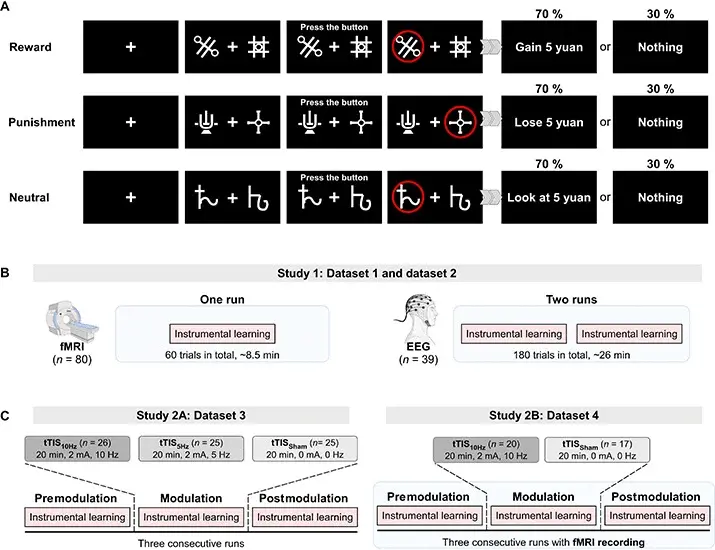
A new study demonstrates that transcranial temporal interference stimulation (tTIS) targeting the ventromedial prefrontal cortex can improve reward learning and reduce symptoms of subclinical depression. Published in Science Translational Medicine, the research identifies a specific neural loop between the prefrontal cortex and ventral striatum that encodes reward prediction errors. In a randomized trial involving 69 participants, three daily sessions of 10 Hz alpha-frequency stimulation significantly alleviated depressive symptoms, with benefits persisting at a seven-day follow-up. The findings suggest a potential noninvasive alternative to invasive deep brain stimulation for treating reward dysfunction associated with depression.
Key points
- Researchers identified a bidirectional excitatory-inhibitory loop between the ventromedial prefrontal cortex (vmPFC) and ventral striatum that encodes reward prediction errors.
- Alpha-frequency tTIS (10 Hz) applied to the vmPFC enhanced reward learning and reshaped frontostriatal connectivity, whereas theta-frequency tTIS (5 Hz) showed no significant effect.
- A randomized controlled trial with 69 individuals with subclinical depression found that three daily sessions of alpha-frequency tTIS alleviated depressive symptoms.
- Benefits from the stimulation persisted at a seven-day follow-up, indicating delayed therapeutic effects.
- The study utilized functional magnetic resonance imaging, electroencephalography, and computational modeling to map neural dynamics in healthy adults before testing the intervention.
Background
This research builds on prior investigations into noninvasive neuromodulation for depression, such as transcranial magnetic stimulation (TMS) and deep brain stimulation (DBS). Recent studies have highlighted the importance of specific neural pathways, such as the cingulum bundle, in the success of DBS for treatment-resistant depression. Additionally, emerging clinics have begun offering accelerated TMS protocols to provide faster, noninvasive alternatives to traditional therapy. The current study advances this field by targeting deep reward circuits without surgery, addressing gaps in current treatments for reward dysfunction.
How outlets are covering it
The primary source, Science Translational Medicine, emphasizes the mechanistic insights gained from neuroimaging and computational modeling, highlighting the specific frequency-dependent effects of tTIS. Secondary sources like Neurology Advisor and UA.NEWS focus on the clinical trial results, noting the alleviation of subclinical depressive symptoms and the persistence of benefits at seven days. Mirage News highlights the safety profile of the intervention in 76 healthy adults and positions it as a less intrusive alternative to invasive deep brain stimulation. All sources agree on the efficacy of 10 Hz stimulation over 5 Hz, but the primary source provides more detail on the underlying neural dynamics, while secondary sources focus on the therapeutic potential and clinical implications.
Why it matters
This study offers a promising noninvasive treatment option for individuals with subclinical depression and reward dysfunction. By targeting specific neural circuits involved in reward learning, tTIS may provide a more precise and accessible alternative to invasive procedures like deep brain stimulation. The persistence of benefits at seven days suggests potential for long-term therapeutic effects, which could improve patient outcomes and reduce the burden of current depression treatments. Further clinical trials are needed to confirm efficacy in broader populations, but these findings advance the understanding of circuit-targeted neuromodulation for neuropsychiatric disorders.
What to watch
Researchers plan to conduct larger clinical trials to establish the therapeutic efficacy of tTIS for depression and related disorders. Future studies will likely explore the long-term effects of the intervention and its applicability to individuals with clinical depression, not just subclinical symptoms. Additionally, further investigation into the underlying neural mechanisms and the role of other frequency bands may refine the stimulation protocols for broader therapeutic use.
- Temporal interference stimulation targeting the ventromedial prefrontal cortex enhances reward learning and improves depression scores Science | AAAS
- Temporal Interference Stimulation Targeting Prefrontal Cortex May Alleviate Depression Symptoms Neurology Advisor
- Noninvasive deep brain stimulation enhances reward learning and eases depressive symptoms News-Medical
- Chinese researchers report reduced symptoms in subclinical depression — News-Medical UA.NEWS
- Brain Stimulation Eases Depression by Boosting Reward Learning Mirage News
Want the full story? Read the original reporting
Read on Science | AAAS