
Century-old drawer fossil reveals first European megaraptoran
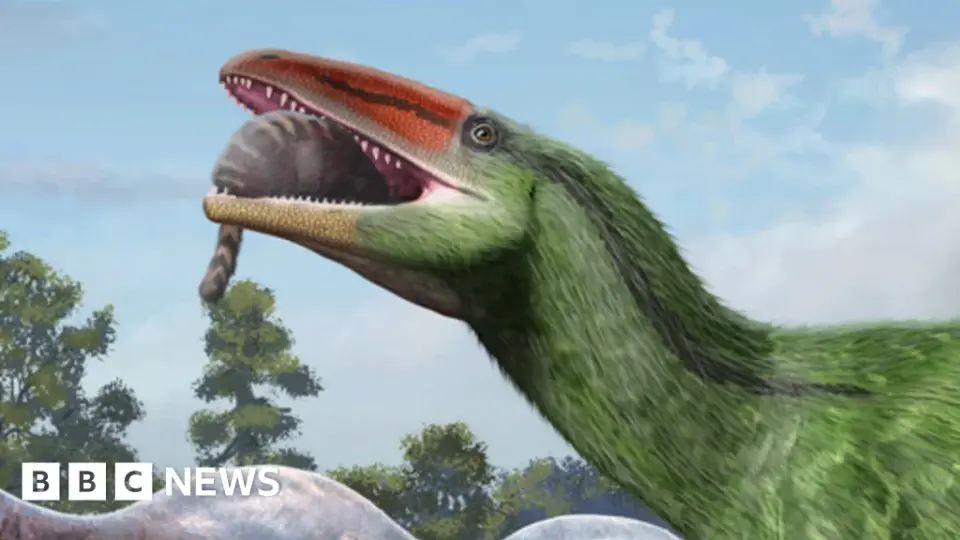
A fossil skull fragment stored in a London museum drawer for nearly 100 years has been identified as a new dinosaur species, Invictibellatrix amberina. This 120-million-year-old predator, roughly the size of a tiger, is the first confirmed megaraptoran found in Europe. The discovery, published in Royal Society Open Science, suggests these agile, claw-hunting dinosaurs migrated from Asia through Europe before spreading to South America and Australia, filling a major gap in their evolutionary history.
Key points
- The fossil, a partial braincase, was found on the Isle of Wight in 1924 and acquired by the Natural History Museum but remained unstudied for nearly a century.
- Invictibellatrix amberina, meaning 'unconquered female warrior,' is estimated to have been 3 to 4 meters long and 1.5 meters tall, with claws 10 to 20 centimeters long.
- The species belongs to the megaraptoran group, agile carnivores that hunted with large arms and claws rather than jaws, distinct from tyrannosaurs.
- This is the first megaraptoran fossil discovered in Europe, supporting a hypothesis that the group migrated from Asia through Europe to Africa and South America.
- Researchers used CT scans and mathematical modeling to analyze the fossil and trace the global spread of megaraptorans over time.
Background
The Isle of Wight is a known hotspot for fossil discoveries, with over 200 years of collecting history. The Natural History Museum holds more than 1,000 specimens from amateur palaeontologist Reginald Walter Tooley, who died in 1924. Previous studies have identified other dinosaurs from the same Wessex Formation, such as Eotyrannus, but this is the first megaraptoran found in Europe.
How outlets are covering it
BBC and NBC News emphasize the mystery of the fossil being overlooked for nearly a century and the implications for understanding megaraptoran hunting strategies. New Scientist highlights the comparison with the Argentinian megaraptoran Murusraptor and the potential link to Eotyrannus, noting that more fossils are needed to confirm the evolutionary hypothesis. All sources agree on the significance of the find for filling a gap in the global distribution of megaraptorans.
Why it matters
The discovery of Invictibellatrix amberina provides crucial evidence for the migration route of megaraptorans, linking fossils from Asia, Europe, Africa, and South America. It also underscores the value of historical museum collections, where many undiscovered specimens may still be waiting to be identified.
What to watch
Researchers hope to find more megaraptoran fossils in Europe to further support the migration hypothesis. The study also encourages re-examination of other historical museum collections for overlooked specimens.
- Island fossil identified as new dinosaur species BBC
- UK dinosaur fossil identified as new long-clawed predator Natural History Museum
- Isle of Wight fossil Europe's first known long-clawed megaraptoran dinosaur Phys.org
- Fossil kept in drawer for a century sheds light on enigmatic meat-eating dinosaurs NBC News
- Dinosaur named new species a century after fossil found on Isle of Wight New Scientist
Want the full story? Read the original reporting
Read on BBC