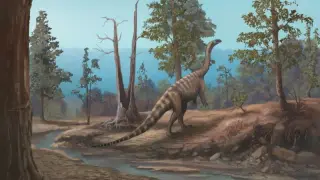
South Korean researchers have identified Doolysaurus huhmini, a juvenile dinosaur fossil found on Aphae Island, offering rare skull remains and clues about Cretaceous life, including a likely omnivorous diet evidenced by gastroliths, with micro-CT imaging revealing detailed anatomy; the name honors the popular cartoon character Dooly.
A mobile AI tool called DinoTracker analyzes photos or sketches of dinosaur footprints to estimate likely makers. Trained on about 2,000 real fossil footprints plus millions of simulated variations to account for distortion, it achieved roughly 90% agreement with human experts and is meant to speed fieldwork, assist researchers, and engage the public. Notably, the AI flagged several footprints over 200 million years old with bird-like features, fueling debate about whether birds evolved earlier than thought or if some early dinosaurs had bird-like feet, and it reexamined Scotland’s Isle of Skye tracks. The study, led by Helmholtz Center and the University of Edinburgh, was published in Proceedings of the National Academy of Sciences (PNAS).
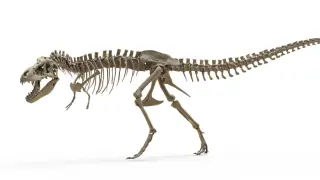
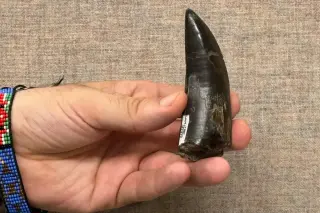
A New Mexico shinbone dating to 74–75 million years ago may belong to an ancestor of Tyrannosaurus rex. Initially identified as Bistahieversor, the bone was reclassified toward Tyrannosaurus, suggesting early tyrannosaur evolution in NM, though more evidence is needed.
Scientists using resonance Raman spectroscopy found signals in fossil vessels from Tyrannosaurus rex and Brachylophosaurus canadensis that resemble hemoglobin fragments, suggesting ancient blood components may survive in some fossils and offering clues on how soft tissues can persist for tens of millions of years, potentially via mineralization processes like goethite formation.
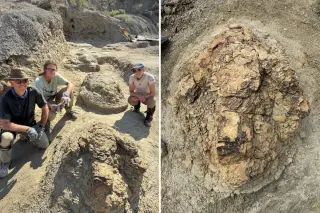
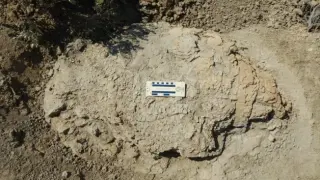
CT scans of 11 Late Cretaceous titanosaur eggs from India’s Lameta Formation uncovered a second inner shell inside one egg — an ovum-in-ovo structure previously known only in birds. The dual shells and microstructure indicate sequential egg development within the oviduct, suggesting titanosaurs had segmented oviducts and avian-like reproductive biology, a rare insight since the other eggs showed normal, single-shell architecture.
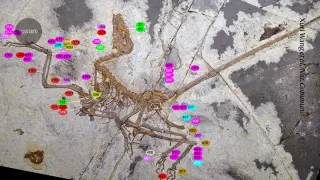
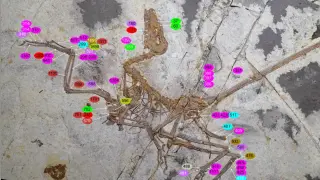
A newly described Alnashetri cerropoliciensis from Argentina weighs about 700 g and challenges the idea that Alvarezsaurid miniaturization evolved linearly from ant-eating; it’s a small, early-branching predator with relatively long forelimbs, suggesting tiny body size evolved multiple times and across a broader geographic range than previously thought, implying a Pangaea-wide distribution with later fragmentation shaping their Late Cretaceous distribution. Researchers plan CT scans of the specimen and have found hints of another Alvarezsaur in the region to help illuminate the next evolutionary steps.
Decider’s Stream It Or Skip It praises The Dinosaurs, a four‑part Netflix docuseries narrated by Morgan Freeman (with Steven Spielberg as EP) that uses ILM CGI to recount the dinosaurs’ rise, reign, and extinction, starting from Triassic times; the premiere delivers stunning visuals and a clear chronological arc that fans of nature docs will enjoy.
A near-complete, adult Alnashetri cerropoliciensis skeleton from Patagonia, dating to about 90 million years ago and weighing under 2 pounds, provides a crucial reference for the alvarezsaurs. The find challenges the idea of a simple miniaturization trend, suggesting repeated evolution within a narrow size range and pointing to a Pangaea-era origin with regional diversification.
New research suggests dinosaurs split ecologically by life stage: juveniles rapidly left parental care, forming age-based groups with different diets and habitats than adults, effectively creating distinct functional roles within the same ecosystem and reshaping estimates of Mesozoic diversity.
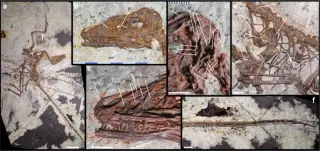
Scientists describe Haolong dongi, a juvenile iguanodontian from northeastern China, with hollow, porcupine-like spikes along its neck, back, and sides. The 2.45 m skeleton is exceptionally well-preserved, but the spikes’ purpose remains unclear—defense, display, or sensing—while pigment was not detected and they are not protofeathers. The discovery broadens our view of dinosaur skin and was published in Nature Ecology & Evolution (2026).
Scientists led by Paul Sereno describe Spinosaurus mirabilis, a new inland Sahara spinosaurid from Niger dating to about 95 million years ago. It has a distinctive scimitar-shaped crest and likely hunted fish in shallow water far from the sea, challenging the idea that spinosaurids were coastal. The crest may have been for display; the team used CT scans and 3D models to reconstruct the skull. The discovery suggests an inland habitat and a new evolutionary phase for the group, with fossils set to be displayed in Niamey and the find published in Science.
A three-day off-road trek to a remote Niger desert site yielded fossils of Spinosaurus mirabilis—one of the largest meat-eating dinosaurs—dating to about 95 million years ago, uncovered across multiple localities that researchers dub a fossil-rich "Spinosaur archipelago."
A newly described Spinosaurus species, Spinosaurus mirabilis, from Niger’s central Sahara suggests this giant fish-eater lived inland in a forested, river-influenced habitat about 100–95 million years ago, far from coastlines. The fossil reveals scimitar-shaped crests on its back (sheathed in keratin) likely used for display and interdigitating teeth ideal for catching slippery river fish. This finding points to a new evolutionary phase for Spinosaurus as a shallow-water predator capable of wading in up to two meters of water, broadening our view of its ecology beyond coastal environments and indicating it coexisted with long-necked dinosaurs along rivers.
Paleontologists in Niger announce a new Spinosaurus species, Spinosaurus mirabilis, featuring a 20-inch sword-like horn and a unique jaw arrangement, discovered inland far from the coast. The fossil suggests this fish-eating predator lived in forested river systems and grew to roughly the size of a Tyrannosaurus rex, with a sail-like back, challenging the view that Spinosaurus hunted exclusively in marine environments.
A newly described Spinosaurus mirabilis from Niger (~95 million years ago) features a dramatic scimitar-shaped head crest and interlocking teeth, fueling the longstanding debate over whether Spinosaurus was aquatic, wading, or fish-hunting. The discovery—published in Science—suggests riverine adaptations and possible display signals, but researchers say more complete fossils are needed to settle exactly how this giant predator lived and hunted.