
New Models Suggest Hypernovae May Be a Myth, Not a Reality
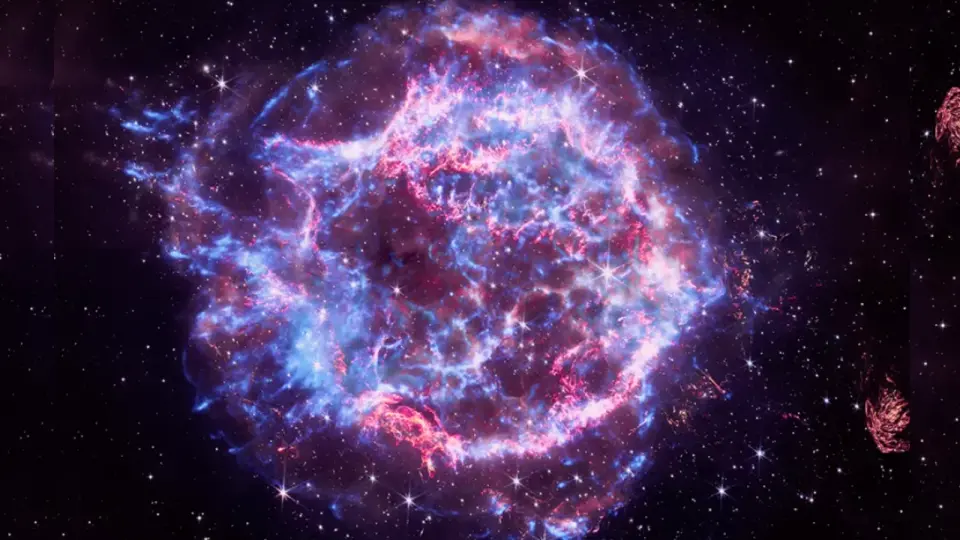
Two new studies from University College London argue that hypernovae, once thought to be the most powerful stellar explosions, may not exist. Researchers Anmol Aggarwal and Ralph Schoenrich show that ordinary supernovae, when accounting for uneven material distribution, can explain the chemical signatures of stars previously attributed to hypernovae. This challenges decades of astrophysical models and suggests the universe’s most extreme explosions might be unnecessary to explain observed stellar chemistry.
Key points
- Two papers published in Monthly Notices of the Royal Astronomical Society challenge the existence of hypernovae by reanalyzing four metal-poor stars previously cited as evidence.
- The researchers argue that ordinary supernovae, when accounting for uneven distribution of elements, can better explain the chemical signatures of these stars than hypernovae.
- The studies suggest that incomplete mixing of supernova debris, rather than extreme explosion energy, may account for the unusual chemical compositions of these stars.
- The findings imply that neutron star mergers, not hypernovae, may be responsible for the heavy elements found in some stars, such as a red giant in the Milky Way’s halo.
- The research highlights the need for more detailed 3D simulations of supernova debris mixing to refine models of galactic chemical evolution.
Background
This story builds on earlier coverage of cosmic mapping efforts, such as the DESI project, which has provided detailed 3D maps of the universe. While those efforts focus on large-scale structure, this new research delves into the micro-scale of stellar explosions and their impact on galactic chemistry. The findings challenge long-held assumptions about the most energetic events in the universe, potentially reshaping how astronomers interpret the chemical fingerprints of ancient stars.
How outlets are covering it
Space.com and Earth.com emphasize the dramatic shift in understanding, highlighting that the evidence for hypernovae 'suddenly disappears' when uneven mixing is considered. Universe Today provides a more technical breakdown, noting that the new models better fit observed data than previous hypernova models. European Scientist focuses on the broader implications for galactic chemical evolution, stressing that the universe may be less dramatic but more nuanced than previously thought. All sources agree that the new findings challenge the need for hypernovae but differ in emphasis: some focus on the statistical improvements in model fits, while others highlight the potential for neutron star mergers to explain heavy elements.
Why it matters
This research could reshape our understanding of stellar explosions and galactic chemical evolution. If hypernovae do not exist, it simplifies models of how elements are distributed in galaxies and may redirect focus toward more common events like ordinary supernovae and neutron star mergers. It also underscores the importance of accounting for uneven material distribution in astrophysical models, potentially leading to more accurate predictions of stellar chemistry and the origins of heavy elements in the universe.
What to watch
Researchers will likely pursue detailed 3D simulations of supernova debris mixing to refine models of galactic chemical evolution. Additionally, highly precise measurements of chemical differences between stars similar to the Sun may provide further tests of the new findings. The studies also suggest that future research should focus on the role of neutron star mergers in producing heavy elements, potentially shifting the focus away from hypothetical hypernovae.
- Scientists discover that some of the universe's biggest explosions may have never happened at all Space
- Hypernovae May Be All Hype, No Nova Universe Today
- Scientists challenge evidence for the most powerful explosions in the universe Earth.com
- Hypernovae May Not Have Happened After All European Scientist
Want the full story? Read the original reporting
Read on Space