
Century-Old Drawer Fossil Reveals First European Megaraptoran
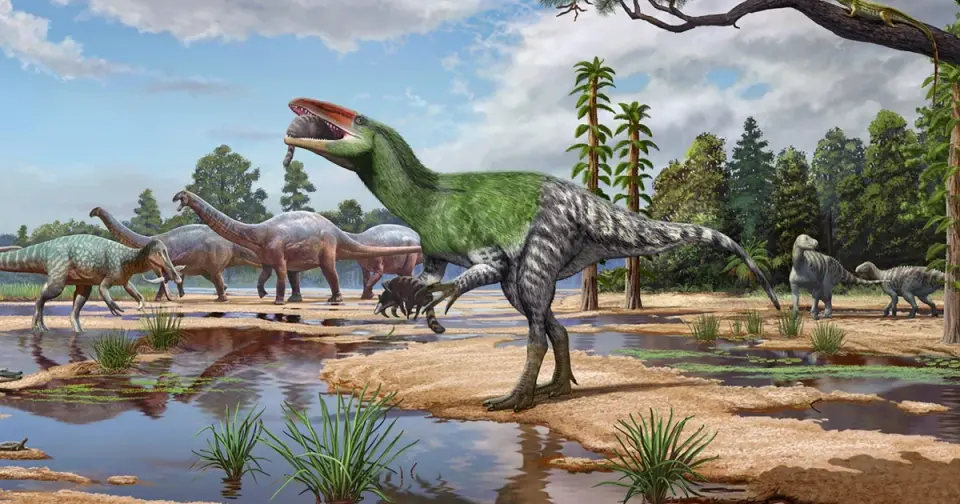
A partial skull fragment stored in a London museum drawer for nearly a century has been identified as a new dinosaur species, Invictibellatrix amberina. This 120-million-year-old predator, roughly the size of a tiger, is the first confirmed megaraptoran found in Europe. The discovery, published in Royal Society Open Science, suggests these agile, claw-hunting dinosaurs migrated from Asia through Europe before spreading to South America and Australia, filling a major gap in their evolutionary history.
Key points
- Invictibellatrix amberina, meaning 'unconquered female warrior,' is a new species of megaraptoran dinosaur discovered from a fossil found on the Isle of Wight in 1924.
- The specimen, a partial braincase, was acquired by the Natural History Museum in London in 1924 but remained unstudied in a drawer until recently.
- Researchers used CT scans to create a 3D model of the fossil, estimating the animal was 3 to 4 meters long, about 1.5 meters tall, and weighed between 200 and 300 kilograms.
- Megaraptorans were agile predators that relied on long arms and large claws rather than powerful jaws, distinguishing them from contemporaries like Tyrannosaurus rex.
- The find is the first definitive evidence of megaraptorans in Europe, supporting a hypothesis that the group originated in Asia, migrated through Europe, and then spread to Africa, South America, and Australia.
Background
This discovery follows a trend of significant findings from historical museum collections, such as the 2026 identification of a 450-million-year-old crinoid fossil in Montreal. It also aligns with broader paleontological efforts to map the global distribution of theropod dinosaurs, including the recent auction of a Nanotyrannus fossil in Manhattan, which highlights the value of rare specimens. The 2026-10-13 archive entry noted this specific discovery as the first European T. rex relative, confirming the timeline of the announcement.
How outlets are covering it
All four sources agree on the identification of Invictibellatrix amberina and its significance as the first European megaraptoran. NBC News and BBC emphasize the 'mystery' of the fossil being overlooked for nearly 100 years, with BBC noting it was part of a collection of over 1,000 specimens from amateur paleontologist Reginald Walter Tooley. New Scientist provides a comparative perspective, noting that while the fossil matches the Argentinian Murusraptor, it is distinct from the earlier Eotyrannus found in the same geological formation. Blue News highlights the CT scan technology as the key breakthrough in identification. There is a minor discrepancy in the attribution of the lead author's affiliation: NBC and BBC cite Cassius Morrison as being at the University of Leeds or University College London, while New Scientist notes he is now at the University of Leeds, having previously been at UCL. All sources agree that the animal was likely feathered and hunted smaller prey, potentially making it more dangerous to humans than a Tyrannosaurus rex due to size compatibility.
Why it matters
This discovery reshapes the understanding of dinosaur migration patterns during the Early Cretaceous. By confirming the presence of megaraptorans in Europe, it supports the hypothesis that these predators originated in Asia and spread globally before the continents separated. It also demonstrates the value of re-examining historical museum collections, as many significant fossils may still be waiting to be identified in archives.
What to watch
Researchers will continue to analyze the fossil and compare it with other megaraptoran specimens to refine the evolutionary tree. The discovery may prompt a re-evaluation of other historical fossils in the Natural History Museum's collection, potentially leading to further new species identifications. The study also raises questions about why megaraptorans disappeared from northern regions in the Late Cretaceous, which may be linked to climate shifts or competition from other predators like tyrannosaurs.
- Fossil kept in drawer for a century sheds light on enigmatic meat-eating dinosaurs NBC News
- Isle of Wight fossil Europe's first known long-clawed megaraptoran dinosaur Phys.org
- Island fossil identified as new dinosaur species BBC
- Dinosaur named new species a century after fossil found on Isle of Wight New Scientist
- Nearly 100 Years in a Drawer: Fossil Turns Out to Be a New Species of Dinosaur blue News
Want the full story? Read the original reporting
Read on NBC News