
JWST Image of Saguaro Galaxy Offers New Clues on Little Red Dots
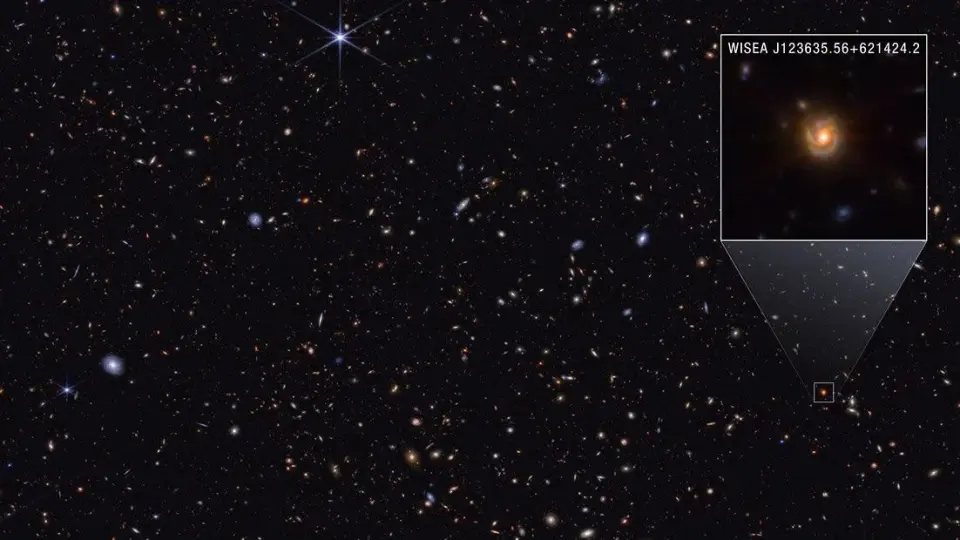
A new image from the James Webb Space Telescope (JWST) of the nearby galaxy Saguaro may help explain the nature of 'little red dots' (LRDs) observed in the early universe. While LRDs were previously thought to be a distinct class of objects, this image suggests they might be ordinary, distant galaxies whose bright centers dominate when viewed from great distances. This implies LRDs are a short-lived phase in the growth of early supermassive black holes rather than a new type of celestial object.
Key points
- JWST captured a new image of the Saguaro galaxy, which provides insights into the 'little red dots' phenomenon.
- The image suggests LRDs may be ordinary galaxies with bright centers, rather than a unique class of objects.
- This finding indicates LRDs are likely a short-lived phase in the development of early supermassive black holes.
- The Saguaro galaxy image helps clarify the evolutionary path of these enigmatic cosmic sources.
Background
Previous JWST observations identified over 300 infrared 'little red dots' dating to about 600 million years after the Big Bang. These objects were compact and unusually red, leading to hypotheses that they might be supermassive stars or early building blocks of globular clusters. Earlier studies also suggested LRDs could be dust-enshrouded galaxies or active galactic nuclei. The Saguaro galaxy image adds to this ongoing debate by offering a nearby analog for these distant phenomena.
Why it matters
Understanding the nature of little red dots is crucial for explaining how supermassive black holes formed so early in the universe. If LRDs are indeed a phase in galaxy evolution, it reshapes our models of cosmic development and the growth of black holes in the early universe.
What to watch
Further observations and analysis of LRDs using JWST and other telescopes will be needed to confirm whether they are a transient phase in galaxy evolution or a distinct class of objects. Researchers will continue to study the Saguaro galaxy and similar systems to refine our understanding of early-universe astrophysics.
Want the full story? Read the original reporting
Read on Yahoo