
Long-Exposure Imaging Reveals Hidden Tidal Streams in the Sombrero Galaxy
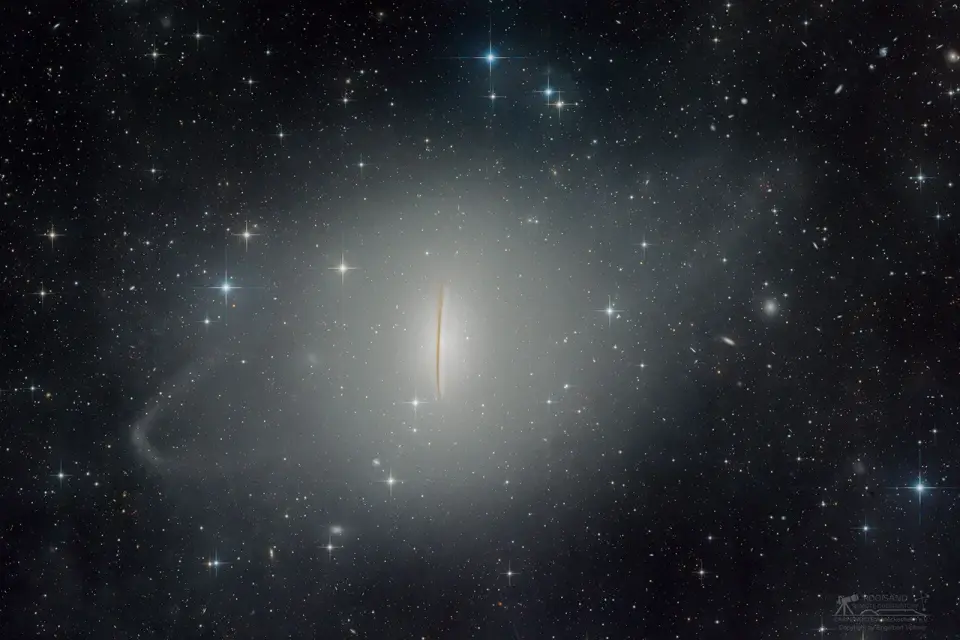
A new deep-space image of the Sombrero Galaxy (M104) reveals faint stellar structures and tidal streams that suggest a violent history of galactic collisions. Captured over seven days in Namibia in mid-2026, the long-exposure photograph shows a hazy halo extending beyond the galaxy's central disk, containing a distinct diagonal ring. These features, invisible in shorter exposures, provide evidence that M104 formed through the merger of smaller galaxies. The galaxy is located approximately 30 million light-years away and spans about 150,000 light-years across.
Key points
- The Sombrero Galaxy, designated M104, is known for its dark dust ring that resembles a hat brim in standard exposures.
- A new image taken in mid-2026 from Namibia used a much longer exposure time to reveal a bright, hazy stellar halo surrounding the central disk.
- This halo contains unresolved stars and distinct structures, including a diagonal ring, which are identified as tidal streams.
- These tidal streams serve as evidence that M104 underwent a violent past involving the collision and merger of smaller galaxies.
- The galaxy is situated roughly 30 million light-years from Earth and has a diameter of approximately 150,000 light-years.
Background
Recent astronomical imaging efforts continue to refine our understanding of galaxy formation through deep-space observations. While previous studies have established M104 as a classic example of a disk galaxy with a prominent dust lane, this new data adds to the broader narrative of galactic evolution through mergers. This follows other recent scientific highlights, such as the observation of supernumerary rainbows, which also rely on detailed atmospheric and optical analysis to explain natural phenomena.
Why it matters
Identifying tidal streams in galaxies like M104 provides critical insights into the history of the universe, demonstrating that large galaxies are often the result of smaller bodies colliding and merging over time. This helps astronomers understand the structural evolution of the cosmos and the forces that shape galactic morphology.
What to watch
Astronomers will likely continue to analyze the detailed stellar distribution in the Sombrero Galaxy's halo to map the specific trajectories of the tidal streams. Further deep-sky imaging campaigns may reveal additional faint structures that offer more clues about the timing and nature of the mergers that formed M104.
Want the full story? Read the original reporting
Read on NASA Science (.gov)