Tag

Galaxy Mergers

All articles tagged with #galaxy mergers

Triple black holes in a distant galaxy reveal rapid early-universe growth
space-and-astronomy7 days ago

Triple black holes in a distant galaxy reveal rapid early-universe growth

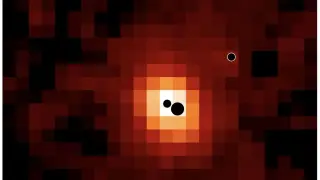
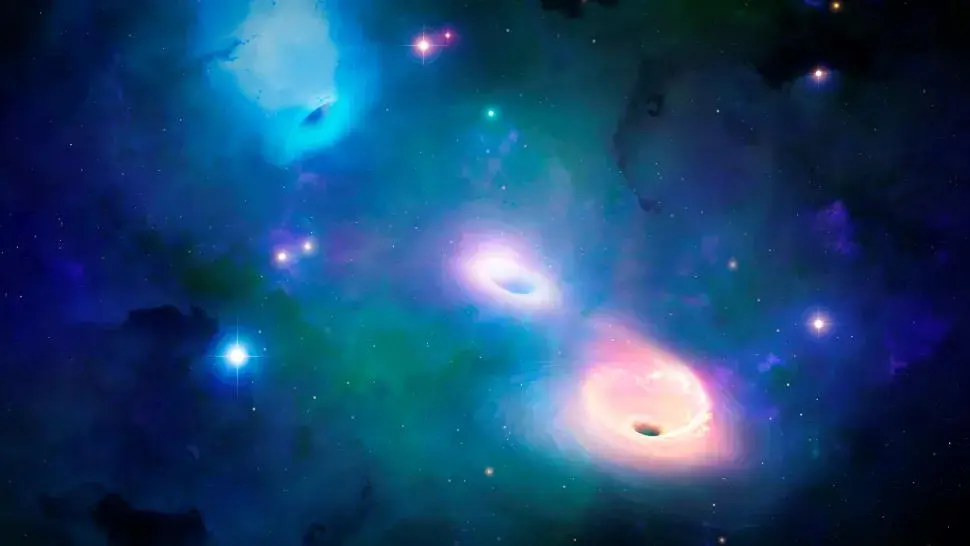
Astronomers using the JWST have identified three active black holes in the distant galaxy J0148-4214, about 12.5 billion light-years away. Two lie at the core (80 million and 600,000 solar masses) and are 620 light-years apart, while a third, ~2 million solar masses, sits ~5,500 light-years away and may merge with the pair or escape. The system supports rapid black-hole growth in the early universe via mergers and foreshadows future low-frequency gravitational-wave detections by space-based observatories like LISA.

JWST uncovers the universe’s closest dual black holes in its early era
space12 days ago

JWST uncovers the universe’s closest dual black holes in its early era

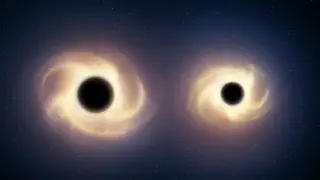
Astronomers using the James Webb Space Telescope (with ALMA) confirm LID-1166—the closest pair of actively feeding supermassive black holes observed this early in cosmic history. The dual SMBHs sit about 4,900 light-years apart in a merging galaxy roughly 1.3 billion years after the Big Bang, with distinct spectral signals and surrounding cold gas indicating two active nuclei. This first close-pair observation helps explain how supermassive black holes grew so rapidly in the early universe and sheds light on galaxy–black hole co-evolution.

Colossal IC 1101: The Universe’s Largest Known Galaxy Emerges
astronomy23 days ago

Colossal IC 1101: The Universe’s Largest Known Galaxy Emerges

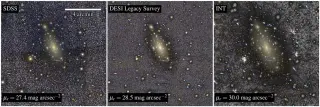
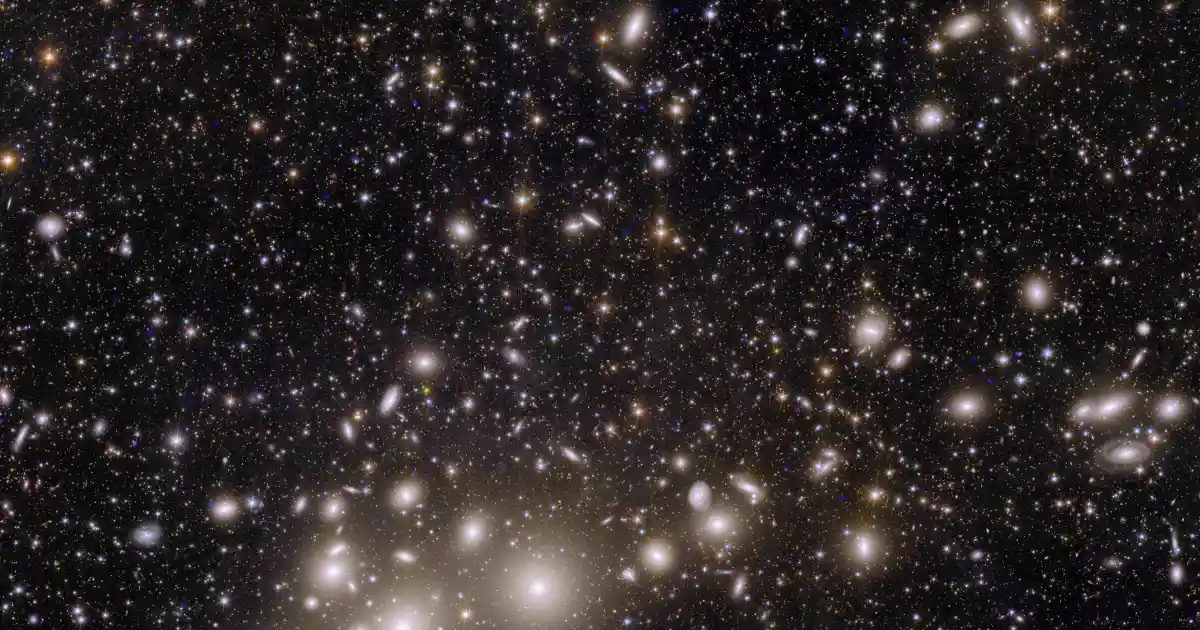
Ultra-deep imaging confirms IC 1101, at the center of Abell 2029, as the largest known galaxy, spanning about 1.7 million light-years and containing ~3.4 trillion solar masses in stars. Using the Isaac Newton Telescope and a star-subtraction technique, researchers teased out the galaxy’s faint outer halo from foreground Milky Way stars, revealing eight structures beyond its edge and evidence of ongoing growth via accretion and a 2–3 billion-year merger. The work, in arXiv ahead of Astronomy and Astrophysics, highlights how brightest cluster galaxies grow by absorbing neighbors and how their outer regions blend into the cluster.

Wandering Black Hole Destroys a Star, Brightening a Galaxy's Edge
space28 days ago

Wandering Black Hole Destroys a Star, Brightening a Galaxy's Edge

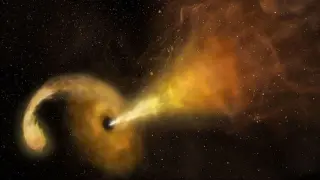
An orphaned supermassive black hole drifting at the edge of its galaxy tore apart a star in a tidal disruption event, producing a brilliant ultraviolet flare that outshone the host for months. Detected by the Zwicky Transient Facility and followed up with SOAR and Swift, the event occurred about 750 million light-years away and involved a black hole roughly 30,000 light-years from the galaxy's center, similar in mass to Sagittarius A*. The finding, likely from past galaxy mergers, suggests wandering black holes may be more common and can illuminate how galaxies and their black holes grow.

Milky Way’s ancient 90-degree flip reshaped its halo
astronomy28 days ago

Milky Way’s ancient 90-degree flip reshaped its halo

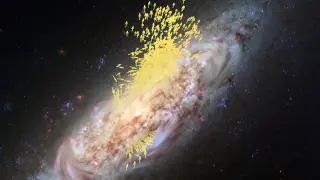
New Gaia measurements and computer simulations show the Milky Way’s halo rotates more slowly than its disk, likely because the galaxy underwent ancient head-on mergers and a dramatic disk flip that reoriented the disk by about 90 degrees. This misalignment slows halo rotation and could have shifted the solar system’s orbit, though the exact mechanism remains under investigation.

JWST Spots Crowded Galaxy Merger at Cosmic Dawn Enriching Surrounding Gas
space1 month ago

JWST Spots Crowded Galaxy Merger at Cosmic Dawn Enriching Surrounding Gas

JWST has imaged JWST’s Quintet, a merger of at least five galaxies at redshift ~6.7 (about 800 million years after the Big Bang), revealing a compact, clumpy system with ~17 galaxy-sized clumps, a combined star-formation rate around 255 solar masses per year, and a halo of oxygen-emitting gas (O III) and Hβ linking the galaxies. The presence of metal-enriched gas around the system shows heavy elements were already dispersed into the surrounding medium by intense interactions, implying the early universe was chemically mature and dynamically complex far earlier than some models predict and potentially related to the emergence of massive, quiescent galaxies later on.

Rare Quasar Pair Merges in the Early Universe, Illuminating Black Hole Growth
astronomy4 months ago

Rare Quasar Pair Merges in the Early Universe, Illuminating Black Hole Growth

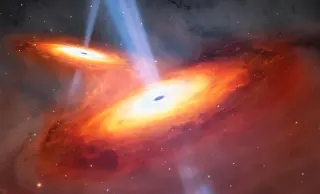
Astronomers confirmed a rare, merging quasar pair at z=5.7 (about 1 billion years after the Big Bang) using ALMA, revealing two massive galaxies connected by a tidal bridge; both host galaxies harbor more than 10 billion solar masses and rapid star formation, signaling intense black hole growth during early mergers, which are expected to form a true binary in ~2.1 billion years and may impact the gravitational wave background.

Vatican Observatory's new leader discusses wars, galaxies, and humanity's future
science11 months ago

Vatican Observatory's new leader discusses wars, galaxies, and humanity's future

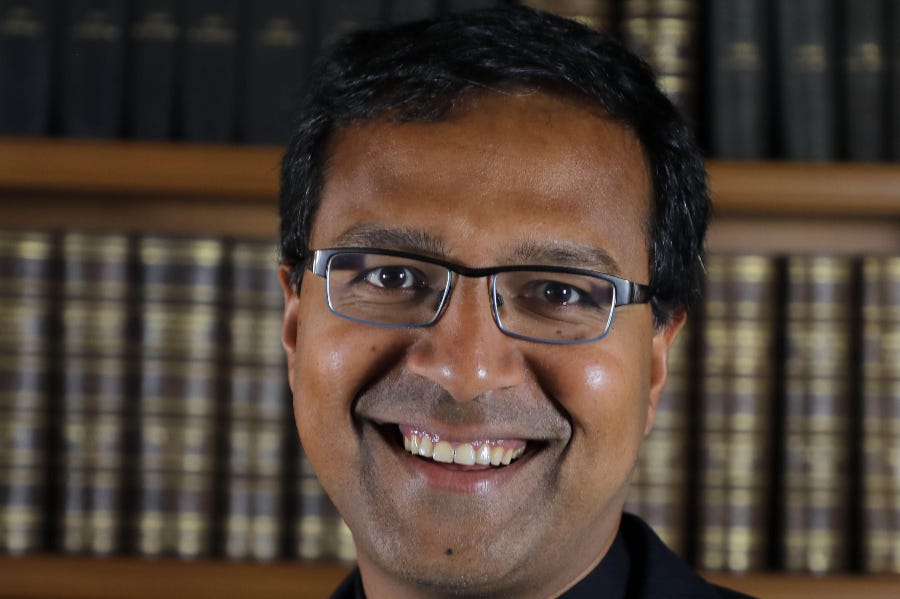
Fr. Richard D’Souza, the new director of the Vatican Observatory and a galactic archaeologist, shares his inspiring journey from a refugee camp to leading the Vatican's astronomical research, discusses galaxy mergers, humanity's future in space, and the importance of human creativity in astronomy, emphasizing the harmony between faith and science.

Revealing the Mysteries of Extreme Black Hole Systems and Jets
science1 year ago

Revealing the Mysteries of Extreme Black Hole Systems and Jets

The article discusses the extreme black hole system OJ 287, which is the most massive known binary supermassive black hole system, located about 4 billion light-years away. It highlights how such systems emit gravitational waves, which are challenging to detect due to their long wavelengths, requiring advanced space-based detectors like LISA or pulsar timing arrays. The system's dynamics, including periodic flares caused by the smaller black hole crossing the larger one's accretion disk, are consistent with Einstein's general relativity. In about 10,000 years, these black holes are expected to merge, releasing an enormous amount of gravitational wave energy.

"Fueling Black Holes: The Role of Cold Gas and Machine Learning"
astronomy2 years ago

"Fueling Black Holes: The Role of Cold Gas and Machine Learning"

Astronomers are using machine learning to identify black hole mergers in early galaxies, with a study showing that software trained by experts can achieve over 80% accuracy in identifying active black holes. The research revealed that the growth of supermassive black holes is linked to the presence of large quantities of nearby cold gas, rather than galactic mergers, indicating a connection between the growth of galaxies and their black holes. As astronomical data collection continues to grow, the combination of skilled observers and software will be essential for effective analysis.

Unraveling the Growth of Black Holes and Formation of New Stars with Machine Learning
astronomy2 years ago

Unraveling the Growth of Black Holes and Formation of New Stars with Machine Learning

New research led by the University of Bath suggests that galaxy mergers alone are not enough to fuel supermassive black holes, as a reservoir of cold gas at the center of the host galaxy is also needed. Using machine learning, researchers found that mergers are not strongly associated with black-hole growth, and that large amounts of cold gas must be present to allow the black hole to grow. This study challenges previous theoretical models and provides new insights into the relationship between galaxy mergers, supermassive black-hole accretion, and star formation.

"Record-breaking: Astronomers Discover Heaviest Black Hole Pair at 28 Billion Solar Masses"
astronomy2 years ago

"Record-breaking: Astronomers Discover Heaviest Black Hole Pair at 28 Billion Solar Masses"

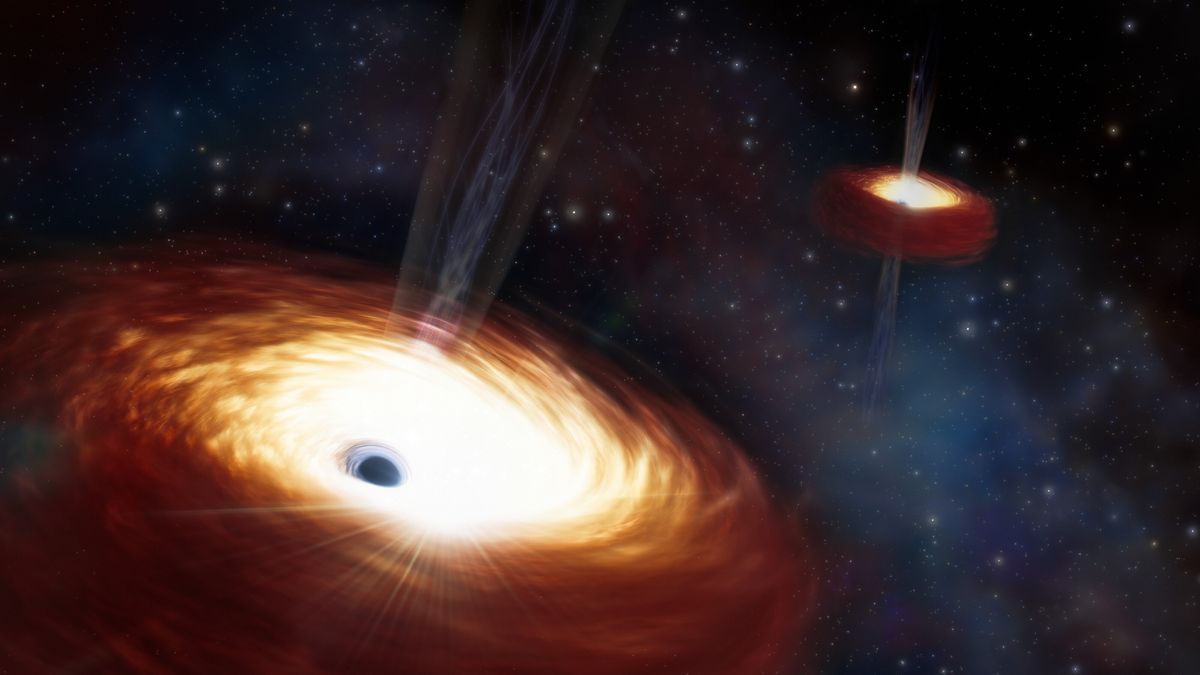
Two supermassive black holes, with a combined mass 28 billion times that of the sun, have been discovered in a fossil galaxy, locked in a gravitational dance preventing them from merging. This finding challenges the theory that supermassive black hole mergers are common, as these are the closest and heaviest black hole pair ever observed. The massive black holes have scoured their galaxy of stars and gas, stalling their collision. The discovery sheds light on the formation and behavior of supermassive black hole binaries after galactic mergers and highlights the potential impact of archival data from telescopes like Gemini North.

"Milky Way-like Galaxies Meet Their End in Galaxy Clusters"
astronomy2 years ago

"Milky Way-like Galaxies Meet Their End in Galaxy Clusters"

Galaxy clusters serve as graveyards for Milky Way-like galaxies as they undergo mergers and experience gas stripping, leading to the cessation of star formation and the eventual transformation into giant elliptical galaxies dominated by old stars. Gas-depleted or gas-free galaxies are unable to form new stars, resulting in a "red-and-dead" state. Various events such as internal dynamics, external gravitational tugs, and galactic mergers can trigger star formation, but once a galaxy becomes gas-depleted, its fate is sealed.

"Galactic Mergers: Unraveling the Early Universe's Mystery"
astronomy2 years ago

"Galactic Mergers: Unraveling the Early Universe's Mystery"

The James Webb Space Telescope has used its NIRCam instrument to reveal that the mysterious hydrogen emission from the earliest galaxies in the universe is due to the chaotic merging of neighboring galaxies. This discovery solves a long-standing mystery in astronomy and sheds light on the intense star-forming activity within interacting galaxies, which energizes hydrogen emission and clears gas from their surroundings, allowing the unexpected hydrogen emission to escape. The findings, published in Nature Astronomy, provide a compelling solution to the puzzle of the inexplicable early hydrogen emission and will improve our understanding of galaxy evolution.