
Raleigh museum moves 5,000-pound dinosaur fossil into public lab
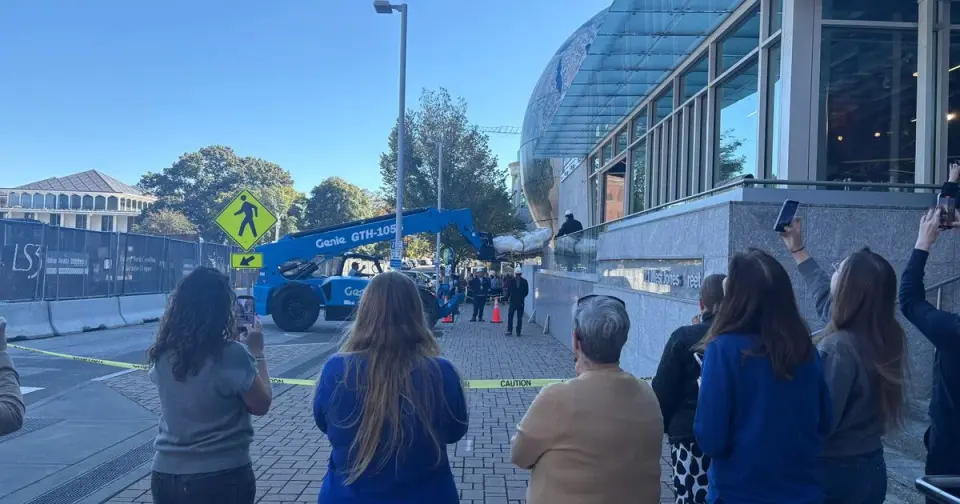
A 75-million-year-old dinosaur fossil, weighing 5,000 pounds, was transported into the North Carolina Museum of Natural Sciences in Raleigh on Wednesday. The specimen, described as an ostrich-like theropod, is being studied in the museum’s SECU DinoLab, where the public can observe the research process. Scientists believe the remarkably preserved skeleton may represent a new species.
Key points
- The fossil, a 5,000-pound block of sandstone, was moved into the museum on October 21, 2026, requiring a temporary closure of W. Jones Street in downtown Raleigh from 8 a.m. to 2 p.m.
- The specimen is a 75-million-year-old theropod dinosaur from the Late Cretaceous period, discovered last summer in the Kaiparowits Formation in southern Utah.
- The dinosaur is described as an ostrich-like animal, 8 to 10 feet long, with a toothless beak and feathers, and was likely a fast runner.
- The fossil is being studied in the SECU DinoLab, an open facility where visitors can watch paleontologists work on the specimen over the next two years.
- Museum head of paleontology Dr. Lindsay Zanno stated the fossil is 'remarkably preserved' and could lead to the discovery of a new species, potentially serving as the holotype for that species.
Background
This discovery follows a recent trend in paleontology where new species are identified from existing fossils or new finds. In October 2026, a century-old fossil in London was identified as Invictibellatrix amberina, the first megaraptoran dinosaur in Europe. The NC Museum of Natural Sciences had previously identified Nanotyrannus lancensis from its 'Dueling Dinosaurs' fossil in 2025. The current fossil is the first major specimen to enter the SECU DinoLab since that discovery.
How outlets are covering it
WRAL.com emphasized the logistical aspects of the move, including the street closure and the use of a plaster 'jacket' for transport. The News & Observer focused on the scientific potential, highlighting the fossil's 'remarkable preservation' and the collaboration with the Natural History Museum of Utah. Axios highlighted the public access aspect, noting that the SECU DinoLab allows visitors to watch the research process in real-time, and mentioned that the fossil could serve as the holotype for a new species. All three sources agreed on the fossil's age, weight, and the involvement of Dr. Lindsay Zanno.
Why it matters
The discovery of a new dinosaur species in a publicly accessible lab advances our understanding of dinosaur evolution and provides a unique educational opportunity for the public. It also highlights the ongoing 'renaissance' in dinosaur paleontology, where new species are being discovered at a rate of about 50 per year, as noted by Dr. Zanno.
What to watch
Paleontologists will spend the next two years studying the fossil in the SECU DinoLab. The public can visit the museum to watch the research process. If the fossil is confirmed as a new species, it will be formally described and named.
- Large dinosaur being moved into downtown Raleigh's NC Museum of Natural Sciences WRAL
- Raleigh’s got a new 75-million-year-old dinosaur skeleton. Could it be a new species? News & Observer
- 75-million-year-old dinosaur delivered to NC Museum of Natural Sciences for research CBS17.com
- You can watch a 75-million-year-old dinosaur emerge from stone in Raleigh Axios
Want the full story? Read the original reporting
Read on WRAL